Daniel James Moody Jr. (June 1, 1893 – May 22, 1966) was a lawyer and Democratic politician who served as the 30th governor of Texas from January 1927 to January 1931. Elected at age 33, he remains the youngest governor in Texas history.
Moody rose to prominence through confrontations with the two dominant forces in Texas politics of the 1920s. As district attorney, he conducted what is widely regarded as the first major criminal prosecution of the Ku Klux Klan in the United States. As state attorney general, he investigated the highway contract scandals of the Governor James Ferguson and recovered approximately $1 million for the state. In 1926 he defeated incumbent Governor Miriam Ferguson in the Democratic primary on a platform opposing “Fergusonism.”
Early Life and Legal Career
Daniel James Moody Jr. was born on June 1, 1893, in Taylor, Williamson County, Texas, the son of Daniel James Moody Sr., an early settler of the town who served as its mayor, justice of the peace, and school board chairman, and Nannie Elizabeth Robertson, a schoolteacher. Moody entered the University of Texas at 16 and studied law during his final two years, gaining admission to the State Bar of Texas in 1914 at age 21.
He began practice in Taylor with Harris Melasky. During the First World War he served in the Texas National Guard, rising from second lieutenant to captain, and in the United States Army as a second lieutenant.
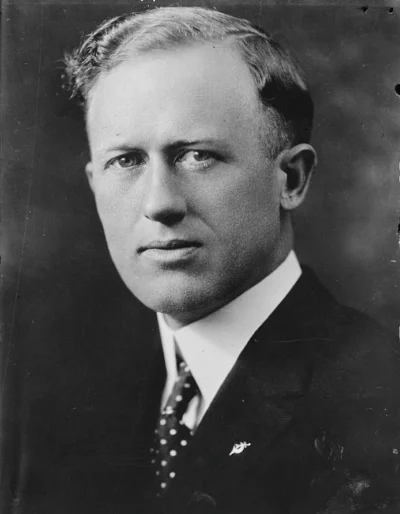
Returning to Taylor after the war, Moody was elected Williamson County Attorney in 1920. In 1922 he became district attorney of the 26th Judicial District, comprising Williamson and Travis counties, the youngest lawyer ever to hold the position.
The Klan Prosecutions, 1923–1924
Moody’s tenure as district attorney coincided with the peak of Ku Klux Klan power in Texas, when membership in the state had surged to approximately 150,000 and Klansmen held growing influence in local and state government and law enforcement. That influence had largely shielded members from prosecution for acts of vigilante violence.
On Easter Sunday 1923, ten Klansmen abducted, flogged, and tarred Robert Burleson, a White traveling salesman who had ignored a Klan warning to leave Georgetown. Williamson County Sheriff Lee Allen and Taylor Constable Louis Lowe opened an immediate investigation, and a two-month grand jury inquiry in May and June 1923 heard one hundred witnesses, produced contempt confinements for four Klansmen, and returned three indictments against men involved in the beating.
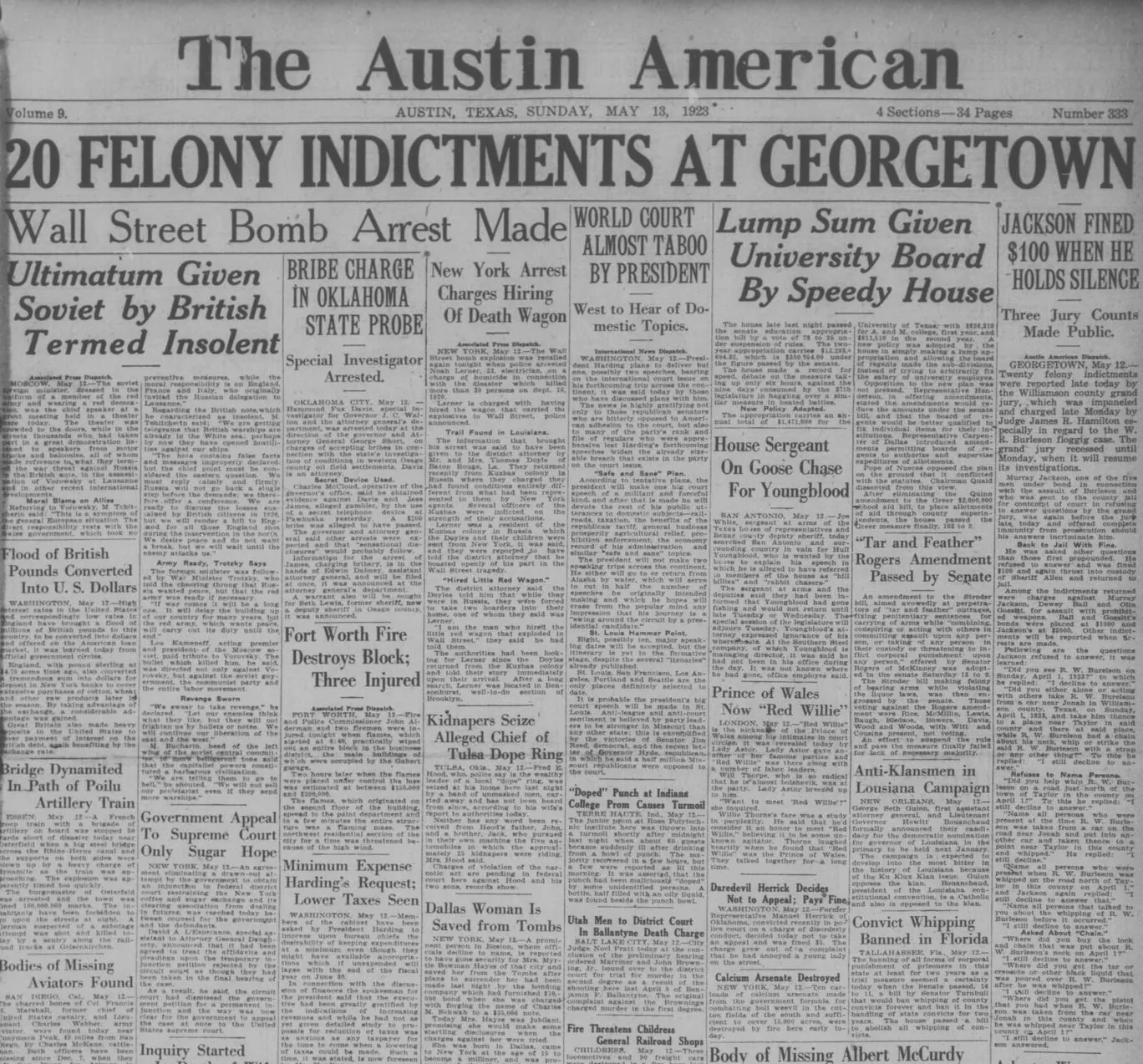
Moody prosecuted the cases in a series of trials at the Williamson County Courthouse between September 17, 1923, and February 1, 1924, beginning with a seven-day trial of Klansman Murray Jackson. Four Klansmen were convicted and sentenced to prison; two others pleaded guilty and received one-year sentences.
The convictions were likely the first prosecutorial success anywhere in the United States against members of the 1920s Klan; a 1926 New York Times article described them as among the first successful prosecutions of Klan law violators in any state. The trials carried significatn personal risk for Moody, the jurors, and law enforcement, and due to implicit or explicit threats of violence from the Klan.
The Ferguson Machine
The other force that shaped Moody’s rise was the political operation of James and Miriam Ferguson. James Ferguson, elected governor in 1914 and 1916 on the strength of a devoted following among tenant farmers and rural voters, had been impeached in 1917 on ten charges including misapplication of public funds and permanently barred from state office. He refused to accept the judgment and campaigned for vindication for the rest of his life, sustained by a personal political organ, the weekly Ferguson Forum, which he founded in November 1917 and which doubled as a vehicle for generating campaign funds.
When the Texas Supreme Court kept James Ferguson off the 1924 ballot, his wife Miriam ran in his place under the open slogan “Two Governors for the Price of One” and won. Her first administration functioned largely as her husband’s: two desks with two swivel chairs stood in the governor’s office, and a contemporary insider summarized the arrangement as “Jim’s the governor, Ma signs the papers.” The administration was accused of awarding State Highway Department contracts to firms that purchased expensive advertising in the Ferguson Forum, and critics alleged kickbacks flowed to Ferguson friends and political supporters through the Ferguson-appointed highway commission.
The governor issued pardons and paroles at an extraordinary rate — 1,318 full pardons and 829 conditional pardons in two years — accompanied by unproven allegations that clemency could be bought. In March 1925, the legislature passed an amnesty act restoring James Ferguson’s political rights, which a subsequent legislature declared void in 1927 on the ground that no legislature had authority to annul an impeachment judgment.
Attorney General, 1925–1927
Moody used the publicity from the Klan trials to campaign against the organization statewide. The Klan’s goal in the 1924 elections was to capture the state’s top offices, and it ran candidates against Moody. Conducting what he called a “poor boy’s campaign,” traveling the state in a Ford Model T, Moody won the vote by a substantial majority in the same election cycle that saw Miriam Ferguson defeat the Klan’s gubernatorial candidate.
Moody took office in January 1925, at 31 the youngest attorney general in state history, serving concurrently with the first Ferguson administration. When the highway contract scandals emerged within months of the new administration taking office, Moody brought suit to void contracts he characterized as unconscionable and to recover misappropriated funds. In one episode, he telephoned a Kansas City banker to announce he was coming for $400,000 in kickback money deposited in private accounts there; told he could not have it, he went anyway and returned to Texas with the cash.
His suits voided highway contracts and recovered approximately $1 million for Texas taxpayers. The litigation made Moody the natural challenger to the Fergusons.
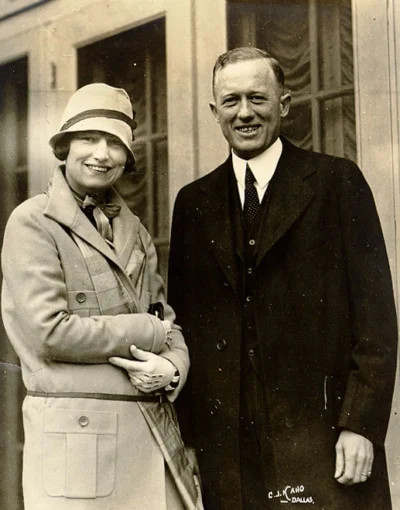
On April 20, 1926, Moody married Mildred Paxton of Abilene, a journalist who had edited the woman’s page of the Abilene Reporter. The wedding took place in Abilene weeks after Moody announced his candidacy for governor, and the couple’s honeymoon merged directly into the campaign. They had two children, Dan Jr. and Nancy. Mildred Moody’s private diary of the campaign and mansion years, later deposited in the North Texas State University Oral History Collection, is a significant primary source for the period.
The 1926 Campaign
In March 1926, Moody announced he would challenge Miriam Ferguson in the Democratic primary. He charged that James Ferguson directed the programs of the State Highway Commission and supervised the award of contracts by the Textbook Commission, that his role in his wife’s administration amounted to “government by proxy,” and that the overriding issue before voters was “Fergusonism.”
His platform supported prohibition and women’s suffrage. The Fergusons attempted to turn the Klan issue against him, with James Ferguson claiming Moody’s campaign was backed by the Klan, but the charge failed against Moody’s prosecutorial record. Suffragist organizations rallied to Moody; Jane McCallum, whom he would later appoint secretary of state, ran a campaign operation from her own home directing letters, editorials, and pamphlets to Texas women.
The campaign’s defining moment came at its opening. Ferguson publicly wagered that she would resign immediately if Moody led her by even one vote in the first primary, provided he would resign his office as attorney general if she led him by 25,000. Moody accepted on the spot, against the advice of his managers — telegrams and telephone calls flooded in from advisers deploring what national newspapers called a “wager of high office.”
According to Mildred Moody’s diary, the same advisers later conceded it was, in the words of seasoned politicians, “the shrewdest political move ever pulled”: Moody had taken the weapon James Ferguson boasted he would use against him and turned it back, putting the Fergusons on the defensive for the remainder of the race.
Moody said he accepted because the challenge offered “a chance to get rid of the Fergusons speedily — the Fergusons and their graft.”
Moody led the first primary by 126,250 votes, taking 49.9 percent — short of the majority required for nomination. Ferguson did not honor the wager, coming forward with the revised position that she had meant she would resign “immediately when her duties were fulfilled,” and contested the runoff. The reversal drew national ridicule. Moody won the runoff 495,723 to 270,595, and went on to defeat Republican Harvey H. Haines overwhelmingly in the November general election.
Governor, 1927–1931
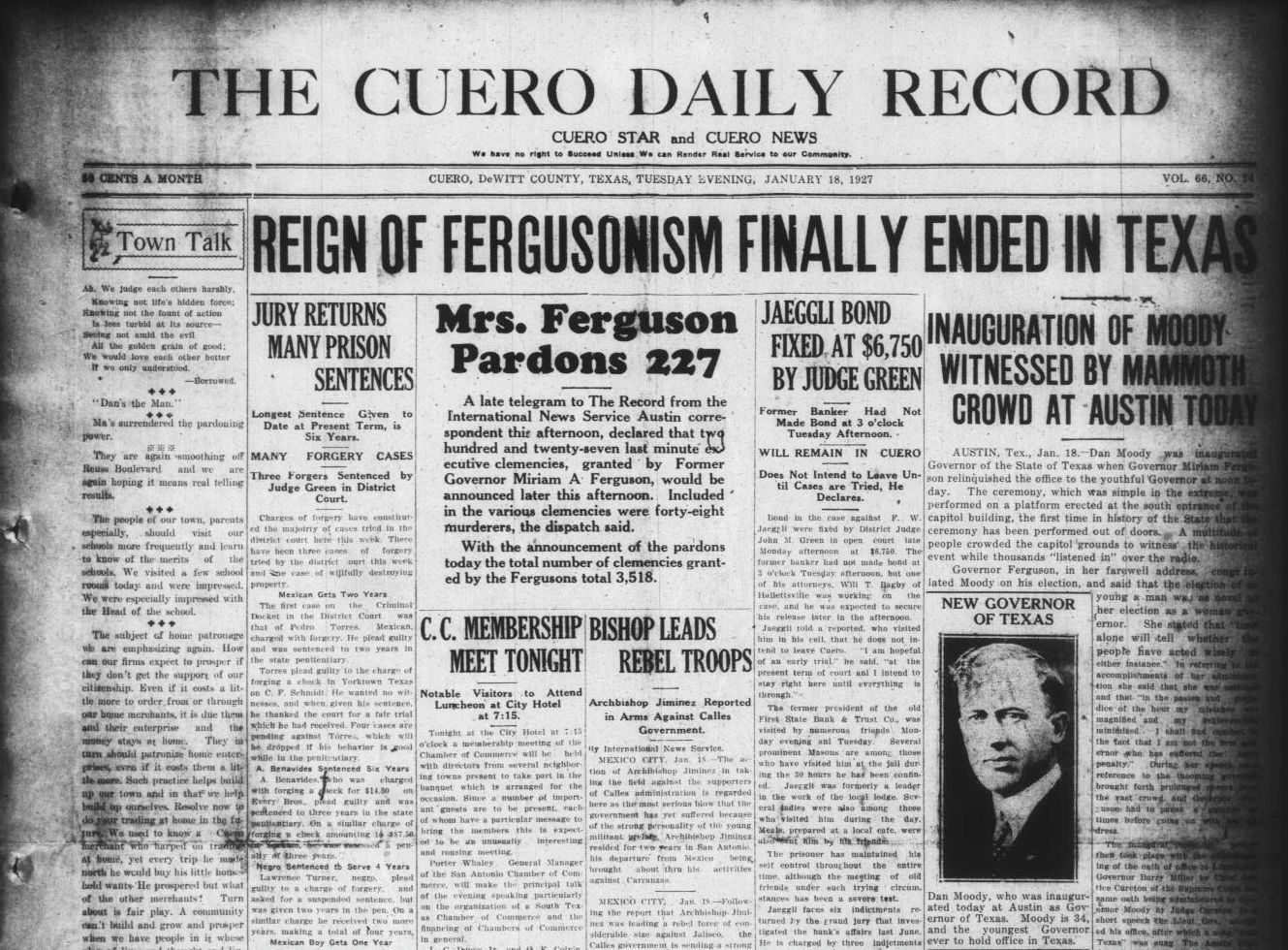
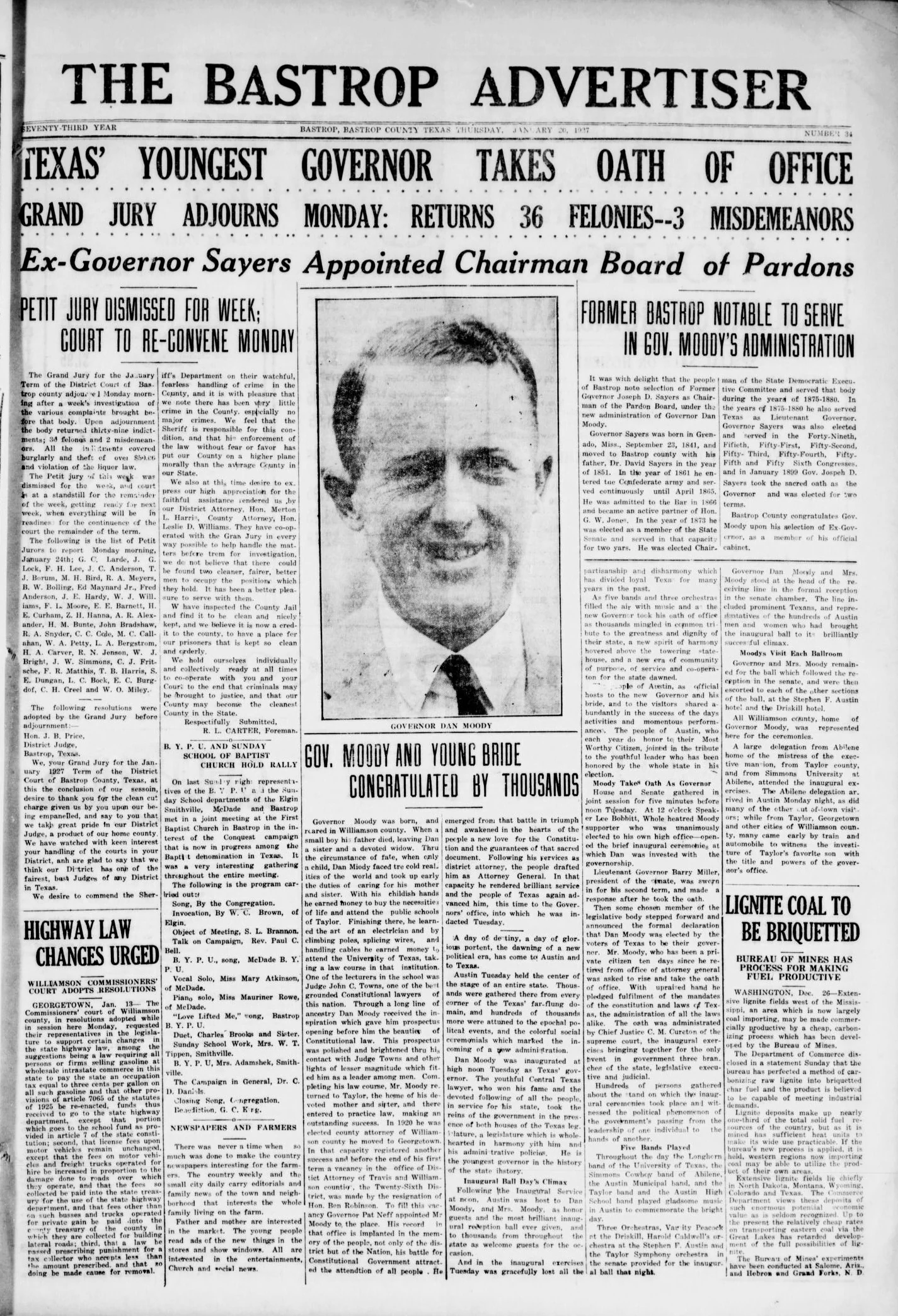
Moody was inaugurated on January 18, 1927, at age 33, the youngest governor in Texas history, in the state’s first outdoor inaugural ceremony, with crowds stretching back to Congress Avenue. He was re-elected in 1928 with little opposition.
The Moodys became known for personal austerity in office. They lived on the governor’s salary of $4,000 a year — $333.33 a month — a resolution that became a national Associated Press story under the headline “Texas Governor and Wife Will Live on $4,000.00 a Year.” Moody refused to let the state pay for expenses that previous administrations had customarily charged to it, including a cook, which he regarded as a personal servant; the couple borrowed money to meet the mansion’s social obligations. The contrast with the preceding administration was central to his public standing.
As governor, Moody pursued a reform program characteristic of the business progressivism of the 1920s South, much of it aimed at dismantling the practices of the Ferguson years. He halted the Fergusons’ pardon policy, reorganized the State Highway Department — cutting highway costs by nearly half from Ferguson-era levels while expanding the road network — and spent much of his first term replacing Ferguson appointees across state agencies. The appointment of a new Highway Commission was among the most consequential decisions of his first months; he named Ross Sterling, the Humble Oil founder who would later succeed him as governor, as its chairman, alongside Cone Johnson and Judge W. R. Ely.
He established the office of state auditor, initiating systematic auditing of state accounts. He pressed judicial reform proposals across eight legislative sessions over his two terms, and sought reforms of taxation and education and the creation of a state civil service system; the legislature, which Mildred Moody’s diary describes as lobby-ridden and obstructive, passed roughly half of his proposals.
Prison reform proved his most difficult undertaking. Moody appointed reformer Robert Baker Holmes as chairman of the Texas Prison Board, with Elizabeth Speer as secretary, and charged the board with implementing humane treatment and rehabilitation. Conditions resisted change: in 1929, overcrowding produced hunger strikes and mass escapes totaling 302 men — roughly six percent of the prison population. Moody remarked, “If I had a dog that I thought anything of, I wouldn’t want him kept in the Texas penitentiary under present conditions.”
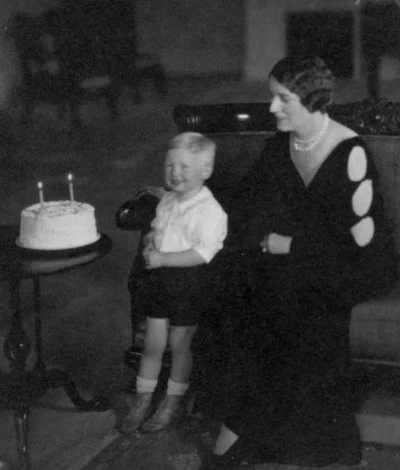
Moody’s national prospects were damaged by the 1928 presidential election. He opposed the nomination of Al Smith, a Catholic opponent of prohibition, but supported him in the general election, a straddle that alienated both camps as Texas gave its electoral votes to a Republican, Herbert Hoover, for the first time.
In 1930, Moody weighed and ultimately rejected a run for an unprecedented third term, telling his wife that the only justification for one would have been “an effort to save the state from Fergusonism once more,” and that with Ross Sterling and Lynch Davidson in the race his entry would split the anti-Ferguson vote. When he formally withdrew his name before the Democratic Executive Committee “in the interest of good government,” James Ferguson leapt up and called him a coward; a near-fight ensued in which Moody told Ferguson to his face what he thought of him, and Ferguson was reported to have left the building white with anger.
Moody then campaigned vigorously for Sterling, who defeated Miriam Ferguson in the runoff. The Ferguson operation that Moody had campaigned against outlasted his governorship. Miriam Ferguson returned in 1932 to unseat Sterling and served a second term from 1933 to 1935, with her husband again at her side. Lasting constraints on the practices Moody had opposed came later: in 1936, Texas voters approved a constitutional amendment transferring the governor’s clemency power to an independent Board of Pardons and Paroles.
Later Career and Death
Moody returned to private law practice in Austin in 1931. At President Franklin D. Roosevelt’s request in 1935, he served as special assistant to the United States attorney general, prosecuting income-tax-evasion cases in Louisiana connected to the political machine of Huey Long. He represented Texas in its boundary dispute with New Mexico and defended the governor’s authority to declare martial law in litigation during the mid-1930s.
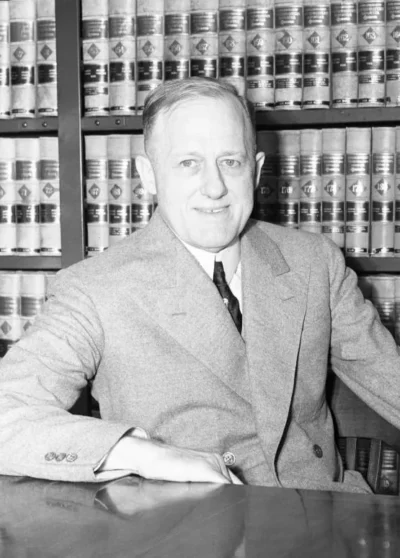
Moody made his final race in 1942, running for U.S. Senate against former governors W. Lee O’Daniel and James Allred. He finished third with 18 percent of the votes — the only political defeat of his career. Moody by then was aligned with the conservative, anti-New Deal wing of the Texas Democratic Party, and in 1944 he helped organize the anti-Roosevelt “Texas Regulars” movement.
In 1948 he represented Coke Stevenson in the disputed Democratic senatorial primary against Lyndon B. Johnson. Though he remained a Democrat, he endorsed Republican Dwight Eisenhower for president in 1952 and 1956.
Moody died in Austin on May 22, 1966, at age 72, and was buried in the Texas State Cemetery. His birthplace in Taylor operates as the Dan Moody Museum, and the Williamson County courtroom in Georgetown where he tried the Klan cases was restored to its 1920s appearance and reopened to the public in 2007.