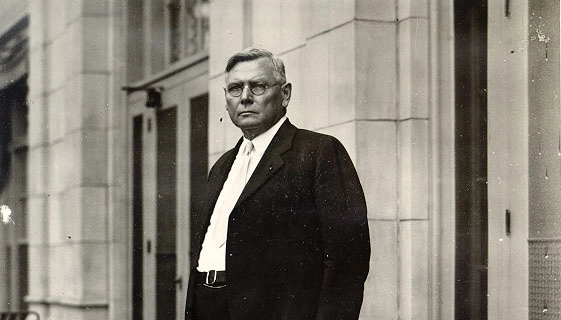
Ross S. Sterling (1875–1949) served as the 31st Governor of Texas from 1931 to 1933, during the deepest years of the Great Depression. A founder and first president of the Humble Oil and Refining Company — forerunner of Exxon — Sterling entered office as one of the wealthiest men in Texas, then presided over an economy in collapse. He served a single term, defeated for reelection by Miriam “Ma” Ferguson in one of the closest races in Texas history.
Sterling’s governorship confronted two emergencies at once: the collapse of farm prices that impoverished rural Texas, and the flood of oil from the newly discovered East Texas field, which drove crude below ten cents a barrel and defied every attempt at regulation. His response to the second — placing four counties under martial law and shutting down the largest oilfield in the world — produced a landmark U.S. Supreme Court ruling on the limits of a governor’s power.
Early Life and Business Career
Ross Shaw Sterling was born near Anahuac, in Chambers County, in February 1875. Biographical sources give his birthdate as either February 11 or February 22. He attended rural public schools, left school as a boy, and farmed until about 1896.
Sterling’s fortune began with feed stores. He opened his first at Sour Lake in 1903, supplying the mules and horses of the oil boomtowns on the upper Gulf Coast, and expanded into other oil-patch towns and small-town banking. In 1910 he bought two producing wells, and the venture grew into the Humble Oil and Refining Company, organized in 1911 with Sterling as president. Under his leadership Humble became one of the major oil producers in Texas, and its later affiliation with Standard Oil of New Jersey placed it on the path to becoming Exxon.
Sterling sold his Humble interests in 1925 and turned to real estate development around Houston. He purchased the Houston Dispatch and the Houston Post in 1925 and 1926, combining them as the Post-Dispatch, and at various times headed a railroad, a flour mill, and a Houston bank. By the end of the 1920s he ranked among the richest men in the state.
Highway Commission and the 1930 Election
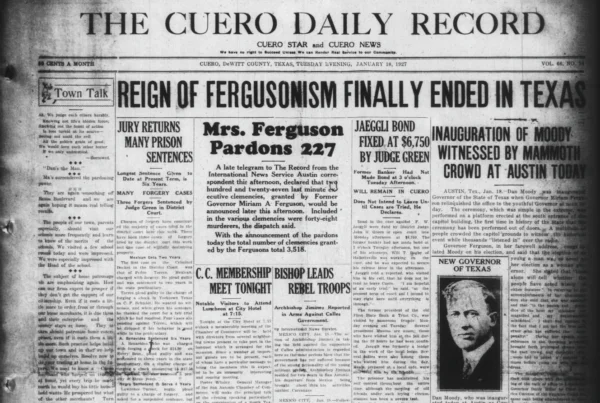
Sterling entered public service under Governor Dan Moody, who appointed him to the Texas Highway Commission, which he came to chair. During his tenure the commission expanded and professionalized the state highway program, including adoption of a 100-foot right-of-way standard for Texas highways. The post gave Sterling a statewide reputation as a builder and clean administrator in the aftermath of the road-contract scandals of the Ferguson years.
When Moody declined to seek a third term in 1930, Sterling entered a Democratic primary field of eleven candidates that included former governor Miriam “Ma” Ferguson, seeking vindication for her impeached husband James E. “Pa” Ferguson. Campaigning on his business record and fiscal responsibility, Sterling defeated Ferguson in the runoff and won the general election, taking office on January 20, 1931.
Sterling represented a distinct strand within the one-party Democratic politics of the era. He was neither an agrarian populist in the Ferguson mold nor a reform progressive like Moody or, later, James Allred, but a business conservative of the Houston commercial establishment. Political scientist Fred Gantt later described him as “a successful business man and a devotee of laissez-faire.”1 Once he took office, however, the crises of the Depression led him to some of the most forceful state interventions of the era, including compulsory crop controls and military occupation of the oil fields.
A Governorship of Emergencies
Sterling took office as cotton was falling to ruinous prices, threatening a cornerstone of the Texas economy. In September 1931 he called the legislature into special session to address the agricultural emergency. The resulting Texas Cotton Acreage Control Law of 1931–32, which required farmers to cut their cotton plantings, was declared unconstitutional before it took effect.
The state’s finances deteriorated alongside the farm economy. Revenues shrank as property values and taxable activity collapsed, while demands for relief grew. Sterling, wary of deficits and new taxes, struggled, like most governors of the era, to match the scale of the crisis.
Martial Law in the Oil Fields
The greater crisis came from beneath the ground. The East Texas oilfield, discovered in 1930, proved to be the largest ever found in the United States, and thousands of wells drilled in a matter of months glutted the market. Crude that had sold for more than a dollar a barrel fell below ten cents. The Railroad Commission issued proration orders limiting production, but federal courts struck them down, and many independent operators simply ignored them.
On August 16, 1931, Sterling declared Rusk, Gregg, Upshur, and Smith counties to be in a state of insurrection and placed them under martial law. National Guard troops under Brigadier General Jacob F. Wolters occupied the field and shut down production entirely. Wells later reopened under military-enforced quotas, and the shutdown temporarily lifted prices.
The intervention was challenged in federal court by producers who noted that the civil courts in East Texas remained open and no actual insurrection existed. In Sterling v. Constantin (1932), the U.S. Supreme Court ruled unanimously against the governor, holding that a declaration of martial law is subject to judicial review and cannot be used to override constitutional property rights. The decision remains a leading precedent on the limits of executive emergency powers. Effective regulation of the field ultimately came through strengthened proration laws and the Railroad Commission, which emerged from the decade as the arbiter of American oil production.
The 1932 Defeat
Sterling sought a second term in 1932 and again faced Miriam Ferguson. Weighed down by the Depression, the martial law controversy, and the Ferguson organization’s strength among struggling farmers, he lost the runoff by fewer than 4,000 votes out of nearly a million cast. Contemporary accounts and later historians noted substantial evidence of fraud in East Texas counties, where in some precincts votes recorded exceeded ballots issued. Sterling contested the result without success and left office in January 1933.
Later Years and Personal Life
Sterling returned to Houston, his fortune greatly diminished by the Depression, and largely withdrew from public life. Within a few years he had rebuilt his wealth as president of the Sterling Oil and Refining Company, which he led from 1933 to 1946, while also heading the American Maid Flour Mills and the R. S. Sterling Investment Company and chairing the Houston National Bank and the Houston-Harris County Channel Navigation Board. In 1934 he supported the successful gubernatorial campaign of James Allred.
Sterling married Maud Abbie Gage in 1898, and the couple had five children. His philanthropies included the donation of his La Porte mansion to the Houston Optimist Club for use as a boys’ home, the establishment of a boys’ camp in memory of his son Ross Jr., who died in 1924, and a $100,000 gift to Texas Christian University. He died in Fort Worth on March 25, 1949, and was buried in Glenwood Cemetery in Houston.
- Fred Gantt, Jr., The Chief Executive in Texas: A Study in Gubernatorial Leadership (1964; repr., Austin: University of Texas Press, 2014), 304. ↩︎