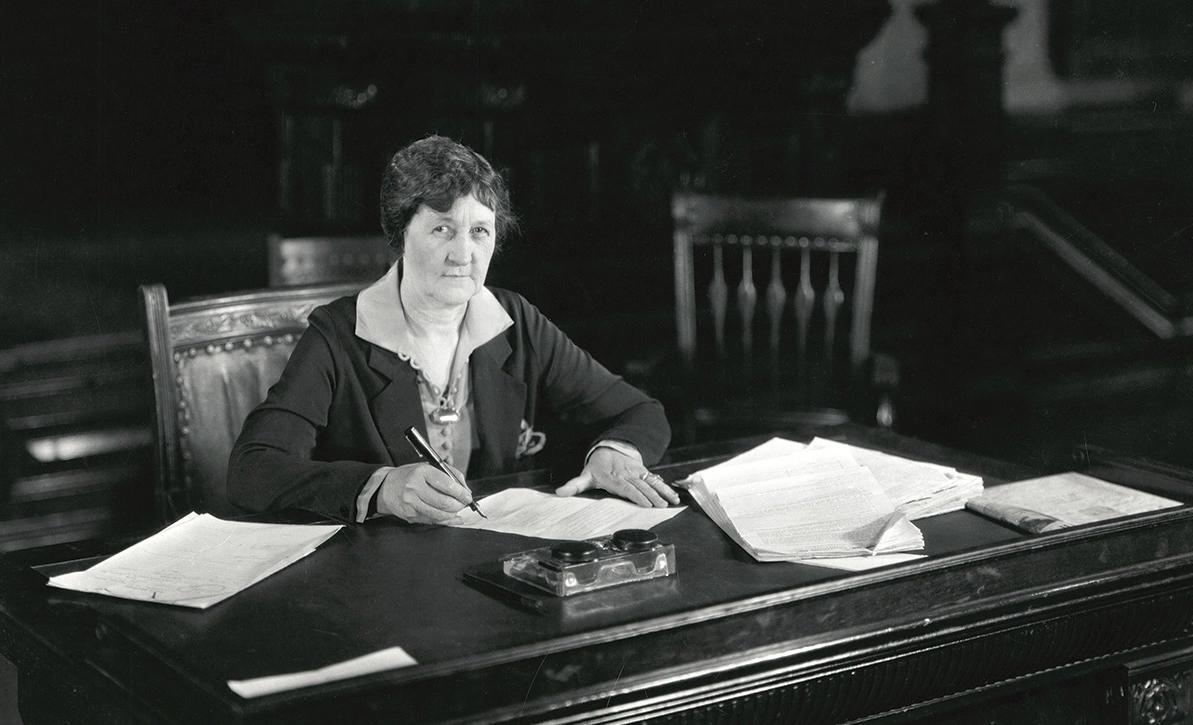
Miriam Amanda Wallace Ferguson (June 13, 1875 – June 25, 1961) was an American Democratic politician who served two non-consecutive terms as the 29th and 32nd governor of Texas, from January 1925 to January 1927 and from January 1933 to January 1935. She was the first woman elected governor of Texas, and the second woman to assume a state governorship in United States history, after Nellie Tayloe Ross of Wyoming.
Her first election came on an explicitly anti-Ku Klux Klan (KKK) platform at a moment when the organization exercised significant political control across Texas, and her subsequent passage of anti-mask legislation through the Texas Legislature marked a turning point in the Klan’s political influence in the state.
Early Life and Marriage
Miriam Amanda Wallace was born on June 13, 1875, in Bell County, Texas, to a farming family. She attended Salado College and Baylor Female College in Belton. On December 31, 1899, she married James Edward Ferguson, a lawyer and banker then active in Bell County politics. The couple settled first in Belton, where Jim opened a bank, then in Temple.
They had two daughters, Ouida Wallace Ferguson and Dorrace Watt Ferguson. Miriam Ferguson took little part in public affairs during this period; she later recalled that she had not even intended to exercise her right to vote when women gained suffrage in 1920.
James Ferguson’s Governorship and Impeachment
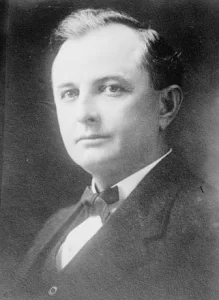
James Ferguson was elected governor of Texas in 1914 and re-elected in 1916, building his political base among small farmers and rural voters hostile to the established Democratic Party leadership. During his second term he was investigated by the state attorney general for the misapplication of public funds, including the acceptance of a large loan from brewing interests and the improper withholding of appropriations from the University of Texas. In 1917 the Texas Senate impeached him on ten charges and, upon conviction, prohibited him from holding any office of honor, trust, or profit under the state of Texas.
He resigned his office partway through the proceedings. The Texas Supreme Court upheld the ban in 1924 when Ferguson again sought a place on the ballot.
The Ku Klux Klan in Texas
The Second Ku Klux Klan established its first Texas chapter in Houston in the fall of 1920. By 1922 membership in the state was estimated at between 75,000 and 90,000. The revived Klan targeted not only Black Texans but also Mexican Americans, Catholics, Jews, immigrants, and people it considered morally deviant. Klan members carried out public floggings, tar-and-feathering, and brandings in several Texas cities.
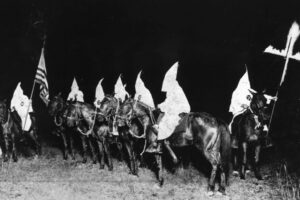
On October 23, 1923, the State Fair of Texas hosted a Klan Day at which more than 5,000 new recruits were initiated. Following the 1922 elections, a majority of members of the Texas House of Representatives were Klan members or Klan-aligned. The organization also controlled city governments across North Texas, and its candidates dominated the 1924 state Democratic convention. The Klan’s preferred gubernatorial candidate for 1924 was Judge Felix Robertson of Dallas.
The 1924 Campaign
With James Ferguson barred from the ballot, he arranged for Miriam to enter the Democratic primary for governor in 1924. She was 49 years old and had no prior political experience. The campaign operated under the open slogan “Two Governors for the Price of One,” and James Ferguson conducted most of the stump speaking at joint rallies, directing his rhetoric principally against the Klan and Robertson.
Campaign materials carried the phrases “Me for Ma” and “Pa Ain’t Bad Either.” Her nickname “Ma” derived both from her initials — Miriam Amanda — and from her role as mother and household manager during Jim’s years in office.
Miriam Ferguson ran on three principal commitments: opposition to the Ku Klux Klan, cuts in state expenditure, and opposition to new prohibition legislation, though she was personally a teetotaler. Women’s rights organizations were divided; many had opposed Jim Ferguson’s earlier anti-suffrage positions, and some, including Jessie Daniel Ames, president of the Texas League of Women Voters, initially viewed the choice between the Klan and Ferguson as a choice between competing dangers. Others set aside their distrust of Jim to support Miriam’s anti-Klan candidacy.
Ferguson defeated Robertson in the Democratic primary runoff by approximately 97,000 votes. In the November general election she faced George C. Butte, a former dean of the University of Texas School of Law and the strongest Republican gubernatorial nominee in Texas since Reconstruction. Many women voters and suffragists crossed party lines to vote for Butte in protest of the Ferguson political history, giving him nearly 295,000 votes. Ferguson received 422,563 votes, or approximately 59 percent, to Butte’s 294,920.
Dallas Morning News editor George Dealey commented on August 17, 1924, that Ferguson’s election would “sound the death knell of the Klan as a political power base in the state.” That assessment, while reflecting a genuine shift in public sentiment, overstated Ferguson’s individual role. District Attorney (and future governor) Dan Moody had already secured convictions against Klan members in Williamson County in 1923, prosecuting a flogging case that exposed the organization to criminal accountability for the first time and damaged its standing among moderate Texans.
Additionally, following Ferguson’s primary runoff victory, the Texas Democratic Party adopted a platform plank condemning the Klan as “undemocratic, un-Christian and un-American.” The national scandal surrounding Klan president D.C. Stephenson, convicted of murder in 1925, compounded the damage further. Ferguson’s electoral defeat of the Klan’s gubernatorial candidate was significant, but not the only cause of the Klan’s decline.
First Term, 1925–1927
Miriam Ferguson was inaugurated on January 20, 1925, fifteen days after Nellie Tayloe Ross of Wyoming, who had been sworn in to complete her late husband’s term. Ferguson thus became the first woman elected to a governorship in the United States in her own right.
Contemporary political observers characterized Miriam Ferguson as a figurehead for her husband. “She didn’t make any decisions,” recalled Sarah T. Hughes, a state representative and future federal judge. Hughes, who had voted for the Fergusons because of their anti-Klan stance, added, “The decisions were all made by Jim Ferguson, and the only reason that she was [governor] was that he had been impeached and couldn’t run. So no one expected her to make many decisions. But she came to the office every day, and I’m sure that she did discuss certain matters with her husband and have some influence on him.”1
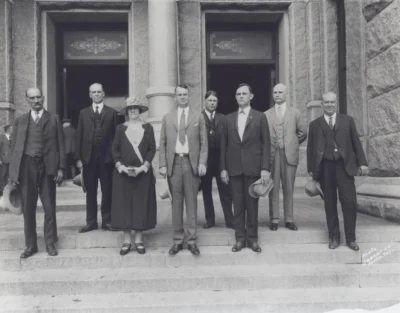
Within her first months in office, Ferguson made good on her central campaign commitment. In March 1925 the Texas Legislature passed a law prohibiting secret societies from parading in public disguise — a measure directed at the Klan’s practice of marching in hoods and robes. The Texas Supreme Court subsequently struck down the law as unconstitutional, but contemporaries and later historians credited the legislation and Ferguson’s election with accelerating the collapse of the Klan’s political standing in Texas. Klan membership in the state declined sharply through the late 1920s.
During the same session, the legislature passed an amnesty measure intended to restore the civil rights of impeached officeholders, including James Ferguson. Its legal effect was disputed, however, and the Legislature later declared that it lacked authority to annul Ferguson’s impeachment judgment.
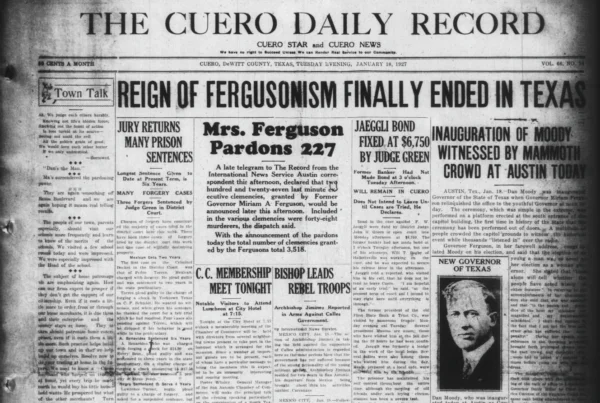
Ferguson’s first term was otherwise marked by controversy. She issued an average of approximately 100 pardons and paroles per month. Critics, including Secretary of State Jane Y. McCallum, charged that clemency was being sold for cash payments to the governor’s husband, and a House committee investigated rumors that highway contracts were awarded exclusively to firms that advertised in the Fergusons’ newspaper, the Ferguson Forum. No charges were filed in either investigation.
Ferguson defended her pardoning record as an exercise of mercy toward overcrowded prisons and toward prisoners unable to attend dying relatives, stating: “I am proud of having a heart that responds to merciful instincts and have no apology to make for granting the pardons.”
In 1926 Dan Moody, the state attorney general who had earlier prosecuted the Klan and recovered funds embezzled during James Ferguson’s governorship, challenged Miriam Ferguson in the Democratic primary and defeated her.
She attempted a comeback in 1930, but lost again in the primary.
Second Term, 1933–1935
Ferguson returned to the governorship in 1933 after narrowly defeating incumbent Ross Sterling in the 1932 Democratic primary. Sterling’s open support for the Texas Rangers during the campaign prompted Ferguson, upon taking office in January 1933, to discharge all serving Rangers — approximately 44 commissioned officers.
Her second term coincided with the depths of the Great Depression, with Texas close to fiscal insolvency. Ferguson cut the state payroll by 25 percent, backed loan programs for cotton farmers, and supported “bread bonds” to provide relief to mothers with starving children. She proposed both a corporate income tax and a state sales tax, neither of which passed the legislature.
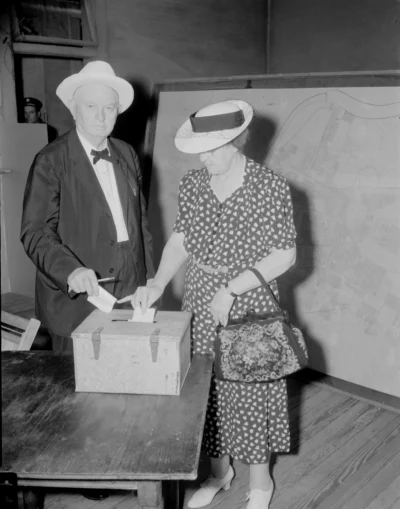
Regulation of the Texas oil industry began under her administration. In October 1933 she signed into law House Bill 194, which established the University of Houston as a four-year institution. She continued to issue pardons and paroles at a rate consistent with her first term, drawing less public opposition in the Depression context, when the cost of incarceration was itself a political issue.
In 1936 Texas voters approved a constitutional amendment stripping the governor of the power to issue pardons and granting it to a newly created, politically independent Texas Board of Pardons and Paroles — a direct consequence of the pardon controversies of the Ferguson administrations.
Later Years and Death
Ferguson did not seek re-election in 1934. She ran once more in 1940, at age 64, losing to W. Lee O’Daniel. James Ferguson died of a stroke on September 21, 1944. Miriam Ferguson remained in Austin in private life. She supported Lyndon B. Johnson’s political career and, together with Price Daniel, backed the Kennedy-Johnson ticket in 1960. The Burpee seed company named a zinnia cultivar after her near the end of her life.
Miriam Ferguson died of congestive heart failure on June 25, 1961, at the age of 86, in Austin. She was buried alongside her husband at the Texas State Cemetery. Her gravestone carries Psalm 119:105: “Thy word is a lamp unto my feet, and a light unto my path.” A marble bust, carved in 1926 by sculptor Enrico Cerracchio, stands in the rotunda of the Texas State Capitol.
Ann Richards became the next woman elected governor of Texas in 1990, fifty-five years after Ferguson left office.
- Judge Sarah Hughes, interview by North Texas State University Oral History Collection, no. 490, Jan. 15, 1969, pg. 7 ↩︎