James Burr V Allred (March 29, 1899 – September 24, 1959) was a lawyer, Democratic politician, and federal judge who served as the 33rd governor of Texas from January 1935 to January 1939. The state’s leading champion of President Roosevelt’s “New Deal,” Allred presided over the creation of old-age assistance, the teacher retirement system, the Texas Department of Public Safety, and the independent Board of Pardons and Paroles.
Allred is generally regarded as the last liberal Democratic governor of Texas for decades. His formative years as a young politician coincided with the peak of the Progressive Era, the rise and fall of the Ku Klux Klan and the Ferguson dynasty, the Roaring Twenties and the oil boom, and the onset of the Great Depression.
Allred’s unusual middle name, the single letter V, was a name rather than an initial.
Early Life
Allred was born on March 29, 1899, in Bowie, Montague County, one of nine children of Renne Allred Sr. and Mary Magdalene Henson Allred. He graduated from Bowie High School in 1917 and enrolled at Rice Institute (now Rice University) but withdrew for financial reasons, working for the United States Immigration Service before enlisting in the Navy in 1918. After the war he read law as a clerk in a Wichita Falls office and received a law degree from Cumberland University in Tennessee in 1921, returning to Wichita Falls to practice.
In 1923 Governor Pat Neff appointed Allred to an unexpired term as district attorney of the Thirtieth Judicial District, comprising Wichita, Archer, and Young counties. Elected to a full term in 1924, he earned the nickname “the fighting district attorney,” in part for his opposition to the Ku Klux Klan. He ran for attorney general in 1926, lost in the Democratic primary, and returned to private practice.
His probity in private practice was tested by the oil boom around Wichita Falls. According to his son David, oil operators aware of undisclosed drilling plans would urge Allred to buy the affected land cheaply so that they could later purchase it from him at a profit to him — an arrangement its proponents maintained was not a bribe. Allred refused them.
Attorney General, 1931–1935
In 1930 Allred defeated incumbent Robert L. Bobbitt to become, at age 31, the state attorney general. His two terms coincided with the chaotic early years of the East Texas oil boom, and much of his work concerned oil and corporate regulation. He filed an unprecedented number of antitrust suits, defended the state’s oil proration laws in their first court test, tightened enforcement of the gasoline tax, and established the Permanent School Fund’s title to West Texas oil royalties valued at more than $20 million.
Allred’s record as an opponent of monopolies and corporate influence in state fiscal policy formed the basis of his 1934 campaign for governor, which he won at age 35. The national Junior Chamber of Commerce named him “Outstanding Young Man in America” in 1935.
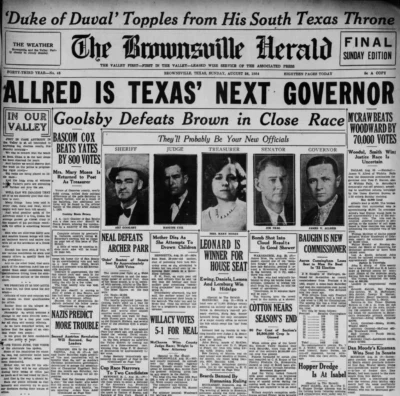
Governor, 1935–1939
Allred was inaugurated on January 15, 1935, with Texas in the depths of the Great Depression. He devoted much of his first term to aligning state government with federal relief programs, holding that cooperation with Washington was the fastest route to recovery. On November 19, 1935, he signed the state’s first old-age assistance law, and constitutional amendments adopted during his tenure brought Texas into the federal Social Security system, with aid to dependent children and the needy blind following.
The Texas Department of Public Safety, consolidating the Texas Rangers and the Highway Patrol, was established in 1935.
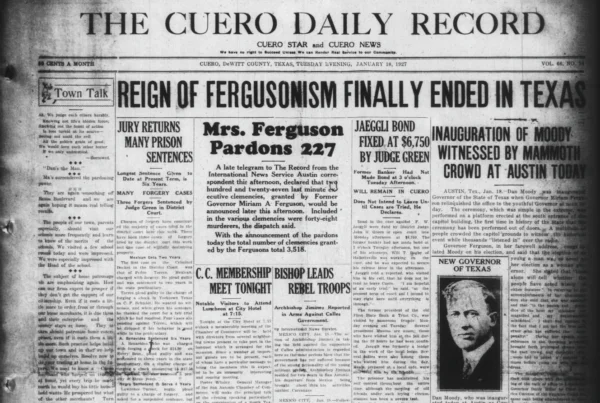
In 1936, voters approved the constitutional amendment creating an independent Board of Pardons and Paroles, ending the governor’s unilateral clemency power that had produced recurring scandal under previous administrations. Allred’s support for the reform was rooted in personal experience as much as principle. His wife, Joe Betsy Allred, later recalled that the weight of capital clemency decisions fell heavily on him:
“I remember many nights, when Jimmie would walk the floor until in the wee small hours, because he had the fate of a man’s hands in his, since he would have the final say. I remember in many cases where he brooded over this, until he wouldn’t be fresh for his next day’s work, because he would feel that if he did sentence a man to the electric chair, that it would be on his back the rest of his life. So he decided to see if he couldn’t get this Pardon and Parole Board establisehd through this amendment. He was instrumental in getting the ball to rolling that finally, ultimately, organized this Board. I think that was a very wise solution to the problem.”
The centerpiece public event of his governorship was the Texas Centennial of 1936, celebrating one hundred years of Texas independence, with its central exposition at Dallas. Allred was credited with much of the celebration’s success, which drew national attention and federal funds to the state.
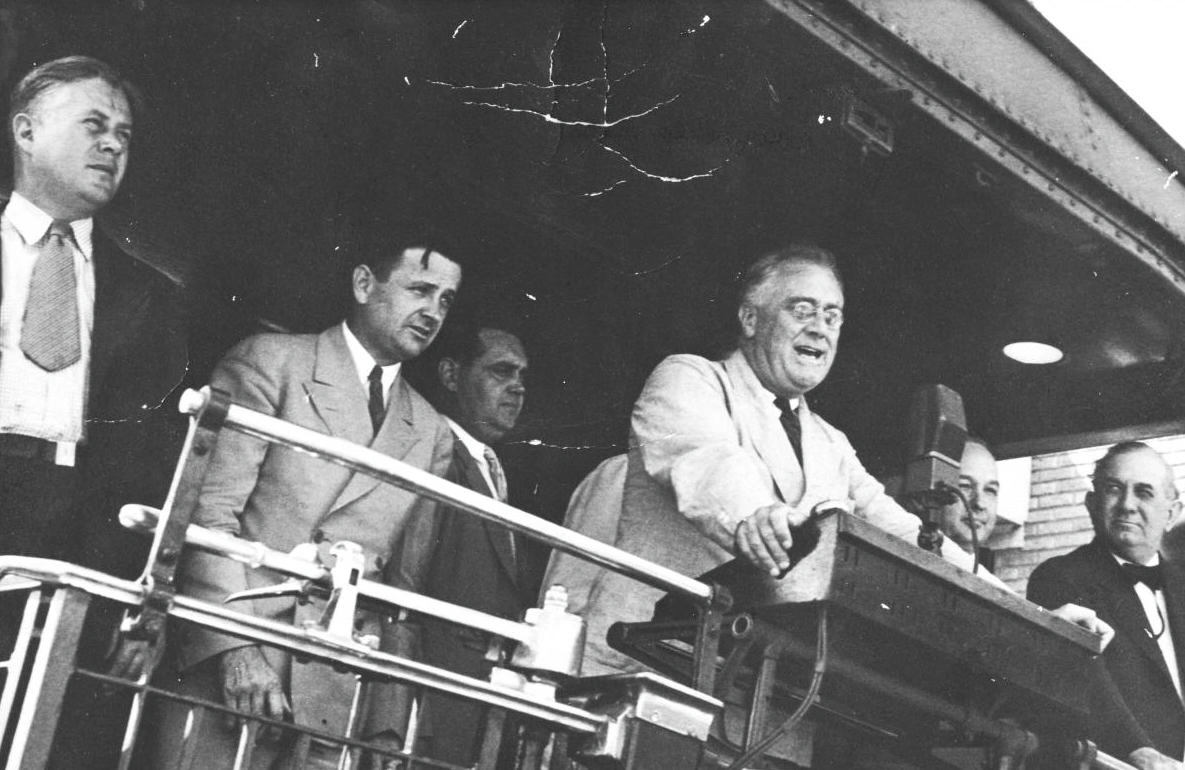
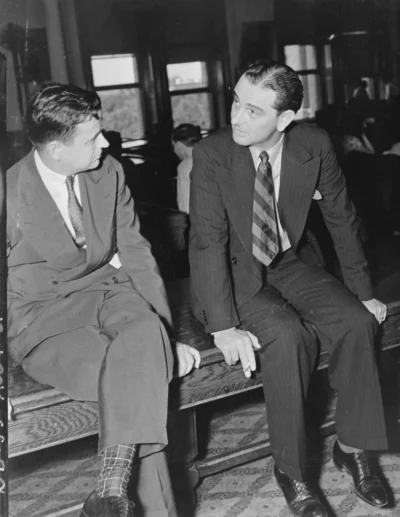
President Roosevelt’s rail tour of Texas in June 1936, tied to the Centennial, cemented a personal friendship between the two men; the Allreds accompanied the president through the state. Eleanor Roosevelt visited the Governor’s Mansion in March 1937 to see the Allreds’ newborn son, Sam Houston Allred, then four days old, and in Galveston, Governor Allred introduced the newly elected congressman Lyndon B. Johnson to Roosevelt as the president came ashore from a Gulf fishing trip. The meeting marked the beginning of Johnson’s association with the White House.
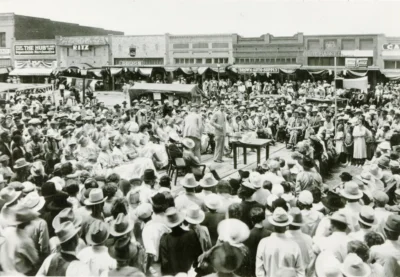
Allred was reelected easily in 1936. His second term produced the teacher retirement system, broadened welfare provisions, increased support for public education, and expanded state services. In 1937 he led the successful fight to repeal pari-mutuel wagering on horse races, which the legislature had legalized in 1933.
The repeal reflected Allred’s personal convictions as much as his platform. His wife recalled, “We were both strong in our feeling about it, realizing the damage that it could do to the Texas people. And Jimmie fought tooth and toenail for the success of that legislation. He led the fight against pari-mutuel betting. When he signed that racetrack gambling law I felt that this formed one of the most important achievements of his record.”
Despite Allred’s legislative successes, the Texas Legislature in both of his terms declined to appropriate funds for many of the programs that it had authorized, leaving education, highway, and welfare initiatives on uncertain financial footing.
Federal Judgeship and Later Career
Allred declined a recess appointment to the federal bench in July 1938 in order to complete his second term as governor. On January 5, 1939, President Roosevelt nominated him to a newly created seat on the U.S. District Court for Southern Texas; the Senate confirmed him in February, and he took his commission shortly after leaving the governorship.
In 1942 Allred resigned his lifetime judicial appointment to run for the U.S. Senate with Roosevelt’s backing. By his family’s account, he had found the bench confining — long nights reading briefs left him saturated with the legal side of public life — and he believed he could do more for Texans in elective office than in a courtroom. He led a field that included former governor Dan Moody but lost the Democratic runoff narrowly to incumbent “Pappy” O’Daniel.
Roosevelt then nominated Allred to the Fifth Circuit Court of Appeals in 1943, but the Senate never voted on the nomination, and Allred practiced law in Houston through the 1940s. In 1949 President Harry Truman appointed him to another newly created judgeship on the Southern District of Texas, where he served for the rest of his life.
Allred died of a coronary occlusion in Laredo on September 24, 1959, at age 60, hours after recessing court because he felt unwell. He was buried at Riverside Cemetery in Wichita Falls. He was survived by his wife and three sons. The James V. Allred Unit, a state prison near Wichita Falls, is named for him. His widow recalled that his tombstone bears words that captured the ambition of his public life: “I want to see Texas grow and prosper. I want only to reflect credit to my native state.”