The ‘White Primary’ was the principal legal mechanism by which the Texas Democratic Party excluded Black voters from the state’s electoral process for more than two decades, from the legislature’s 1923 statute through the U.S. Supreme Court’s 1944 ruling in Smith v. Allwright. The exclusion applied only to the Democratic primary; Black Texans remained legally free to vote in the general election and the Republican primary.
But Texas had become a one-party Democratic state by the early twentieth century, so the general election that followed the primary was little more than a formal ratification of a result already decided, and minority-party votes determined nothing. Exclusion from the Democratic primary therefore amounted in practice to exclusion from any meaningful vote at all. The practice survived four separate rounds of Supreme Court litigation, with the state and the party each time adjusting the legal theory behind exclusion in response to adverse rulings, before it was finally struck down.
Background
In the years immediately following Reconstruction, Black Texans voted and held office in significant numbers. Beginning in the 1870s and 1880s, however, white Democratic clubs and associations formed in counties across East Texas with the explicit goal of removing Black voters from local, county, and state politics; through fraud, intimidation, and outright violence, white Democrats in counties such as Grimes, Wharton, Fort Bend, and Harrison succeeded in driving Black voters from the political system, even in counties where Black residents formed a numerical majority.
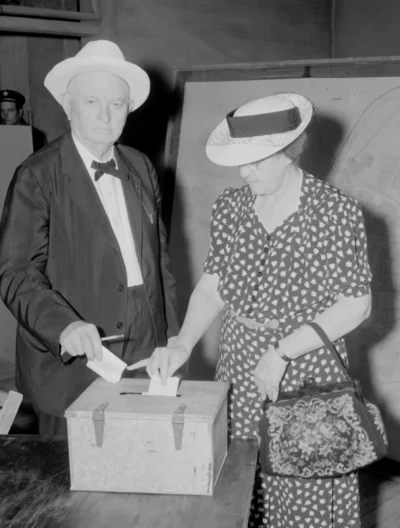
By 1900 Texas had become a one-party state, and the local practice of holding Democratic primaries had spread statewide; because nomination in the primary was tantamount to election, and the general election that followed was merely a formal acknowledgment of the primary’s results, exclusion from the primary meant exclusion from any meaningful vote.
A poll tax amendment, added to the state constitution in 1902, discouraged poor voters of any race from voting but did not by itself eliminate Black participation, since Black Texans who could pay the tax remained legally entitled to vote.
In 1903 the legislature adopted a mandatory primary statute, later amended to let county Democratic executive committee chairmen set their own voting qualifications; the law never mentioned race directly, but it was widely understood to bar Black voters from the primary, and enforcement varied by county, with some white Democrats continuing to solicit Black support even as others pushed for stricter exclusion.
Local discretion ended in 1923, when local officials, prohibitionists, and Ku Klux Klan members drove the legislature to enact a statute declaring that “in no event shall a negro be eligible to participate in a Democratic party primary election held in the State of Texas, and should a negro vote in a Democratic primary election, such ballot shall be void and election officials shall not count the same.”1 The law marked Texas’s shift from informal, county-level disfranchisement to an explicit statewide statutory bar.
Nixon v. Herndon (1927)
The 1923 law was challenged by Lawrence Nixon, a Black El Paso dentist and longtime Democratic primary voter, who was turned away from the polls. With assistance from the local and national NAACP (National Association for the Advancement of Colored People), he sued the election judges who had denied him a ballot.2
In their Supreme Court brief, NAACP lawyers rejected the Texas attorney general’s argument that the state Democratic Party was “a white man’s party,” calling the claim “a contemptible platitude that is in itself an insult to the constitution.”3
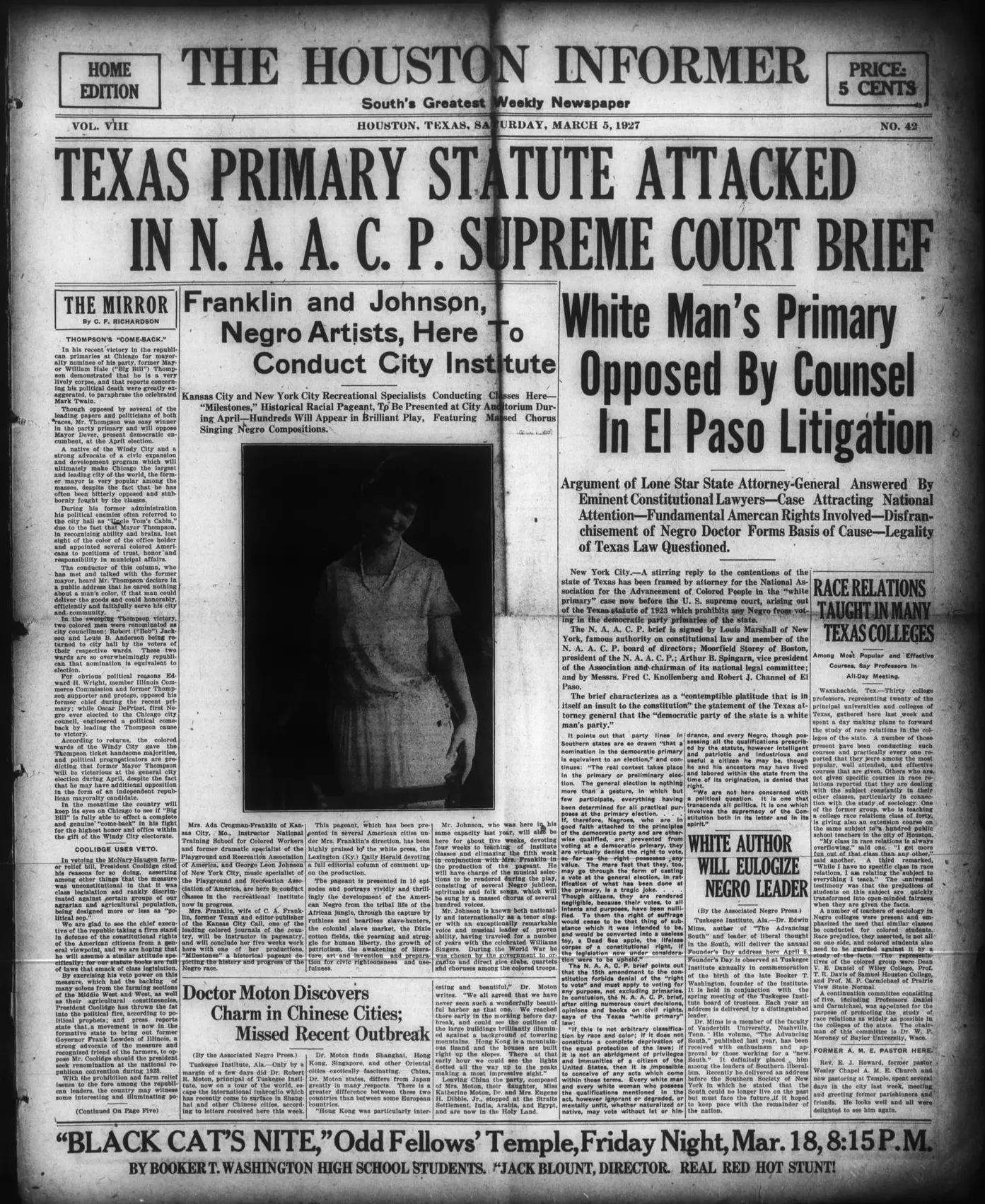
On March 7, 1927, the Supreme Court unanimously held the statute unconstitutional. Justice Oliver Wendell Holmes, writing for the Court, reasoned that the 1923 statute was state action in the most direct sense: the Texas legislature itself had enacted the bar, naming race as the sole disqualifying criterion, with no other voter qualification at issue. Because the law on its face singled out Black citizens for exclusion from a state-regulated election, it amounted to the state using its own statutory authority to deny them “the equal protection of the laws” guaranteed by the Fourteenth Amendment.4
The ruling was narrow, however: Holmes’s opinion addressed only a legislature’s direct, explicit exclusion of Black voters by statute, and said nothing about whether the party itself, acting on its own initiative, could achieve the same result.
Nixon v. Condon (1932)
Texas Democrats moved quickly to exploit that opening. The legislature repealed the 1923 statute and substituted a new law authorizing each party’s state executive committee to “prescribe the qualifications of its own members and… determine who shall be qualified to vote or otherwise participate.” The Democratic executive committee promptly resolved that only White Democrats would be permitted to participate in primary elections, and Nixon sued again. In a 5-4 decision on May 2, 1932, Cardozo held that whatever inherent power a party has to determine its own membership resides in the party convention, not in a committee — and since the executive committee’s authority derived from the statute rather than from the convention’s own delegation, its action was that of the state, not the party, and violated the Fourteenth Amendment.
Within weeks, Harris County Democratic chairman W. O. Huggins persuaded the state Democratic convention that a resolution adopted by the convention itself, rather than by a state-authorized committee, would not be attributable to the state and so would escape constitutional scrutiny. The convention adopted the so-called Huggins Plan on May 24, 1932, resolving “that all white citizens of the State of Texas who are qualified to vote under the constitution and laws of the state shall be eligible to membership in the Democratic party and as such to participate in its deliberations.”5
Black attorneys, including Houston’s James Nabrit and Carter Wesley, were turned away when they attempted to address the Resolutions Committee before the convention adjourned. Suits filed in Bexar, Grayson, Tarrant, and Jefferson counties to enjoin local Democratic officials from enforcing the new resolution were uniformly defeated in the lower courts; a temporary injunction won in San Antonio on the eve of the 1932 primary was overturned by the Fourth Circuit Court of Appeals within hours.6
One narrow victory came in El Paso, where a federal district judge held in 1934 that Cardozo’s reasoning in the second Nixon case still controlled and awarded Nixon five dollars in damages — but, as the only county where a federal ruling actually compelled compliance, the case had almost no effect on Black voting elsewhere in the state.
The 1934 primary and the Allred opinion
The 1934 gubernatorial primary tested the convention resolution directly. Attorney General James Allred, then a candidate for governor and under pressure from supporters who feared Black voters would favor a rival, issued an official opinion declaring that, under the 1932 resolution, “negroes are not entitled to participate in the primary elections of the Democratic Party.”7 Reaction split along county lines: some chairmen welcomed the ruling as a useful tool, while others announced they would continue letting qualified Black voters cast ballots, and at least one major daily called Allred’s reasoning “mighty poor law.”
Two Jefferson County men, W. H. Bell and E. L. Jones, sued without NAACP assistance, naming roughly two hundred defendants in an attempt to compel compliance. The Texas Supreme Court denied relief in Bell v. Hill, holding that the 1932 resolution remained the valid policy of the party. Allred, having campaigned on keeping “the Democratic Party of Texas a white man’s party,” won the election; complaints filed afterward by the National Bar Association and the NAACP with the U.S. Department of Justice produced federal investigations but no prosecutions, on the grounds that Texas election officials had acted in apparent good-faith reliance on a state court ruling.
Grovey v. Townsend (1935)
A separate challenge, brought independently of the NAACP by Houston barber Richard R. Grovey with attorneys J. Alston Atkins and Carter W. Wesley, reached the Supreme Court the following year, after Grovey was denied an absentee ballot by a county clerk. On April 1, 1935, the Court unanimously rejected the claim, holding that the Democratic Party’s convention, as a voluntary association, could set its own membership qualifications free of constitutional constraint — effectively reversing the practical gains of the Nixon cases.
Carter Wesley, writing in Houston’s Informer, called the decision a betrayal on the scale of Dred Scott, declaring that the Court “makes political slavery in Texas and the South constitutional, just as the Dred Scott decision made bodily slavery constitutional seventy-eight years ago.” NAACP secretary Walter White later described the organization’s reaction in similarly stark terms: “It should not be difficult to imagine the gloom we all felt. Years of hard work and heavy expense appeared to have gone for naught.”8
Smith v. Allwright (1944)
Grovey stood for nine years. The Supreme Court’s composition changed substantially under Franklin D. Roosevelt’s appointments, and American entry into the Second World War, fought in part against a regime built on doctrines of racial superiority, sharpened scrutiny of domestic disfranchisement.9 In 1941 the Court’s decision in United States v. Classic, a Louisiana case unrelated to race, held that Congress had authority to regulate primary elections where they functioned as a “step in the exercise by the people of their choice of representatives in Congress.” NAACP counsel Thurgood Marshall treated the ruling as a direct opening to revisit Grovey and built a new case around Lonnie E. Smith, a Houston dentist denied a primary ballot.
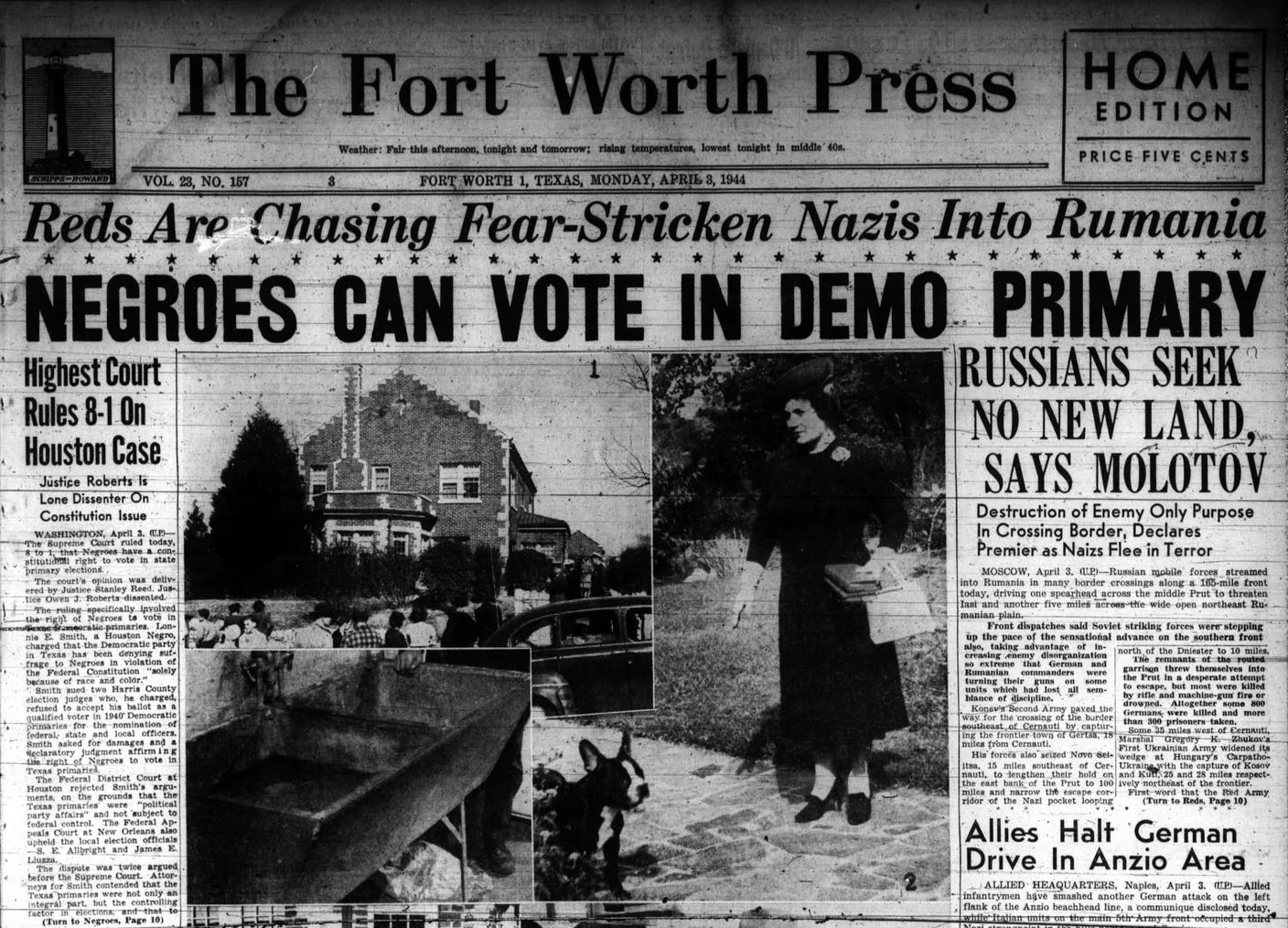
On April 3, 1944, the Supreme Court ruled eight to one in Smith v. Allwright that the Texas white primary was unconstitutional, expressly overturning Grovey. Writing for the majority, Justice Stanley Reed held that state election statutes had made the primary an integral part of the electoral process, so that neither the state nor the Democratic Party possessed authority to exclude Black voters by race.
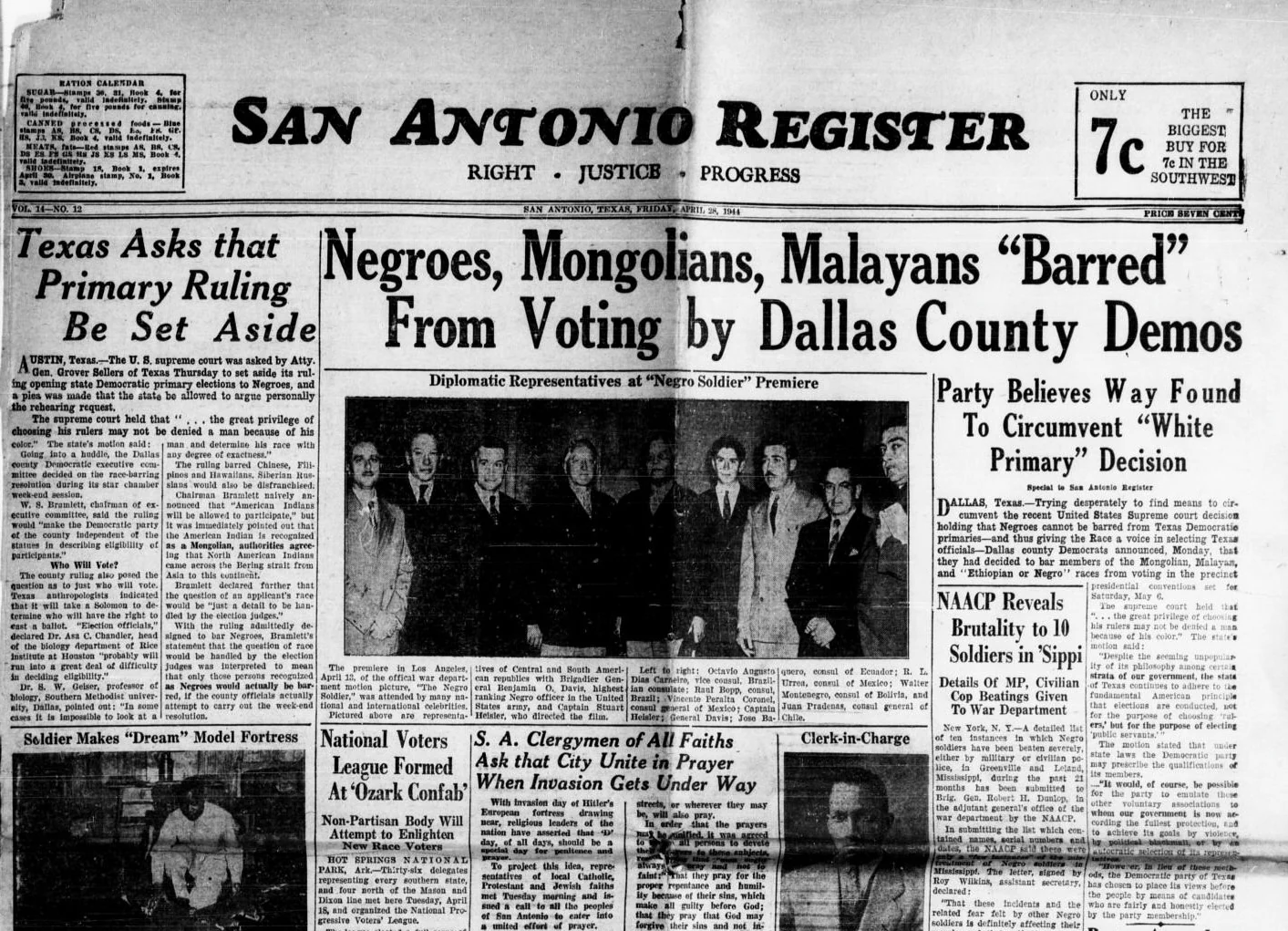
Even after the ruling, some Texas Democrats sought alternative means of exclusion: in Fort Bend County, the all-white Jaybird Democratic Association had for decades run privately organized “pre-primary” primaries to select nominees before the official primary was held. The Supreme Court ended this final variant in Terry v. Adams (1953), ruling that the Jaybirds’ role in the county’s electoral process brought the association within reach of the Fifteenth Amendment.
Aftermath
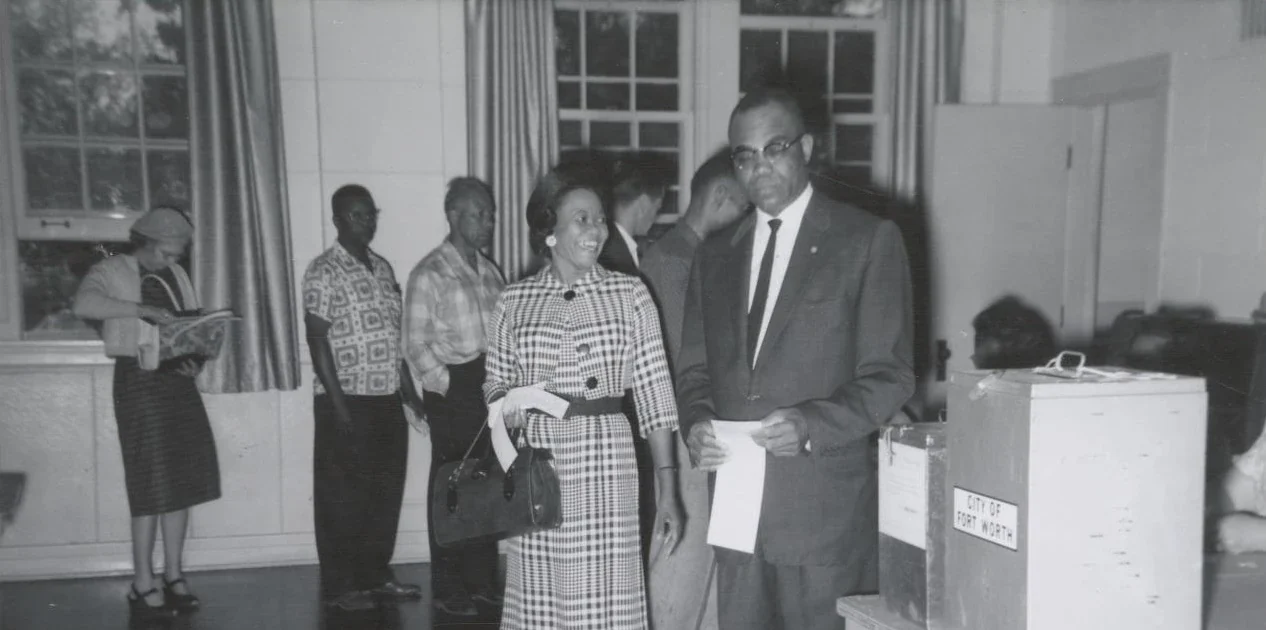
Smith v. Allwright was a significant step toward dismantling the Jim Crow system of segregation and second-class citizenship in Texas: it removed the most direct legal barrier to the Black vote and established a precedent on which later voting rights litigation would build. The ruling substantially expanded Black political participation in Texas, with registration rising from roughly 30,000 in 1940 to about 100,000 by 1947.10
Other disfranchisement tools remained, most prominently the poll tax, which continued to depress turnout among Black and poor White voters alike until the 24th Amendment in 1964, which prohibited poll taxes as a condition for voting in federal elections.
Notes
- Darlene Clark Hine, “The Elusive Ballot: The Black Struggle Against the Texas Democratic White Primary, 1932–1945,” Southwestern Historical Quarterly 81 (1977–1978): 373. ↩︎
- Sanford N. Greenberg, “White Primary,” Handbook of Texas Online, published February 1, 1996, revised September 29, 2020, https://www.tshaonline.org/handbook/entries/white-primary. ↩︎
- “White Man’s Primary Opposed by Counsel in El Paso Litigation,” The Houston Informer (Houston, Tex.), vol. 8, no. 42, ed. 1, March 5, 1927, 1. ↩︎
- Hine, “The Elusive Ballot,” 373. ↩︎
- Hine, “The Elusive Ballot,” 374–375. ↩︎
- Hine, “The Elusive Ballot,” 375–376. ↩︎
- Hine, “The Elusive Ballot,” 380. ↩︎
- Hine, “The Elusive Ballot,” 386. ↩︎
- Hine, “The Elusive Ballot,” 386–387. ↩︎
- Greenberg, “White Primary,” Handbook of Texas Online. ↩︎