The Fredonian–Cherokee Treaty, signed at Nacogdoches on December 21, 1826, was the principal document of the short-lived Fredonian Rebellion, the first organized attempt by Anglo-American settlers in Texas to separate from Mexican rule. The agreement aimed to create a military alliance between the Fredonian movement led by Benjamin W. Edwards and the Cherokee tribe, which had settled in northeast Texas only a few years earlier, after being expelled from their homelands in the east.
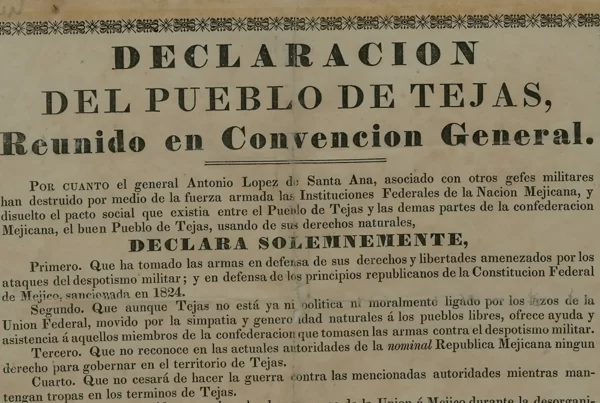
Although the document has traditionally been published under the title “The Fredonian Declaration of Independence,” the declaration itself comprises only the opening portion of the text. The remainder establishes a formal treaty creating a “Union, League and Confederation” between the two parties, defining territorial boundaries, guaranteeing property rights, and outlining mutual obligations.
The treaty emerged from a dispute over land claims in the empresario colony of Haden Edwards near Nacogdoches. After Edwards demanded that existing settlers prove the validity of their land titles, he came into conflict with long-established Tejano and Anglo residents. Mexican authorities ultimately revoked his colonization contract and ordered him to leave Texas. Rather than abandon the colony, the Edwards brothers proclaimed the independent “Republic of Fredonia” and sought allies among the Cherokee, promising them title to a vast territory north of Nacogdoches in exchange for military support.
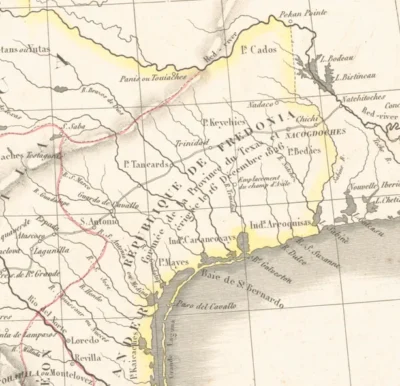
The agreement guaranteed mutual defense, recognized existing property rights, and provided reciprocal access to roads and navigable waterways. For the Cherokee, the treaty represented the culmination of years of unsuccessful efforts to secure official recognition of their settlements in East Texas. Richard Fields, the tribe’s diplomatic chief, had petitioned both Spanish and Mexican authorities for a permanent land grant but had returned empty-handed. Frustrated by these failures, Fields negotiated with the Fredonian leaders in hopes of obtaining legal title through the proposed republic instead.
After the treaty was signed, the Mexican government’s Indian Agent, Peter Ellis Bean, urged the Cherokee Council to reject the alliance. Although Cherokee leaders Richard Fields and John Dunn Hunter had signed the agreement, the tribe’s governing council ultimately refused to send warriors to the Fredonian cause. No Cherokee force joined the rebellion. The council repudiated the treaty and tried Fields and Hunter for involving the Cherokee in the venture. Both men fled, were captured separately, and executed in early February 1827.
Without the support of the Cherokee, Haden Edwards’ rebellion collapsed quickly. When Mexican troops and allied militia (dispatched from Stephen F. Austin‘s colony) entered Nacogdoches in late January and early February of 1826, they encountered no resistance; the Fredonians had already abandoned the town and fled across the Sabine River.
Although the Fredonian-Cherokee Treaty of 1826 was short-lived, it was part of a long and ultimately doomed Cherokee struggle to secure land rights in Texas. In 1836, Sam Houston negotiated another agreement with the Cherokee that would have recognized a defined homeland, but the Texas Senate never ratified it. In 1838, Texas officials accused Cherokee leaders of supporting the Córdova Rebellion in the Nacogdoches District. President Mirabeau Lamar then ordered the Cherokee removed from East Texas. Texas troops defeated Cherokee fighters at the Battle of the Neches in 1839 and forced the survivors north into Indian Territory.
Whereas, the Government of the Mexican United States, have by repeated insults, treachery and oppression, reduced the White and Red emigrants from the United States of North America, now living in the Province of Texas, within the Territory of the said Government, into which they have been deluded by promises solemnly made, and shamefully broken, to the dreadful alternative of either submitting their frozen necks to the yoke of an imbecile, faithless, and despotic government, miscalled a Republic, or of taking up arms in defence of their unalienable rights and asserting their Independence; They —viz:—The White emigrants now assembled in the town of Nacogdoches, around the Independent Standard, on the one part, and the Red emigrants who have espoused the same Holy Cause, on the other, in order to prosecute more speedily and effectually the War of Independence, they have mutually and unitedly, undertaken to, and do hereby bind and by these presents, by the ligaments of reciprocal interests and obligations, resolve to, execute a Treaty of Union, League and Confederation, the conditions of which are as follows:
For the illustrious object, BENJAMIN W. EDWARDS and HARMAN B. MAYO, Agents of the Committee of Independence, and RICHARD FIELDS and JOHN D. HUNTER, the Agents of the Red people, being respectfully furnished with due powers, have agreed to the following Articles.
- The above named contracting parties, bind themselves to a solemn Union, League and Confederation, in Peace and War, to establish and defend their mutual independence of the Mexican United States.
- The contracting parties guaranty, mutually, to the extent of their power, the integrity of their respective Territories, as now agreed upon and described, viz:
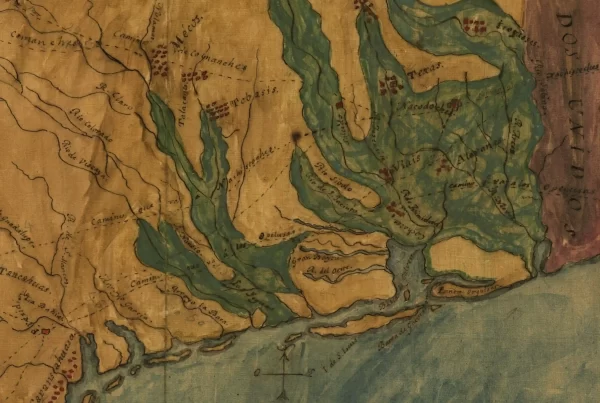
- The Territory apportioned to the Red people, shall begin at the Sandy Spring, where Bradley’s road takes off from the road leading from Nacogdoches to the Plantation of Joseph Dust, from thence West, by the Compass, without regard to variation, to the Rio Grande, thence to the head of the Rio Grande, thence with the mountains to the head of Big Red River, thence north to the boundary of the United States of North America, thence with the same line to the mouth of Sulphur Fork, thence in a right line to the beginning.
- The territory apportioned to the White people, shall comprehend all the residue of the Province of Texas, and of such other portions of the Mexican United States, as the contracting parties, by their mutual efforts and resources, may render Independent, provided the same shall not extend further west than the Rio Grande.
- The contracting parties mutually guaranty the rights of Empresarios to their premium lands only, and the rights of all other individuals, acquired under the Mexican Government, and relating or appertaining to the above described Territories, provided the said Empresarios and individuals do not forfeit the same by an opposition to the Independence of the said Territories, or by withdrawing their aid and support to its accomplishment.
- It is distinctly understood by the contracting parties, that the Territory apportioned to the Red people, is intended as well for the benefit of the Tribes now settled within the Territory apportioned to the White people, as for those living in the former Territory, and that it is incumbent upon the contracting parties for the Red people to offer the said Tribes a participation in the same.
- It is also mutually agreed by the contracting parties, that every individual, Red and White, who shall make improvement within either of the Respective Allied Territories and lives upon the same, shall have a fee simple of a section of land including his improvement, as well as the protection of the government under which he may reside.
- The contracting parties mutually agree, that all roads, navigable streams, and all other channels of conveyance within each Territory, shall be open and free to the use of the inhabitants of the other.
- The contracting parties mutually stipulate that they will direct all their resources to the prosecution of the Heaven-inspired cause which has given birth to this solemn Union, League and Confederation, firmly relying on their united efforts, and the strong arm of Heaven.
In faith whereof the Agents of the respective contracting parties hereunto affix their names. Done in the Town of Nacogdoches, this twenty-first day of December, in the year of our Lord one thousand eight hundred and twenty-six.
[Signed.]
B. W. EDWARDS,
H. B. MAYO,
RICHARD FIELDS,
JOHN D. HUNTER.
We, the Committee of Independence, and the Committee of Red People, do ratify the above Treaty, and do pledge ourselves to maintain it in good faith. Done on the day and date above mentioned.
[Signed.]
MARTIN PARMER, President
RICHARD FIELDS,
JOHN D. HUNTER,
NE-KO-LAKE,
JOHN BAGS,
CUK-TO-KEH,
HAEDEN EDWARDS,
W. B. LEGON,
INO. SPROW,
B. P. THOMPSON,
JOS. A. HUBER,
B. W. EDWARDS,
H. B. MAYO.
This article is part of Texapedia’s curated primary source collection, which makes accessible both famous and forgotten historical records. Each source is presented with historical context and manuscript information. This collection is freely available for classroom use, research, and general public interest.