Stephen F. Austin was a pioneer settler and the organizer of the largest American colony in Texas in the 1820s and 1830s, during the era of Mexican rule. Austin was a bilingual statesman with a background in law, frontier business ventures, and administration. He became known as the “Patriarch” or “Father” of Texas because of his founding role in bringing American settlers to Texas and his skilled administration of the Austin Colony.
Austin’s colony operated under a contract with the Mexican government, which designated him as empresario — a Spanish legal term for a private colonization contractor or land promoter. This contract gave him control of immense landholdings across about fifteen present-day counties in Southeast Texas, which he disbursed to other settlers for a fee. The arrangement also gave him wide-ranging local governmental powers, including the right to control immigration to the colony and adjudicate local civil disputes and certain criminal matters.
Until the Texas Revolution of 1835-1836, Austin functioned as an intermediary between American immigrants and the Mexican state and national governments. He was effectively a local political chief under Mexican national authority, professing Mexican citizenship while also serving as an American community leader, land agent, and international promoter of the colony.
During a tumultuous political era, Austin worked hard to build peaceful relations between settlers and the Mexican government. His relations with Native groups varied, alternating between diplomacy and conflict. Through a combination of vision, diplomacy, and administrative discipline, Austin laid the groundwork for the Republic of Texas and its later annexation by the United States.
Early Life and Frontier Ventures
Austin was born in 1793 in Virginia, where his father, Moses Austin, was the operator of a lead mine. This business incurred too many debts and failed while Stephen was a young child. His father then traveled to Missouri to escape debtor’s prison and to prospect for lead. He became one of the earliest American settlers in the region, which was then under Spanish rule. After swearing allegiance to the Spanish Crown, he received a grant of 4,428 acres and permission to operate a mine.
In 1803, Spain transferred Missouri to France, which immediately sold it to the United States as part of the Louisiana Purchase. The next year, Moses Austin sent his son Stephen to Connecticut, his home state, to attend boarding school. He studied there for several years and for two years at Transylvania University in Kentucky.
Stephen Austin returned to Missouri at the age of 16 and worked for his father, who by this time had become wealthy and owned a general store, a bank, and a lead mining business. At the age of 21, Austin won election to the Missouri territorial legislature.
The family’s success in Missouri eventually turned to ruin after Moses Austin again overextended himself financially. During the War of 1812, a two-year British blockade harmed the lead business by cutting off markets in the east (the metal was too heavy to transport overland). The final blow came with the Panic of 1819, the first widespread financial crisis in the U.S., which caused the failure of the Austin-owned Bank of St. Louis.
In the aftermath, Stephen, then in his mid-20s, moved to Arkansas and then to New Orleans, where he befriended an attorney who agreed to board him and train him in law.
Father’s Dying Wish
Meanwhile, Austin’s bankrupt father looked for opportunity farther afield. Having previously dealt with Spanish authorities, he traveled to San Antonio in Spanish Texas in 1820 and received permission to settle 300 American families in the territory. He envisioned creating a trading post that would prosper on the largely unsettled Texas coast.
On his return journey, Moses Austin was robbed of his horse and provisions and left to complete the journey on foot in the cold. Although he made it home to Missouri, he contracted a fatal case of pneumonia. On his deathbed, he asked that his son carry out his dream and fulfill his contract with the Spanish colonial government. He said to his wife,
“Tell dear Stephen that it is his dying father’s last request to prosecute the enterprise that he had commenced.”
Receiving this news by letter in New Orleans, Stephen Austin initially looked askance at his father’s Texas colonization scheme. “This was not what Stephen Austin wanted to hear,” historian H.W. Brands wrote of the deathbed wish.1 “Stephen had observed his father’s rise and fall, taking particular note of the latter. Their temperaments could hardly have been more different. Stephen was cautious where Moses was a gambler, studious where Moses learned from life, modest in ambition where Moses always sought more and better.”
Nevertheless, Stephen decided to leave his legal apprenticeship in New Orleans and journey to Texas to honor his father’s wish.
‘Don Estevan’: Empresario of Texas
Stephen F. Austin was just 27 years old when he arrived in Texas in 1821. His impressions of the countryside, as he traveled south toward San Antonio, left him feeling more optimistic about his father’s plans. He encountered vast prairies, rich black soils in the river valleys, and immense quantities of wild grapes.
On reaching San Antonio, however, he discovered that he would have to travel farther. That very year, Mexico had won its independence from Spain. The sudden change of sovereignty meant his father’s agreement with the Spanish Crown was no longer valid. Determined to salvage the project, Austin traveled to Mexico City and met with the new national leaders.
The turbulent post-independence politics of Mexico left Austin waiting for nearly a year until he received approval for his colony. Though frustrated by the delay, Austin gained fluency in Spanish during his stay in Mexico City. He cultivated relationships with Mexican officials and observed first-hand the political machinations of the capital—all experiences that contributed to the eventual success of his colony.
Austin eventually persuaded Mexican authorities to recognize and renew his father’s contract. As a condition, he swore allegiance to Mexico and accepted citizenship, binding himself to uphold Mexican law and act as the government’s agent on the frontier. The contract authorized him to settle 300 American families—later celebrated as the “Old Three Hundred”—but it also obligated him to enforce loyalty, regulate land titles, and ensure that settlers adapted to Mexican requirements.
Austin chose land along the Brazos and Colorado Rivers. He helped organize the settlers, marked out land grants, and set up rules. He worked closely with Mexican officials but had wide latitude over local affairs of his colony. Austin kept the colony’s records in Spanish, and wrote fluent Spanish to his governmental superiors in San Antonio and Saltillo. Yet few other American settlers followed his example and most spoke only English.
As empresario, Austin had both great opportunity and great responsibility. He acted as a kind of middleman between the settlers and the Mexican government. Settlers had to meet certain requirements: they had to be Catholics or agree to convert (though many saw this merely as a formality and did not become practicing Catholics), and they had to be loyal to Mexico. Austin reviewed applications, granted land titles, and kept careful records. In a land full of rumors and confusion, people trusted his word—and that gave him influence. He also enforced order, settled disputes, and made judgments in civil and low-level criminal cases.
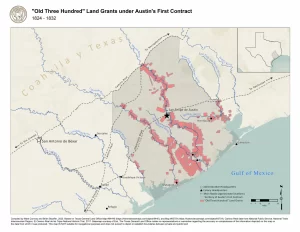
At times, Austin used his own money to keep his colony going. He paid surveyors, hired translators, and even bought food for settlers who had nothing. He wrote countless letters to Mexican officials, explaining delays, asking for support, and defending the actions of his colonists. The journey to Mexico City could take weeks, and Austin made the trip more than once—often during times of illness or personal hardship. He saw it as his duty to hold the colony together.
Austin’s colony prospered, and his success led the Mexican government to grant him more contracts. He brought in new groups of settlers from the United States, expanding his colonies east and west. Other empresarios followed his example, but few were as respected or as effective.

During the short-lived Fredonian Rebellion in 1826-1827, Austin and 250 militia from his colony assisted Mexican troops in reestablishing control in the Nacogdoches border region. This helped cement Austin’s reputation among the Mexican authorities, even as they grew increasingly distrustful of American settlers more generally. In 1830, the Mexican government banned further immigration from the United States.
From then on, this policy was a key source of tension between Mexican authorities and American settlers. Another source of tension was slavery. Many of the settlers from the American South brought enslaved people with them, even though Mexico had begun to move toward ending slavery across its territory. Austin argued that slavery was necessary for farming cotton in Texas, and he helped write colonization laws that gave settlers time to adjust. This kept peace for a while but would become a deeper source of tension later on.
Despite the challenges, Austin’s colonies grew quickly. By the early 1830s, thousands of Americans were living in Texas, building farms, shops, and small towns. They lived under Mexican law but spoke English, followed American customs, and held American ideas about rights and government. Austin tried to bridge these two worlds—Mexican law and American culture. For a time, he succeeded. But the balance could not last forever.
The Convention of 1833 and Arrest in Mexico City
Austin believed for most of his career that Texas could remain part of Mexico—if granted enough autonomy to govern its own affairs. Over more than a decade, Austin cultivated influence not only in Mexico City but also in the provincial capitals of San Antonio and Saltillo, giving him credibility with both national leaders and regional officials.
Yet growing centralization in Mexico, along with a series of restrictive laws—including the 1830 ban on immigration from the United States—strained that vision. Many settlers grew restless, but Austin continued to urge patience and loyalty. He became known as the leader of the “Peace Party,” in opposition to the “War Party” that advocated for outright rebellion and separation.
Austin’s own response to the new restrictions showed his characteristic pragmatism. He was on good terms with General Manuel de Mier y Terán, the immigration law’s chief architect, and persuaded the government to exempt his colonies from the immigration ban on the grounds that they were already established. His settlements kept growing while others stalled. He also won election in 1830 to the legislature of Coahuila y Tejas, and traveled to Saltillo for its sessions to represent settler interests within the system.
Austin was away at the legislature in the summer of 1832, when disputes over customs enforcement erupted into armed clashes between settlers and Mexican garrisons at Anahuac and Velasco. He helped calm the aftermath, and that October he presided over a convention at San Felipe that petitioned for repeal of the immigration ban and for separate statehood within Mexico. The petitions went undelivered. When settlers gathered again the following spring, the mood had hardened — and delegates passed over Austin, electing War Party leader William H. Wharton to preside instead.
At the Convention of 1833, settlers drafted a Texas constitution and petitioned for separate statehood within Mexico. Austin carried the request to Mexico City, where he spent months lobbying for approval. Frustrated by the delays, however, Austin wrote to the ayuntamiento (town council) of San Antonio urging Texans to begin organizing a state government without waiting for approval. The letter was forwarded to Mexico City, and Austin was arrested at Saltillo in January 1834 on his journey home.
He was held for months in a prison in Mexico City, initially in solitary confinement, and was never brought to trial. Released on bond in late 1834, he remained confined to the capital until a general amnesty in July 1835 finally allowed him to return to Texas.
Role in the Texas Revolution
Austin’s imprisonment was a turning point that shifted his view from Mexican loyalist to reluctant revolutionary. After his release and return to Texas in September 1835, under the terms of a general amnesty, Austin declared that President Antonio López de Santa Anna intended to “destroy and break up foreign settlements in Texas.” Meanwhile, a force of 400 Mexican soldiers under General Martín Perfecto de Cos arrived at Copano Bay with orders to disarm militia companies and arrest militants inciting revolt. Austin proclaimed,
“Conciliatory measures with General Cos and the military at Bexar are hopeless. War is our only resource.”
Other members of Austin’s ‘Peace Party’ likewise had changed their tune, amid widespread and growing distrust of Mexico’s centralist, authoritarian turn; the “War Party,” led by firebrands like William Travis, was ascendant. “We shall give them hell if they come here,” Travis said of the Mexican Army. As the Anglo-Texian revolutionaries prepared for war, some Tejanos (Hispanic natives of Texas) likewise armed themselves to fight in defense of the old constitution, in connection with a broader Mexican civil war between federalists and centralists.
The Tejano federalists and Anglo separatists did not necessarily share the same goals and ideals, yet they shared a common enemy. Bilingual leaders like Stephen F. Austin were among those who bridged the cultural divide and forged this revolutionary alliance. The first fighting erupted in October 1835 at the Battle of Gonzales. Though Austin was not present at this initial clash, he took command of revolutionary forces at the Siege of Bexar shortly thereafter.
Meanwhile, Austin also helped organize the Consultation of 1835, which formed a provisional government—the precursor to the Republic of Texas. He did not attend the Consultation himself, opting to remain with troops in San Antonio. Yet Austin still exerted a moderating influence on the critical gathering, supporting a cautious federalist faction over a more radical separatist faction. Under the influence of Austin and other federalists, the General Council continued to profess loyalty to the Mexican Constitution of 1824, while resisting the despotism of Santa Anna.
This stance, however, was to be short-lived, and it was largely a tactical political position rather than one of conviction; by this point, most of the Texians, including Austin himself, preferred the creation of a separate republic, or at least leaned in that direction—though Austin admitted so only privately. Amid preparations for the Consultation, Austin wrote to his brother-in-law James Perry, “The formation of a government (perhaps of a nation) is to be sketched out… The dayly progress of events is to be watched over, and public excitement kept from going too fast or too slow.”2
More vehemently, Austin declared in a letter to David G. Burnet after the fighting at Gonzales, “No more doubts—no submission. I hope to see Texas forever free from Mexican domination of any kind. It is yet too soon to say this publicly, but that is the point we shall end at—and it is the one I am aiming at. But we must arrive at it by steps and not all at one jump.”3
In December 1835, the General Council appointed Austin as an envoy to the United States to solicit money, supplies, and volunteers for the revolutionary cause. He departed Texas in early 1836 at the beginning of Santa Anna’s invasion of Texas, traveling to New Orleans, Washington, D.C., and other cities. For this reason, Austin was not present during the Convention at Washington-on-the-Brazos at which delegates declared independence from Mexico and adopted the constitution of the Republic of Texas.
During his travels, Austin wrote a letter to U.S. President Andrew Jackson, pleading for funds to support the Texan cause and for military intervention to halt the Mexican invasion. Jackson declined to intervene, saying the Texas Declaration of Independence was “a rash and premature act, our neutrality must be faithfully maintained.”
Birth of the Republic and Death of Austin
While Austin was still in the U.S., Texan forces won the Battle of San Jacinto and captured Santa Anna, ending hostilities. Austin returned to Texas and ran for president of the new republic. He lost the election to Sam Houston, the military leader credited with winning the Battle of San Jacinto. Houston made Austin Secretary of State, the chief diplomat of the new republic, but Austin became ill and died only two months later. He was 43 years old.
At the time of his death, Austin held renown in Texas yet he lived in poverty, exhausted and indebted from his recent years of travel, imprisonment, and war. His home at San Felipe had been burned by the Mexican Army during Santa Anna’s failed invasion, and he was living in a primitive log cabin on the farm of his brother-in-law. Austin’s once powerful status as empresario had no direct financial value under the new political order (though he likely could have secured land under the new republican land grant system, if he had lived).
“All my wealth is prospective and contingent upon the events of the future,” Austin wrote in a letter just weeks before his death. “I have no farm, no cotton plantation, no income, no money, no comforts. I have spent the prime of my life and worn out my constitution in trying to colonize this country… My health and strength and time have gone in the service of Texas, and I am therefore not ashamed of my present poverty.”4
An early 20th century biographer wrote that Stephen F. Austin “was a man of warm affections, and loved the idea of home, but he never married. Texas was home and wife and family to him. He died on a pallet on the floor of a two-bedroom clapboard shack, a month and twenty-four days past his forty-third birthday. His work was done, but he was denied the years so hardly earned for the enjoyment of its fruit…”5
Legacy and Remembrance
As the most prominent empresario of Mexican Texas, Stephen Austin played a foundational role in shaping the state’s early trajectory—not only by bringing settlers to the region, but by establishing a sense of political order and long-term possibility. His efforts helped transform a remote, thinly governed frontier into an organized, semi-autonomous region with townships, land titles, and civic life.
Austin was also a skilled intermediary between cultures. He won the trust of Mexican authorities while advancing the interests of Anglo-American settlers, delaying open conflict for over a decade. If Austin had not died prematurely, he would have played a leading role in the Republic of Texas. As Secretary of State, he was in a position to help guide relations with Mexico. Due to his diplomatic skill and fluency in Spanish, he might have succeeded in negotiating peace with Mexico, helping to prevent the conflicts that marred the republican era and early statehood, including the Mexican-American War.
But Austin’s contributions cannot be separated from his support for slavery. He was a slaveholder himself and actively worked to protect and expand the practice in Texas, viewing enslaved labor as essential to the colony’s success. Even as Mexico moved toward abolition, Austin lobbied for exemptions and legal loopholes to preserve slavery in the region. His legacy, like that of many early American founders, is deeply entangled with the economic and moral contradictions of slavery.
Despite these complexities, Austin remains one of the most influential figures in Texas history. His name is carried by the state capital, a county, numerous schools, and roads across the state. He helped turn a remote frontier into a place where thousands of families could start new lives—initially not by conquest, but through trust, negotiation, and cooperation with Mexican authorities. His steady leadership and institutional mindset left a mark that still shapes Texas today.
Sources Cited
- H. W. Brands, Dreams of El Dorado: A History of the American West (New York: Basic Books, 2019), 90. ↩︎
- Austin to James F. Perry, September 13, 1835, quoted in Eugene C. Barker, The Life of Stephen F. Austin: Founder of Texas, 1793–1836 (Austin: University of Texas Press, 1926). ↩︎
- Austin to David G. Burnet, October 5, 1835, in Fugitive Letters, 1829–1836, ed. Jacqueline Beretta Tomerlin (San Antonio: Trinity University Press, 1981), 37. ↩︎
- Austin to Ficklin, October 30, 1836, quoted in Barker, The Life of Stephen F. Austin: Founder of Texas, 1793–1836 (Austin: University of Texas Press, 1926). 629. ↩︎
- Barker, The Life of Stephen F. Austin: Founder of Texas, 1793–1836, 630. ↩︎
📚 Curated Texas History Books
Dive deeper into this topic by purchasing any of these handpicked titles:
- History of the American Frontier – 1763-1893
- Dreams of El Dorado: A History of the American West
- Wars of the Mexican Gulf: The Breakaway Republics of Texas and Yucatan, US-Mexican War, and Limits of Empire 1835-1850
As an Amazon Associate, Texapedia earns a commission from qualifying purchases. Earnings are used to support the ongoing work of maintaining and growing this encyclopedia.