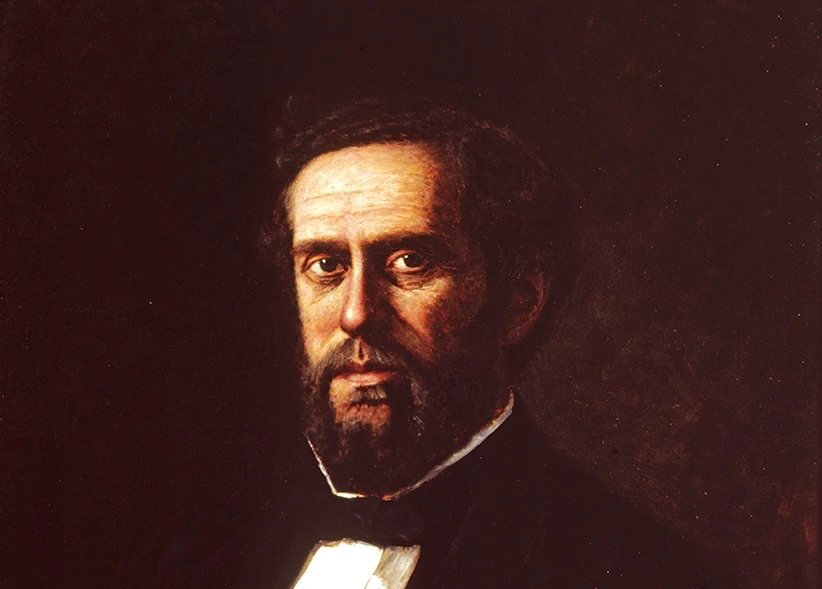
John Ireland (1827–1896) served as the 18th Governor of Texas from 1883 to 1887, navigating a period of rising agrarian unrest, frontier disorder, and structural modernization. A former Confederate officer, Supreme Court justice, and railroad-skeptic Democrat, Ireland was chosen to lead the state at a time when public dissatisfaction with land sales, railroad monopolies, and educational underfunding had begun to splinter traditional political loyalties.
He entered office with a mandate to rein in the railroad companies, restore public confidence in government, and defend the rule of law. His tenure was marked by both upheaval and institution-building—most visibly in the laying of the cornerstone for the Texas State Capitol, which Ireland insisted be made of native granite.
Early Life and Civil War Service
John Ireland was born on January 21, 1827, near Millerstown, Kentucky. Largely self-educated, he served for several years as constable and sheriff of his home county before taking up the study of law, and was admitted to the bar in 1852.
He moved to Texas in 1853 and established a practice in Seguin, where he was elected mayor in 1858. Seguin in the 1850s was still very much a frontier town—where courtroom justice and frontier justice often overlapped.
Ireland was a slaveholder and reported ownership of six people in the 1860 census. He served as a delegate to the Texas Secession Convention in 1861 and voted in favor of disunion. When war broke out, he volunteered as a private in the Confederate Army in 1862 and rose to lieutenant colonel in Hobby’s Eighth Texas Infantry Regiment. He served along the Gulf Coast, helping defend positions at Corpus Christi and Fort Esperanza, and remained stationed on the Texas coast through the end of the war.
Judicial Service and Political Rise
After the war, Ireland participated in the Constitutional Convention of 1866 and was elected district judge. However, like many former Confederates, he was removed from office by military authorities under Reconstruction. He returned to political life during the Democratic resurgence of the 1870s, serving in both houses of the state legislature — including as president pro tempore of the Senate — before being appointed to the Texas Supreme Court in 1875. That same year, he served as a delegate to the constitutional convention that drafted the Constitution of 1876. The new charter reduced the Supreme Court to three judges, ending his brief judicial tenure.
Known for his opposition to lavish land grants and subsidies to railroads, Ireland earned the nickname “Oxcart John” after fighting a proposal to reward the International–Great Northern Railroad with millions of acres of public land. This stance endeared him to many rural voters who viewed railroads and large landowners with suspicion. Though he lost bids for Congress and the U.S. Senate in the mid-1870s, he remained a visible figure within Texas Democratic politics.
By 1882, pressure had mounted within the party to nominate a candidate who could balance the interests of small farmers and ranchers, stabilize rural unrest, and restore faith in public institutions after years of speculative land policies and school underfunding. Ireland’s reputation for frugality, regional loyalty, and legal integrity made him an attractive compromise candidate. He won the nomination and defeated Greenback Party candidate George W. ‘Wash’ Jones in the general election.
The Fence-Cutting War
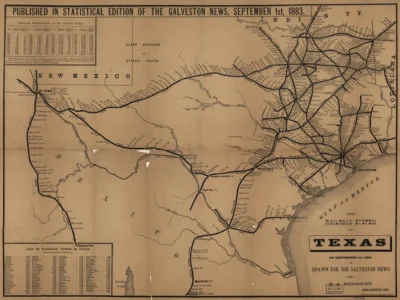
John Ireland assumed office in January 1883 amid a volatile political and economic landscape. The state’s population was booming, railroads were spreading, and the cattle frontier was rapidly closing. Yet prosperity was uneven, and tensions over land access, fencing practices, and monopoly power were at a breaking point.
These dynamics exploded into violence during what became known as the Fence-Cutting War. In the wake of a severe drought, cattlemen without land found themselves locked out of traditional grazing routes. Large landowners—some of them fencing public lands—enclosed vast tracts with barbed wire, blocking access to water and roads. Fence-cutting gangs destroyed hundreds of miles of fencing, and several deaths were reported.
One of the most prominent landowners targeted was Mabel Doss Day, who publicly called on the legislature to intervene after her ranch lost over 100 miles of fencing in coordinated attacks. Ireland responded by calling a special session of the Eighteenth Legislature in early 1884. In his message, he placed blame on both sides, criticizing both the “wanton destruction” of property and the unlawful enclosure of public land.
The legislature ultimately passed laws making both acts criminal offenses and required gates every three miles on fenced land. These changes calmed tensions and marked the formal end of Texas’s open-range era.
Later that year, Ireland won reelection to a second term, again defeating Wash Jones. The victory affirmed public confidence in his handling of the crisis and set the stage for the most visible undertakings of his governorship.
Law and Order
Despite his alignment with the small-government ethos of post-Reconstruction Democrats, Ireland recognized the need for modernization and civil order. In his first inaugural address in 1883, he outlined three measures to achieve better enforcement of the state’s criminal laws:
- “We must have a good judiciary, which cannot be had, but in exceptional cases—without better salaries.”
- “A salary to the prosecuting officer [i.e. district attorneys] that will ensure talents and fidelity to duty, that will be equal to our young, vigorous, and splendid bar.”
- “A higher sense of duty on the part of our juries.”
At the same time, he called for reforms of the state penitentiary system, including sentencing reductions for low-level crimes, and the construction of a reformatory for boys: “I do not doubt but there are numbers sent to that institution for petty offenses, who should be punished in some other way; and for youths, a house of correction or other place of confinement and punishment should be devised. I doubt the propriety of sending any [youths], no matter what the age, to the penitentiary for short periods of time.”
Despite Ireland’s calls for reform, overcrowding persisted during his time in office. “The Nineteenth Legislature took little action on the governor’s suggestion for easing prison overcrowding. The penalty for gambling was actually increased, and new punishments were imposed for those who vandalized telephone equipment.”1
Governor Ireland returned to the theme in his second inaugural two years later, highlighting prison overcrowding and criticizing “the present unjust and shiftless policy of working the convicts on railroads for hire” (he proposed instead employing them in urban “commercial centers,” arguing this would be both more humane and more profitable to the state).
Despite the Wild West lawlessness in parts of the state, Ireland expressed cautious optimism about its trajectory:
“With reasonable legislation our country will continue to grow and prosper. The border [i.e., frontier] will continue to recede; our new counties will continue to organize, the six-shooter and the Spencer rifle will disappear, and the people will be able to elect a local government that will afford protection to life and property without having to appeal to a central power to do that for which local officers are created.”
This expressed the typical post-Reconstruction Democratic prioritization of county-level government. Counties enjoyed unprecedented power and autonomy under the new 1876 constitution, and they built elegant county courthouses during this “Courthouse Era.” It also expressed his longer-term hope that Texans would one day feel safe and secure without needing always to carry weapons for their self-defense.
Public Education
A cornerstone of Ireland’s political agenda was his commitment to public education. During his 1883 inaugural address, he voiced deep concern over the state’s practice of using public funds to buy back its own bonds at a premium, calling it wasteful and irresponsible. “Shall we guard, protect and increase this fund as a sacred trust,” he asked, “or shall we throw it away by paying forty per cent premium for an investment?”
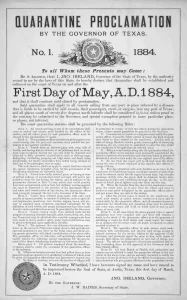
Previously, public lands belonging to the state school fund were being sold on the cheap, for fifty cents per acre. Ireland ended the practice and supported legislation raising land prices.
Ireland supported a constitutional amendment to allow a dedicated school tax and a law lengthening the annual school term to six months. Under his administration, the framework for independent school districts was clarified, local officials were given more authority to manage funds, and the office of State Superintendent of Public Instruction was created. Ireland also stood behind the founding of the University of Texas, which formally opened in 1883 and symbolized the state’s growing investment in higher education.
Ireland’s own education was limited and came at a cost. Growing up in rural Kentucky, he later recalled, “What education I got I paid for by working two days in the week for five days’ schooling at an ‘old field school.'”2
Building the Capitol
One of the most visible legacies of Ireland’s time in office is the construction of the Texas State Capitol. The previous building had burned in 1881, and construction of a new, grander Capitol was a top priority. Though funding was tied to a controversial land deal that granted vast acreage in the Panhandle to a syndicate of investors, Ireland exerted executive influence over the project’s symbolic details.
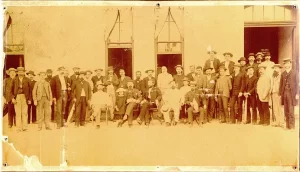
He insisted that the building be constructed with pink granite quarried from Texas, rather than imported Indiana limestone. The result was a uniquely Texan structure that remains a defining architectural and cultural landmark in the state. The cornerstone was laid during his second term, reinforcing his legacy as a builder of state institutions.
The Great Southwest Strike
One of the final crises of Ireland’s administration came in 1886, when the Knights of Labor launched the Great Southwest Strike against Jay Gould’s Texas and Pacific Railway. The walkout began in Marshall and quickly spread, paralyzing freight traffic across the state. After strikers began blocking trains from passing in Fort Worth, Ireland dispatched state militia and Texas Rangers to protect railroad operations and enforce public order.
However, Ireland also hurried to the scene of the strike himself, reaching there before the troops did, where he listened to the grievances of the strikers and, threatening to unleash the troops on them, convinced them to allow the trains to resume passing. The strike ultimately failed, dealing a blow to organized labor in Texas and giving Ireland a lasting reputation as an anti-labor hardliner. Ireland himself, however, saw his actions as necessary for upholding economic stability and the rule of law.
Political Philosophy
Ireland advocated for a small but professional government, focused mostly on upholding the rule of law and social order. In his 1883 inaugural address, he declared:
“Let us multiply the machinery of government as little as possible, adhere to the simplicity, purity and honesty of the fathers, and see how best to excel in virtue, purity of character, and in all those things that make us a light to our race.”
This ethos of minimalism and public morality guided his efforts to limit corporate abuses without embracing radical reform. He was skeptical of both speculative capital and class-based politics, but never fully embraced the broader regulatory agenda that would later define James Hogg’s administration.
Though considered for higher office, Ireland lost a U.S. Senate race in 1887 and never again held political power. He returned to Seguin and resumed practicing law.
Personal Life and Later Years
John Ireland married Matilda Wicks Faircloth in 1854, a year after arriving in Seguin. After her death in 1856, he married Anna Maria Penn in 1857. The couple had three daughters, and Ireland later adopted his grandson, Patrick Ireland Carpenter.
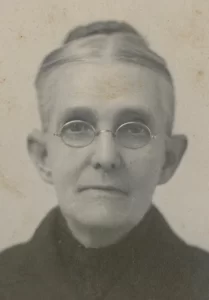
A devout Methodist, Anna declined to attend her husband’s inauguration, objecting to the dancing and public spectacle of the celebration. She was known for her charitable work. During the Civil War, she followed his encampments and served as a nurse to wounded soldiers.
In retirement, Ireland practiced law in Seguin. His investments in land and railroad stocks were reportedly wiped out in the Panic of 1893, and he died on March 15, 1896, at the age of 69. He was buried in the Texas State Cemetery in Austin.
Anna continued her civic efforts after her husband’s death, becoming a leader in the Women’s Missionary Society, raising funds for missions in Mexico and overseeing work at the Rescue Home in San Antonio. She died in 1911, and her funeral was attended by the sitting governor and other dignitaries.
Historical Reputation
Ireland’s most visible legacy is the Capitol itself, whose pink granite construction he championed and whose cornerstone was laid during his second term. The town of Ireland in Coryell County bears his name. Historians have generally placed him in the line of frugal post-Reconstruction Democratic governors between Oran Roberts and the more aggressively regulatory era of James Hogg. He was a transitional figure who used state power to end the open range and break a strike, while resisting any broader expansion of government.
Sources Cited
- Patsy McDonald Spaw, ed., The Texas Senate Volume 2: Civil War to the Eve of Reform, 1861–1889 (College Station: Texas A&M University Press, 1999), 285. ↩︎
- Quoted in Percy V. Pennybacker, A New History of Texas for Schools: Also for General Reading and for Teachers Preparing Themselves for Examination, Revised ed. (Palestine, TX: Percy V. Pennybacker, 1895), pg. 295 ↩︎