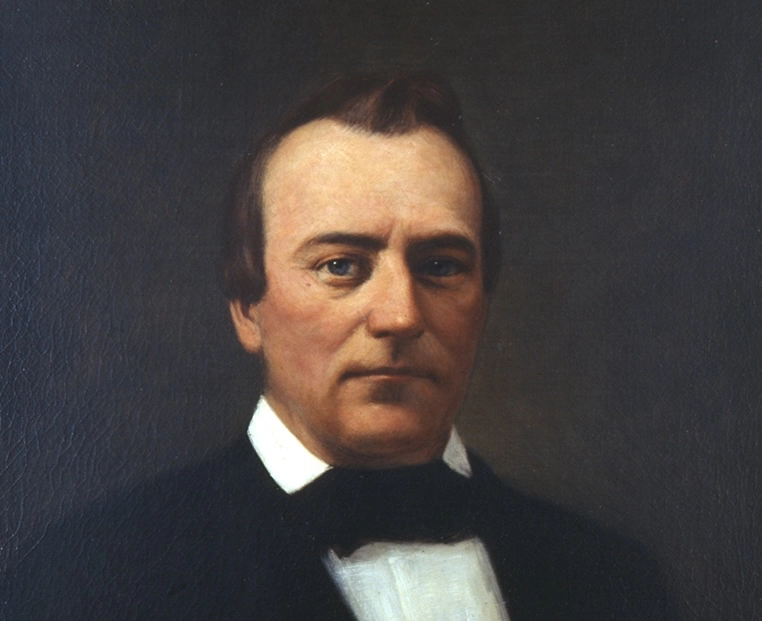
Francis Richard Lubbock (1815–1905) served as the ninth Governor of Texas from 1861 to 1863, during the early and critical years of the Civil War. A committed secessionist and energetic administrator, Lubbock oversaw the transition of Texas from a Union state to a Confederate one and worked closely with Jefferson Davis’s government to mobilize manpower and resources for the Southern cause.
After his term, he entered Confederate military service, rising to become aide-de-camp to President Jefferson Davis, and fled with the remnants of the Confederate leadership in 1865. Imprisoned for eight months, he was released without trial and returned to Texas, where he eventually reentered government office.
Lubbock’s long life, public memoirs, and association with key wartime events made him a symbolic figure of the Lost Cause generation in Texas.
Early Life and Political Career
Francis Lubbock was born on October 16, 1815, in Beaufort, South Carolina. He moved to Louisiana as a young man and eventually settled in Texas in the 1830s, during the Republic era. He became involved in commerce and politics in Houston and quickly emerged as a capable and ambitious figure.
Lubbock held a variety of public offices during the Republic of Texas period, serving as comptroller and then, for some sixteen years, as district clerk of Harris County. He developed a reputation for administrative skill and fiscal conservatism.
In the late 1850s, Lubbock aligned himself with the pro-slavery, pro-secession faction of the Texas Democratic Party. His political rise mirrored the intensifying sectional conflict in the South. In 1857 he was elected lieutenant governor on the Democratic ticket headed by “fire-eater” Hardin Runnels. He lost his 1859 reelection bid when Sam Houston, running as a Unionist, swept Runnels and his ticket from office.
In March 1861, after Texas seceded, Governor Sam Houston was removed from office for refusing to swear allegiance to the Confederacy, and Lieutenant Governor Edward Clark was elevated in his place. That August, Lubbock ran for the governorship as an avowed Confederate nationalist and defeated Clark by a mere 124 votes — one of the narrowest margins in Texas history.
Governorship: Mobilization for War
Lubbock’s term as governor (1861–1863) coincided with the Confederacy’s formation and the early organization of its war effort. He took office just months after Texas formally joined the Confederacy and faced the immediate challenge of converting the state’s legal, military, and fiscal systems to align with Richmond’s authority.
He worked closely with the Confederate government to organize troop recruitment, conscription enforcement, and supply logistics. Unlike Clark, whose brief interim administration had taken a more cautious approach, Lubbock embraced centralized Confederate control and supported military draft laws—even when they clashed with traditional Texas notions of localism and personal liberty.
Lubbock’s administration also oversaw the confiscation of Unionist and abolitionist property, the suppression of dissent, and the enforcement of loyalty oaths. His firm stance against suspected Union sympathizers, particularly in the Hill Country and among German Texans, led to controversial crackdowns and summary justice. The 1862 Nueces Massacre, in which Confederate forces killed a group of German immigrants attempting to flee conscription, occurred during his tenure and remains a dark stain on the era.
Though criticized in some quarters for overreach, Lubbock defended his actions as necessary for wartime unity and discipline. He repeatedly urged Texans to subordinate state interests to the broader Confederate cause, placing him among the more centralizing and ideologically committed Confederate governors.
Post-Governorship and Confederate Service
Lubbock declined to run for reelection in 1863 and was succeeded by Pendleton Murrah. He then entered Confederate military service as a lieutenant colonel, serving as assistant adjutant general on the staff of Major General John B. Magruder in Texas and later under General John A. Wharton during the Red River campaign in Louisiana. In 1864, President Jefferson Davis summoned him to Richmond as an aide-de-camp with the rank of colonel, making the former governor one of the president’s close advisers in the Confederacy’s final months.
As the Confederate government crumbled in 1865, Lubbock joined Davis and other officials in fleeing southward through the Carolinas and Georgia. He was captured alongside Davis in Georgia in May 1865 and imprisoned at Fort Delaware, where he was held in solitary confinement for eight months. Unlike some Confederate officials, he was eventually released without trial and returned to Texas.
Later Life and Memoirs
Following his release, Lubbock returned briefly to ranching before going into business in Houston and Galveston, where he served three years as tax collector. From 1879 to 1891, he returned to state government as Texas State Treasurer, first elected in 1878 under the post-Reconstruction administration of Governor Oran Roberts. His return reflected the rehabilitation of many former Confederates during the Redemption period, as Democratic “redeemers” reasserted traditional Southern leadership. After leaving the treasury, he served on the Board of Pardons under Governor James S. Hogg before retiring from public service at the age of eighty.
In the late 19th century, Lubbock became something of a living relic of the Confederate past. He published a memoir, Six Decades in Texas, in 1900, which chronicled his life from the Republic era through Reconstruction. The book offered both personal recollection and partisan justification, portraying the Confederacy in heroic terms and defending the suppression of Unionists as necessary to preserve order.
He died in Austin on June 22, 1905, at the age of 89. His longevity and literary legacy cemented his symbolic role as a senior figure of antebellum and Confederate Texas. He is buried in the Texas State Cemetery.
Historical Reputation
Francis R. Lubbock’s legacy is inseparable from the Civil War and the Confederate cause. As governor, he demonstrated administrative ability and unwavering ideological commitment to secession and Southern nationalism. He was effective in organizing the war effort within Texas, often more aligned with Richmond than with local resistance to conscription or centralization.
His involvement in wartime crackdowns and support for Confederate supremacy over state concerns placed him at odds with Texas’s older traditions of decentralization and frontier autonomy. In recent scholarship, his administration’s role in suppressing Unionist communities—including German Texans and Tejanos—has drawn increased scrutiny.
Lubbock County is named for the governor’s younger brother Thomas S. Lubbock, who co-founded Terry’s Texas Rangers, a cavalry regiment in the Confederate Army.
Lubbock’s writings, though partisan, offer a rare first-person account of the political transformation of nineteenth-century Texas across six decades.
📚 Curated Texas History Books
Dive deeper into this topic with these handpicked titles:
- Shifting Grounds: Nationalism and the American South, 1848-1865
- Colossal Ambitions: Confederate Planning for a Post–Civil War World
- The Texas Lowcountry: Slavery and Freedom on the Gulf Coast, 1822–1895
- A South Divided: Portraits of Dissent in the Confederacy
- This Republic of Suffering: Death and the American Civil War
Texapedia earns a commission from qualifying purchases. Earnings are used to support the ongoing work of maintaining and growing this encyclopedia.