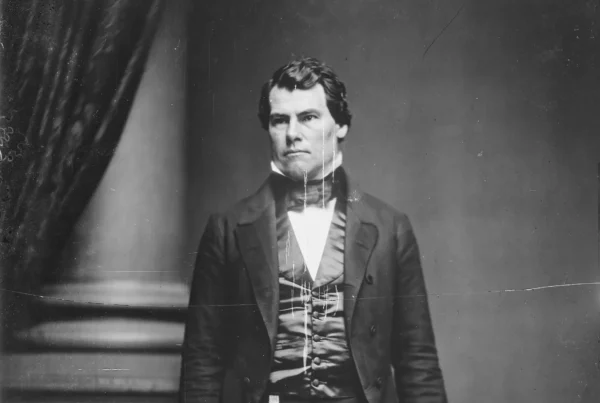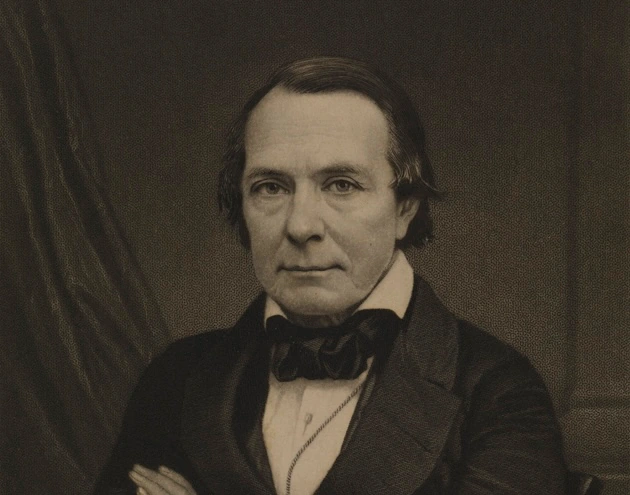
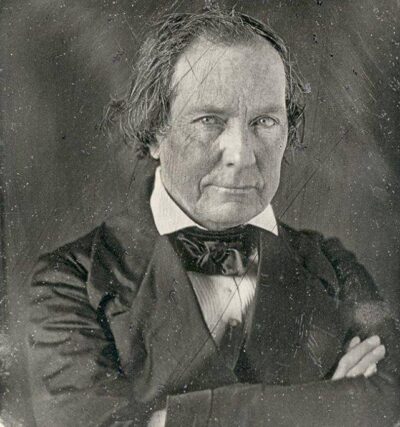
Mirabeau Buonaparte Lamar, born in Georgia in 1798, was a Texan separatist, the second president of the Republic of Texas (1838–1841), and the founder of the Texas capital at Austin.
Lamar served as secretary of war and vice president of the Republic of Texas prior to winning election as president in 1838. A veteran of the Battle of San Jacinto, he declared a martial vision for the new republic, comparing it to Sparta and Rome: “If peace can be obtained only by the sword, let the sword do its work.”
During his presidency, he favored aggressive military action against Mexico and Native American tribes, authorizing or encouraging several military expeditions. His militaristic policies were opposed by his predecessor, Sam Houston, who reversed many of them when he won a second term as president in 1841.
Lamar has been called “the father of Texas nationalism” and the leader of the “War Party” in Texas during the republic era, in opposition to the “Peace Party” led by Houston and his allies. Later Texan secessionists and Neo-Confederates lionized him for his expansionist, aggressive ideology and political instincts. However, Lamar himself eventually abandoned Texas nationalism and supported annexation by the United States in 1845, a move long advocated by his rival Sam Houston and the majority of the Anglo-Texan population.
Early Life and the Road to Texas
Lamar grew up at Fairfield, his father’s plantation near Milledgeville, Georgia, where he proved an omnivorous reader, an expert horseman, an accomplished fencer, and a writer of verse. He was, in short, a product of the Southern planter class in its most cultivated form — but financial circumstances denied him a college education, and his early career was marked by repeated failure and personal tragedy.
After a brief partnership in an Alabama general store and a stint as co-publisher of the Cahawba Press, Lamar returned to Georgia to serve as secretary to Governor George Troup in 1823, becoming a member of his household and absorbing the states’-rights political philosophy that would define his career. He married Tabitha Jordan in 1826 and established the Columbus Enquirer as an organ for the Troup political faction, winning election to the Georgia state senate in 1829. The death of his wife from tuberculosis on August 20, 1830 derailed his political ambitions.
Two unsuccessful congressional campaigns followed, along with the suicide of his brother Lucius. By 1835 Lamar had sold his interest in the Enquirer and left Georgia for Texas.
He arrived in July 1835, initially intending to collect historical materials, but the independence struggle against Mexico quickly redirected him. He declared for Texas independence almost immediately, helped build a fort at Velasco, contributed poems to the Brazoria Texas Republican, then returned to Georgia to settle his affairs before rushing back at the news of the Alamo and the Goliad Massacre.
San Jacinto and the Birth of a Republic
Lamar joined the revolutionary army at Groce’s Point as a private. On April 20, 1836, the day before the main battle, he distinguished himself in a skirmish near the San Jacinto River, rescuing Thomas Jefferson Rusk and Walter Paye Lane from encircling Mexican forces and earning a field promotion to colonel. The following day he commanded the Texan cavalry at San Jacinto, where Houston’s army routed Santa Anna’s forces and secured Texan independence.
His battlefield performance brought swift reward. Ten days after San Jacinto, he was appointed secretary of war in David G. Burnet‘s provisional cabinet. In this capacity, he demanded that Santa Anna be executed as a murderer — a demand resisted by others in the provisional government. A month later he was named major general and commander in chief of the Texas army, though the unruly Texas troops refused to accept his authority and he retired to civilian life. He was elected vice president of the Republic of Texas in September 1836, spending most of 1837 in Georgia, where he was feted as a hero.
The Election of 1838

Lamar returned to Texas for the presidential election of 1838. His victory in this contest owed much to circumstance: the incumbent, Sam Houston, remained politically influential but was constitutionally barred from succeeding himself. Houston’s preferred successor, Peter W. Grayson, committed suicide in July 1838, and another Houston-faction candidate, James Collinsworth, drowned in Galveston Bay after a week of heavy drinking.
With opposition effectively eliminated, Lamar ran on a platform of Texan greatness and future glory, winning nearly 97 percent of the vote — 6,995 votes to Robert Wilson’s 252. During the campaign, opponents had charged that Lamar was constitutionally ineligible for the presidency, not having been a Texas citizen for the required three years. Lamar dismissed the charge as “mortifying if seriously entertained,” producing a land receipt from Coles’ Settlement as evidence of his intention to settle in Texas from July 1835.
A President at War
Lamar was inaugurated on December 10, 1838, into a republic already in acute financial distress. The Panic of 1837 had devastated the American economy and cut off any prospect of foreign credit for Texas, leaving the republic without the means to fund the government that Houston had already struggled to maintain.
Militarily and diplomatically, Texas was vulnerable and isolated. Although the Texans had won a sudden victory in the revolution of 1835-1836, Mexico City refused to recognize the Republic of Texas and still considered Texas to be a rebellious province. Mexican ruler Santa Anna, captured at the Battle of San Jacinto, had promised not to invade Texas again, but this commitment (the Treaty of Velasco) was not accepted by his successors.
Furthermore, relations between Anglo-Texan settlers and Native American tribes were at a low point, with violence escalating with the Comanche, and a breakdown of talks with the Cherokee. Though the Houston Administration had negotiated a treaty with the Cherokee, the Texas Senate refused to honor it, and Lamar preferred war. Within Lamar’s first year of office, the “Córdova Rebellion” erupted in northeast Texas — an uprising allegedly fomented by Mexico — which gave Lamar an excuse to expel the Cherokee from Texas.
Lamar’s inaugural address set the tone for a presidency on a permanent war footing. Mexico, he said, “still seems to cherish the illusory hope of conquest,” even though it lacked the means to realize its aim of retaking Texas. This attitude of supine and sullen hostility” needed to be corrected forcefully: “We should compel a more active prosecution of the war. If peace can be obtained only by the sword, let the sword do its work.”
“Our young Republic has been formed by a Spartan Spirit — let it progress and ripen into Roman firmness, and Athenian gracefulness and wisdom. Let those names which have been inscribed on the standard of her martial glory, be found also on the page of her history, associated with that profound and enlightened policy, which is to make our country a bright link in the chain of free States, which will some day encircle, and unite in harmony the whole American Continent. Thus, and thus only, will true glory be perfected; and our nation which has sprung from the harsh trump of war, be matured into the refinements, and the tranquil happiness of peace.”
As Fehrenbach observed, Lamar “advocated pressure against the Mexicans, war against the Indians, and, sometimes overlooked because it was not implemented, a policy of education and development within the state. Lamar did not look to Washington and, if his programs were impossibly ambitious, he caught a part of every Texan’s heart.”
The fires of the revolution, stirred up by the Alamo and San Jacinto, still burned. However, the Republic of Texas lacked a standing army that was large enough or adequately supplied for offensive operations south of San Antonio. Lamar said in a speech to the Texas Congress, “We have not the means to raise, equip, and continue in the field an army of sufficient force to chastise that nation [Mexico] into an acknowledgement of our independence, without involving ourselves in pecuniary difficulties and embarrassments infinitely greater than those which now surround us.”
As a result, Lamar’s government relied on a policy of more limited operations and pressure tactics, some of which were driven more by the grassroots than by the republican government. For instance, companies of Texan volunteers supported the breakaway Republic of the Rio Grande, helping it win the Battle of Saltillo in October 1840.
Additionally, Lamar authorized a disastrous expedition targeting Mexican-controlled Santa Fe, and a naval campaign to harass Mexican shipping.
“It was easier, in the south, to declare the war reopened with Mexico than to carry the war to it… the declared hostilities languished, since there were no Texans in contact with, or within 300 miles of, the southern Rio Grande.”1
Eventually, conflict died down along the key frontier of the Rio Grande, notwithstanding Lamar’s avowal of open hostilities. Active conflict resumed the year after Lamar left office when Santa Anna, newly returned to power, ordered one final invasion of Texas in 1842 (possibly in response to Lamar’s New Mexico expedition).
The Indian Wars
On the question of the Indian nations, Lamar made no pretense of diplomacy. He regarded them, in Fehrenbach’s blunt summary, as “merely trespassing vermin on Texas soil,” and replaced Houston’s conciliatory policy with one of outright expulsion and force. Working through his Secretary of War Albert Sidney Johnston, Lamar launched a series of campaigns employing militia, regular Texas army forces, and local “ranging companies.” In one campaign in east Texas alone, more than 1,000 soldiers were mobilized.
The main blow fell on the border Indians occupying territory between the Comanches and White settlements — groups that were broken, dominated, and forced back. The Cherokees and several other so-called “immigrant” tribes, who had themselves been dispossessed in the United States and had moved into east Texas, were attacked and driven into Oklahoma or Arkansas in 1839. The campaigns against the Penatekas, or southern Comanches, in the San Antonio region pushed them back north of Bexar and ended a period of Comanche raiding. The cost was $2.5 million and bitter, bloody warfare along the borders of Anglo-Texas in which large numbers of both whites and Indians were killed.
Fehrenbach, drawing on historian Rupert Richardson, noted that the justice of Lamar’s campaigns “may be questioned, but their effectiveness is beyond dispute.” The wars expelled virtually all of the immigrant Cherokee from Texas and opened east Texas to white settlement — outcomes that carried, as Fehrenbach acknowledged, the same injustice as the removals carried out under Andrew Jackson to the east.
Negotiations with Mexico and Naval Strategy
Lamar made several genuine, if ultimately fruitless, diplomatic overtures to Mexico. For instance, he offered $5,000,000 for Mexican recognition of the Rio Grande boundary. Each side lacked the political will to pursue these talks more intensively, since recognition of Texas was an unpopular idea in Mexico City, and peace with Mexico was considered folly by Anglo-Texans who remembered betrayals by Santa Anna, such as the Goliad Massacre.
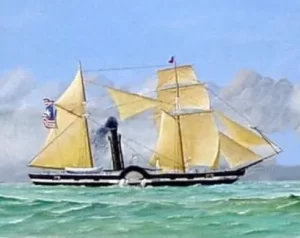
Toward the end of Lamar’s term, as diplomacy with Mexico faltered, Texas signed an alliance with the breakaway Mexican state of Yucatán, then engaged in civil war with the Mexican central government. Lamar authorized naval operations against Mexico on behalf of the Yucatán Republic.
In his annual address to Congress in November 1841, just weeks before leaving office, Lamar promoted the naval operation as a cost-effective way to pressure Mexico into recognizing Texan independence. He also portrayed the criollo (Spanish-descended) planter elite of Yucatán as natural allies: “This intelligent, wealthy, and populous state [Yucatán]… instead of uniting with the benighted, corrupt, and priest-ridden portions of Mexico for our destruction, they are themselves at war with the very power that would subjugate us.”
The practical terms were straightforward: three Texas ships would defend Yucatán’s coast in exchange for $8,000 a month, keeping the idle Texas navy active and self-financing. The resulting Yucatán Campaign began on Lamar’s final day in office, as Commodore Edwin Moore set sail from Galveston with three warships, despite objections by the incoming president, Sam Houston. This eventually led to major political conflict during the Houston Administration and a crisis in civil-military relations, as Moore refused orders to end hostilities, began operating from New Orleans, and eventually was declared a pirate.
Foreign Recognition and the Capital
Two significant achievements distinguished Lamar’s otherwise embattled presidency. His willingness to act as the ruler of a genuine sovereign state — aggressive, expansionist, and emphatically not seeking annexation by the U.S. — quickened European interest in Texas. By the close of his term, Britain, France, Belgium, and the Netherlands had recognized Texas or concluded commercial treaties with the republic. The French recognition came in 1839, assisted by French frustration over Mexican debts. Three British-Texas treaties followed in 1840, including recognition, commerce and navigation agreements.
Lamar also moved the capital. In 1839 a commission selected a site on the Colorado River, almost at the center of the claimed territory — a location that lay 70-odd miles north of San Antonio, well beyond the frontier of Anglo settlement and on the edge of Comanche country. Lamar moved the government there regardless, naming it Austin, in honor of pioneer statesman Stephen F. Austin. By 1840 the new capital held nearly 900 people. Many members of the Texas government were unwilling even to travel there, lacking, as Fehrenbach put it, “the President’s compulsion to look and go West.”
Education and Legacy
Lamar’s most enduring domestic achievement was his advocacy for public education. His inaugural address declared that “cultivated mind is the guardian genius of Democracy” — a phrase later rendered into Latin as Disciplina Praesidium Civitatis and adopted as the motto of the University of Texas. His administration secured the act of January 26, 1839, which set aside public lands to fund schools and two universities throughout the republic. The school system itself took decades to materialize, but the land endowment provided its eventual foundation. The nickname “Father of Texas Education” followed him to his grave.
Fiscal Collapse and Aftermath
By 1841 the financial consequences of Lamar’s wars had become catastrophic. The Indian campaigns alone cost $2.5 million. More than $3 million in “red back” paper currency had been printed and soon fell to around a dime on the dollar. Receipts for his administration totaled roughly $1,083,000 against expenditures of $4,855,000. When he left office, the republic’s debt stood at more than $7,000,000.

The political cost was equally severe: his expenditures had revived the conservative Peace party and returned Sam Houston to the presidency in the election of 1841 — a campaign fought, in Fehrenbach’s telling, not on ideology but on “the issues of which candidate was the greatest coward, drunkard, or public thief.”
Lamar retired to his plantation near Richmond, Texas. After his daughter Rebecca Ann’s death in 1843, he was plunged into melancholia. He had become convinced by 1844, after years of opposing annexation, that Texas statehood was necessary to protect slavery and prevent the state from becoming a British satellite, and he lobbied for annexation while in Washington. With the outbreak of the Mexican War in 1846, he joined Zachary Taylor’s forces at Matamoros as a lieutenant colonel, fought at the Battle of Monterrey, and subsequently served as captain of Texas Mounted Volunteers on the Rio Grande.
He helped organize municipal government at Laredo and represented Nueces and San Patricio counties in the Second Texas Legislature in 1847. He married his second wife, Henrietta Maffitt, in New Orleans in February 1851. His collected poetry, Verse Memorials, appeared in September 1857, the same year President James Buchanan appointed him U.S. minister to Nicaragua and Costa Rica — a post he held for twenty months.
Two months after returning to Richmond, he died of a heart attack on December 19, 1859, and was buried in the Masonic Cemetery at Richmond.
- T.R. Fehrenbach, Lone Star: A History of Texas and the Texans (New York: Macmillan, 1968). ↩︎