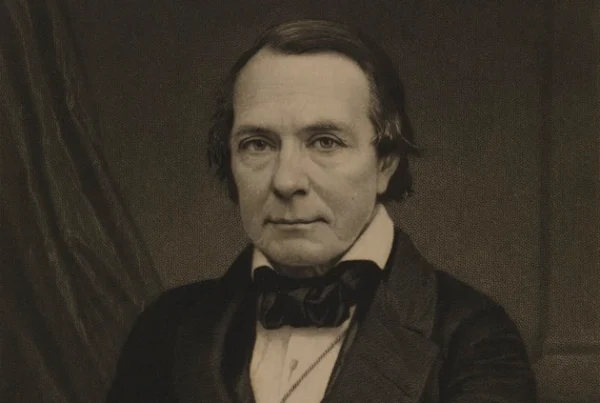
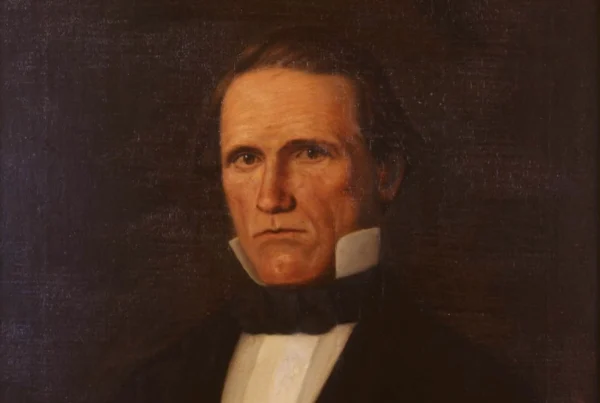
On December 29, 1845, the United States formally admitted Texas into the Union as the 28th state. This act marked the culmination of nearly a decade of diplomatic maneuvering, domestic political turmoil, and international intrigue. More than a simple act of territorial expansion, the annexation of Texas was a lightning rod that inflamed sectional tensions, galvanized the ideology of Manifest Destiny, and ultimately set the stage for war with Mexico.
The Texas Revolution
Originally part of New Spain, Texas had changed hands amid colonial rearrangements and wars before becoming a province of newly independent Mexico in 1821. The Mexican government, eager to populate the sparsely settled northern frontier, encouraged immigration from the United States. Anglo-American settlers poured in, many bringing enslaved laborers with them, a direct challenge to Mexico’s anti-slavery laws.
By the early 1830s, tensions flared. Settlers ignored laws requiring Catholic conversion and outlawing slavery, while Mexico imposed new restrictions to reassert authority. Meanwhile, the Mexican federal system collapsed in 1835. A new centralizing regime in Mexico City abrogated the country’s original constitution, passed a series of authoritarian measures known as the Siete Leyes, and dissolved state legislatures.
These factors led to the brief but bloody Texas Revolution in 1835-1836, after which Texas declared itself an independent republic. General Santa Anna, then president of Mexico, was captured and signed a treaty recognizing Texas’s independence, but the Mexican government refused to ratify it. Thus, Texas stood in diplomatic limbo: independent in fact but not in the eyes of its former sovereign.
Turning Away From Mexico, Toward the United States
During the Republic of Texas era, Texan political leaders considered themselves revolutionaries who had thrown off the yoke of an old system and rid themselves of a tyrant, Santa Anna — just as the American colonists in 1776 had rid themselves of King George. At the same time, the Texan ‘revolutionaries’ were conservatives in the sense that they wanted to preserve their own social, political, and economic traditions imported from the United States, rather than embrace Mexican customs or create something entirely new.
Politically, the government established in Texas in the 1830s and 1840s bore the hallmarks of American republicanism. The new Republic of Texas had a bicameral Congress, a president, and a judiciary modeled after the U.S. system. The republic’s constitution guaranteed rights like trial by jury, freedom of the press, and governmental neutrality in religious matters (“no preference shall be given by law to any religious denomination or mode of worship over another…”). These rights and structures were distinctive of American government at the time, in contrast to Mexican and European systems, making it easy to envision an eventual transition to U.S. statehood.
Immigrants from the U.S. continued to arrive in Texas during the republic era. Many of them were committed to the plantation economy system of the U.S. South, while others were craftsmen or yeoman farmers lured by the promise of cheap land. This influx of new English-speaking settlers strained relations with native Tejanos, such as Juan Seguín, who had participated in the Texas Revolution. Some of these Spanish-speaking residents of Texas eventually felt betrayed by the Texas Revolution, and opposed annexation by the U.S.
The majority of U.S.-born settlers in Texas lacked the colonial experiences of the early settlers who had lived under Mexican rule. They had little interest in cultural assimilation or involvement in Mexican politics. Unlike pioneer leader Stephen F. Austin, who had learned Spanish and envisioned a future for Texas as part of Mexico, the majority of Texans during the Republic era looked eastward to Washington, not southward to Mexico City.
Austin died in 1836, as did another key Mexican federalist, Lorenzo de Zavala, who had served as the first Vice President of the Republic of Texas. This left the (Mexican) federalist party in Texas leaderless, even as American nationalists like Sam Houston rose to the fore. Grassroots support for the Mexican federalist cause lingered in Texas in the late 1830s and early 1840s — many Texan volunteers fought for the Republic of the Rio Grande, and the Texas Navy fought for the Republic of Yucatán — but it grew less important with time, as economic and political factors continued to pull Texas eastward.
Overall, support for U.S. annexation grew throughout the 1840s. A minority party of Texan nationalists like President Mirabeau Lamar envisioned a permanently independent Texas empire. But most Texans retained their loyalty to their country of birth: the United States of America.
Houston’s First Push for Annexation
No one championed the cause of annexation more consistently than Sam Houston. Having led Texas through its revolution and into its early years as an independent republic, Houston believed that long-term security and prosperity could only be achieved through union with the U.S. His views were shaped by his deep political and personal ties to President Andrew Jackson and the broader Jacksonian tradition of national expansion.

Barely eighteen months after declaring independence from Mexico, the Republic made its first formal overture to the United States. In August 1837, President Houston appointed Memucan Hunt Jr. as minister to Washington, and Hunt formally submitted a request for annexation to President Martin Van Buren.
Van Buren, wary of the political implications, rejected the proposal outright. He chose not to forward it to Congress for consideration, fearing it would provoke a war with Mexico, which had never recognized Texas’s independence. Additionally, Van Buren faced mounting pressure from anti-slavery factions in the North, who opposed the admission of another slaveholding territory into the Union.
Northern Resistance to Annexation
Abolitionists in the North opposed the annexation of Texas early and openly. In cities like Boston, organizers held public meetings and issued resolutions condemning annexation as a pro-slavery project rather than a neutral act of expansion. They asserted that slavery in Texas had been introduced in defiance of Mexican law, and that annexation would strengthen slaveholding interests within the Union.
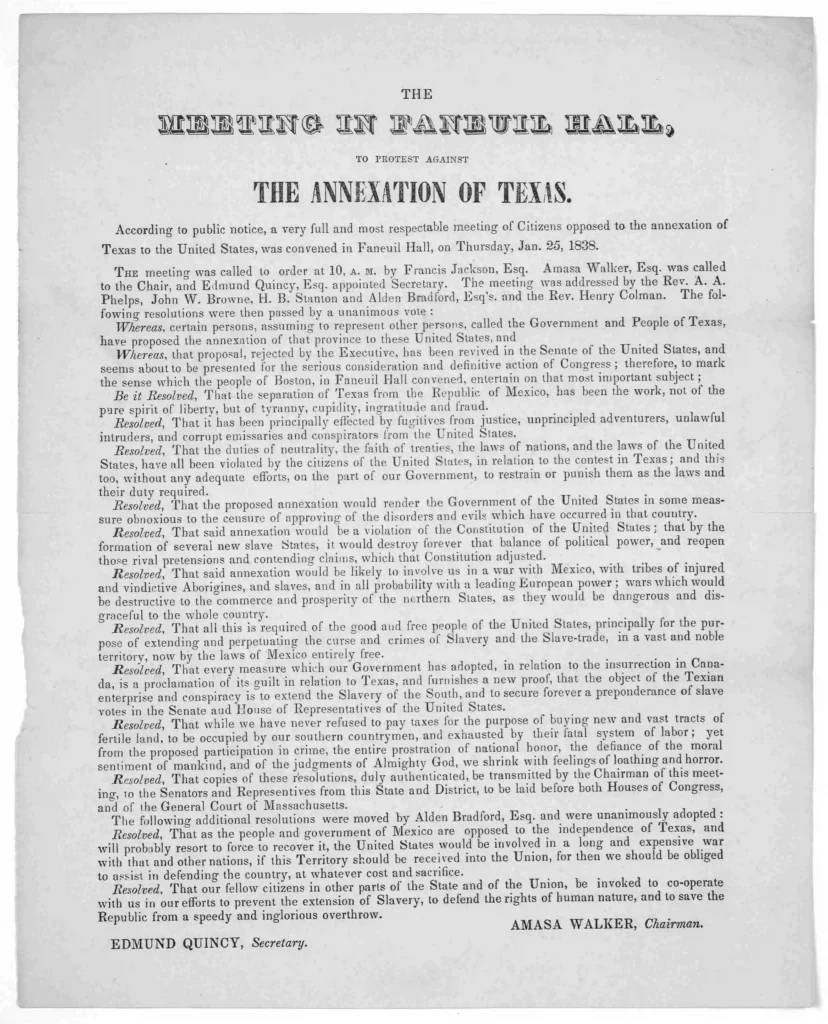
At a January 1838 meeting in Faneuil Hall, Boston citizens passed resolutions condemning the Texas Revolution and belittling the founding Texians as “fugitives from justice, unprincipled adventurers, unlawful intruders, and corrupt emissaries and conspirators.”
“Be it Resolved, that the separation of Texas from the Republic of Mexico, has been the work, not of the pure spirit of liberty, but of tyranny, cupidity, ingratitude and fraud.”
Faneuil Hall Declaration, Boston, January 1838
Abolitionists further warned that annexation would upset the political balance between Free and Slave states, established by the U.S. Constitution during the revolutionary era. The Faneuil Hall resolution declared, “By the formation of several new slave States, [annexation] would destroy forever that balance of political power, and reopen those rival pretensions and contending claims, which the Constitution adjusted.” (At the time, it was believed that Texas was large enough to create several states, which would substantially alter the composition of the U.S. Senate. Ultimately, the 1845 annexation resolution of the U.S. Congress did authorize the creation of five states in the territory today called Texas).
Opponents also raised concerns about foreign entanglements. The same meeting cautioned that annexation would “involve us in a war with Mexico, with tribes of injured Aborigines [Native Americans], and in all probability with a leading European power, wars which would be destructive to the commerce and prosperity of the northern States, as they would be dangerous and disgraceful to the whole country.”
For many Northerners, annexation appeared to serve sectional interests while exposing the nation to unnecessary war and instability. These objections proved decisive in the short term. They spread beyond abolitionist circles into mainstream Northern political discourse. Faced with mounting Northern opposition and the risk of war with Mexico, President Van Buren declined to advance the proposal. Congress showed little appetite to revive it, and by 1838 the effort had effectively collapsed.
Houston’s Return and Renewed Annexation Efforts
The collapse of the annexation effort did not resolve the Texas question; it merely delayed it. After stepping aside during the presidency of Mirabeau Lamar—who favored continued independence and territorial expansion—Sam Houston returned to office in 1841 with a more cautious and pragmatic approach. Where Lamar had pursued an ambitious but costly vision of an independent Texas, Houston sought stability, fiscal restraint, and renewed engagement with the United States.
By the early 1840s, the Republic of Texas faced mounting internal pressures. Its finances were strained, its currency depreciated, and its frontier remained vulnerable to conflict with Native American tribes and the threat of renewed Mexican invasion. These conditions made long-term independence increasingly uncertain. Houston recognized that annexation, once politically unviable, might again become attractive if conditions in the United States shifted.
At the same time, Houston pursued a diplomatic strategy designed to strengthen Texas’s bargaining position. His administration sought recognition and closer ties with Britain and France, both of which had economic interests in an independent Texas. British officials, in particular, showed interest in encouraging stability in the region and were perceived in the United States as favoring eventual emancipation in Texas.
This raised alarm among Southern leaders, who feared that a British-influenced Texas could undermine slavery in the American South. In this changing geopolitical context, annexation reemerged not only as a question of expansion, but as part of a broader contest over influence, security, and the future of slavery in North America.
Tyler’s Secret Diplomacy
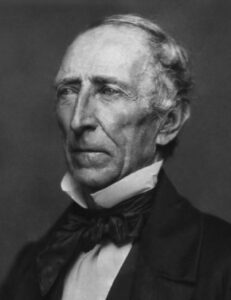
Into this volatile mix stepped President John Tyler, a political orphan expelled from the Whig Party who saw Texas annexation as the key to political resurrection. Tyler’s administration, particularly under Secretary of State Abel P. Upshur, pursued annexation with zeal. They justified it as a national security measure to prevent British meddling in North America and protect the institution of slavery from external threat.
At the heart of these concerns was Britain’s growing interest in Texas. Although British officials had no intention of annexing Texas themselves, they were firmly opposed to Texas joining the United States. British policy aimed to keep Texas an independent republic, believing this would slow U.S. westward expansion, open new trade routes for British goods, and weaken the influence of American tariff policies.
More importantly, Britain sought to broker a peace between Mexico and Texas and had encouraged Mexico to recognize Texas’s independence—on the condition that Texas not annex itself to any other country. While British officials avoided direct pressure on slavery, American leaders suspected that Britain’s long-term goal was to steer Texas toward emancipation, thereby undermining slavery in the American South. These fears, combined with anxieties about British diplomatic influence in North America, gave Tyler and his supporters a powerful justification for urgent annexation.
A widely circulated pro-annexation pamphlet authored by Senator Robert J. Walker of Mississippi described Texas as a necessary outlet for enslaved labor and a buffer against British abolitionist influence. Walker warned that if Texas remained independent, Britain might pressure it to abolish slavery, destabilizing the institution in the American South.
Tyler’s fears were stoked by reports from Duff Green, his unofficial agent in London, who warned that Britain harbored designs on Texas. Convinced the threat was genuine, Tyler authorized Secretary of State Abel P. Upshur to open secret annexation negotiations with Texas in the fall of 1843. Upshur worked closely with Isaac Van Zandt, the Texas chargé d’affaires in Washington, as well as with President Sam Houston, to explore the terms of a possible treaty. The negotiations were conducted discreetly, with only a handful of officials in either government informed.
By early 1844, a draft treaty had been reached, proposing the annexation of Texas as a U.S. territory and the assumption of its public debt. But just as it was nearing completion, Secretary of State Upshur and Secretary of the Navy Thomas Gilmer died in a cannon explosion aboard a navy ship. Tyler turned to South Carolina firebrand John C. Calhoun to serve as Secretary of State and complete the annexation treaty negotiations.
Calhoun’s appointment sent an unmistakable signal: the annexation of Texas was about slavery. Soon after taking office, Calhoun authored a letter to British Minister Richard Pakenham in which he explicitly defended slavery and accused the British government of trying to influence Texas to abolish the institution. He included this letter as part of the official annexation documents submitted to the Senate, effectively making slavery a central justification for the treaty.
This alarmed anti-slavery politicians and further inflamed sectional tensions. Combined with concerns about executive overreach in treaty-making, the slavery-centric framing of the annexation effort contributed to the Senate’s overwhelming rejection of the treaty in June 1844 by a vote of 16–35.
The Election of 1844: Destiny at the Ballot Box
The debate over Texas consumed the 1844 presidential election. Democrat Martin Van Buren, a cautious anti-annexationist, was denied his party’s nomination. Instead, delegates turned to James K. Polk, an ardent expansionist who campaigned on the twin promises of annexing Texas and reoccupying Oregon. Polk’s message of Manifest Destiny resonated.
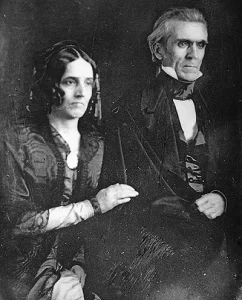
But Polk’s nomination was also a triumph for Southern Democrats, who saw Texas annexation as a means of preserving their political influence and protecting slavery. The joint resolution allowed up to four additional states to be carved from Texas territory, all of which potentially could enter the Union as slave states. This gave Southerners a powerful incentive to support annexation—and framed it as a sectional issue as much as a national one.
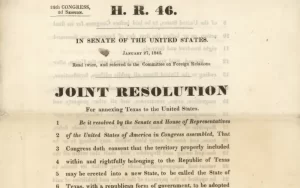
Polk narrowly defeated Whig candidate Henry Clay, who had wavered on Texas and lost Southern support as a result. Recognizing Polk’s mandate, Tyler moved quickly. With weeks left in his term, he asked Congress to bypass the treaty process and annex Texas via joint resolution—a constitutionally dubious tactic, but one requiring only a simple majority. The House, dominated by pro-annexation Democrats, approved the measure. The Senate, under intense pressure and political horse-trading, passed a compromise resolution in late February 1845.
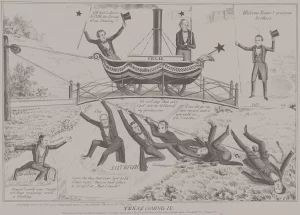
On March 1, Tyler signed the resolution into law and sent it to Texas with an offer of immediate statehood. Polk, inaugurated just days later, allowed the process to proceed unchallenged.
Texas Chooses Union: Why Annexation Triumphed
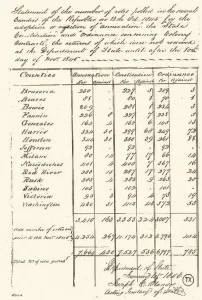
Texians enthusiastically accepted the U.S. offer. On July 4, 1845, a state convention adopted a constitution, approved by popular vote in October. On December 29, Congress admitted Texas to the Union. The Lone Star Republic ceased to exist on February 19, 1846.
The speed and enthusiasm with which Texans embraced annexation may seem surprising, given their recent hard-won independence. But the reality on the ground made annexation an appealing—if not essential—course. Despite romantic notions of frontier sovereignty, the Republic of Texas was fragile. It suffered from an overextended military, unmanageable debt, a weak currency, and diplomatic isolation. Britain and France had extended diplomatic recognition, but recognition alone could not deliver the economic or military guarantees that Texas needed to survive.
Texas’s economy, dependent on cotton and slave labor, faced depressed global prices and limited markets. The republic’s tax base was too small to service its debts, and its paper currency, known as “Redbacks,” had plummeted in value. Border raids from Mexico remained a threat, and the republic lacked the military resources to repel a sustained invasion.
Annexation promised not only protection but prosperity. As part of the United States, Texas would gain access to international credit markets, a stable currency, and federal military support. It would also be integrated into a vast commercial network, enabling the export of cotton to the booming textile mills of the North and Europe. Many Anglo settlers, most of whom had immigrated from the Southern U.S., felt culturally and politically aligned with their former country and viewed continued independence as unnatural or temporary.
Nonetheless, not all Texians supported annexation. A small faction of nationalists, particularly those in President Anson Jones’s administration, favored continued independence. They believed Texas could eventually gain full international legitimacy, negotiate better trade terms, and remain free of the entanglements of American politics. Jones himself delayed calling the annexation convention, hoping Mexico might finally recognize Texas independence and give Texans a genuine alternative to the American offer. That recognition came in the spring of 1845: through British mediation, Mexico agreed to acknowledge Texas as an independent nation on the condition that it never annex itself to another country.
But the broader Texan population had little patience for delay. Many feared that rejecting or postponing the U.S. offer might cause it to evaporate—especially if domestic politics shifted again in Washington. The Texas Congress and electorate moved swiftly, leaving Jones politically sidelined. In the end, the overwhelming majority of voters approved annexation and the new state constitution. Independence, while proudly remembered, was viewed by most as a transitional chapter in a larger American story.
But the broader Texian population had little patience for Jones’s maneuvering. Many feared that postponing the U.S. offer might cause it to evaporate, especially if domestic politics shifted again in Washington, and public opinion ran overwhelmingly toward union. Jones, politically sidelined, yielded and called the convention. In October, voters approved annexation and the new state constitution by an overwhelming margin. Independence, while proudly remembered, was viewed by most as a transitional chapter in a larger American story.
Mexico’s Reaction and the Road to War
The annexation enraged Mexico, which had never recognized Texas’s independence. From the Mexican perspective, the territory remained a rebellious province temporarily under foreign occupation. The decision by the United States to absorb Texas was seen as a grave insult to national sovereignty. Mexico severed diplomatic relations in protest and warned of war if the U.S. pushed further.
Though Mexico lacked the military strength to invade the United States, it could not ignore what it saw as a blatant provocation. For years, the disputed border between Texas and Mexico had remained unsettled—Texans claimed the Rio Grande as the boundary, while Mexico insisted on the older Nueces River line. In November 1845, President James K. Polk sent diplomat John Slidell to Mexico City with an offer to purchase the contested land, along with California and New Mexico. Mexican officials refused to meet with Slidell, citing domestic political instability and popular outrage.
Frustrated by the diplomatic impasse, Polk ordered General Zachary Taylor to march his troops south to the Rio Grande. When Mexican forces clashed with Taylor’s soldiers in April 1846, Polk claimed that American blood had been shed on American soil. Congress soon declared war, launching the Mexican-American War. The conflict would last two years, ultimately ending in a resounding U.S. victory and the cession of half of Mexico’s territory under the Treaty of Guadalupe Hidalgo. The annexation of Texas had lit the match.
The Legacy of Annexation
The annexation of Texas was a watershed moment in American political history. It affirmed the doctrine of Manifest Destiny—the belief that the United States was divinely ordained to expand across the continent. It demonstrated the limits of the Constitution when ambition and ideology aligned. And it irrevocably tied expansion to slavery, accelerating the sectional divide that would eventually tear the Union apart.
Texas’s admission also set a legal precedent: future annexations, such as Hawaii in 1898, would also be done by joint resolution rather than treaty. Tyler’s maneuver, though controversial, proved durable.
📚 Curated Texas History Books
Dive deeper into this topic with these handpicked titles:
- Storm over Texas: The Annexation Controversy and the Road to Civil War
- Adding the Lone Star: John Tyler, Sam Houston, and the Annexation of Texas
- The Texas Republic: A Social and Economic History
Texapedia earns a commission from qualifying purchases. Earnings are used to support the ongoing work of maintaining and growing this encyclopedia.