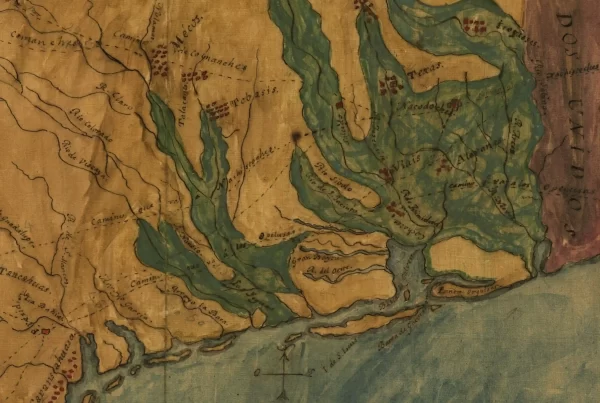
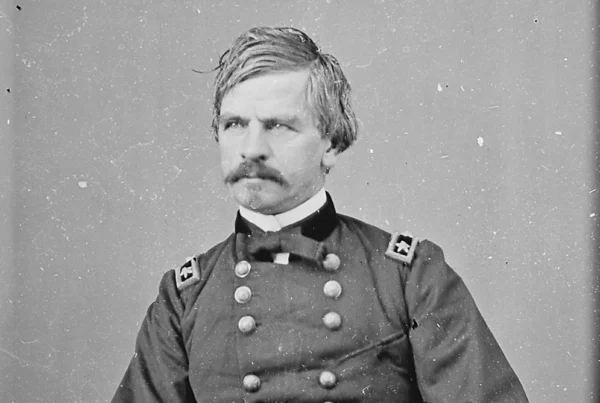
On the eve of his departure to Mexico City in April 1833, the founder of the Austin Colony, Stephen F. Austin, wrote to his friend and agent in Philadelphia, Thomas F. Leaming, outlining his vision for Texas’ political development within Mexico.
As empresario and one of the few bilingual leaders in Texas, Austin was the principal interlocutor between Anglo settlers and Mexican authorities, both state and national.
Later called the “father of Texas,” Austin was not a leading agitator in the events leading to the Texas Revolution. Though he eventually supported the armed struggle for independence, Austin first attempted to secure political rights and self-government for the American immigrants—called ‘Texians’ at the time—by petitioning for separate Texas statehood within the Mexican federalist system.
At the time, Texas was part of the State of Coahuila y Tejas, and settlers viewed the distant authorities at the state capital of Saltillo as ineffective and out of touch. They held a convention in April 1833 and resolved to petition the Mexican government for separate statehood. Austin was chosen as envoy to deliver this appeal.
Since arriving with the first settlers in Texas in 1822, Stephen F. Austin had played a key role in managing civic and legal affairs in eastern Texas, particularly within his colony headquartered at San Felipe de Austin. He acted in a hybrid role as private entrepreneur and land agent, while also representing the Mexican government. He corresponded with state authorities and kept them appraised of developments in the colony, while operating with considerable independence.
Mexican law and customs prevailed in certain matters, but the Anglo settlers already exercised self-government to a large degree, and they sought recognition of this through the division of the state of Coahuila y Tejas into two federal states. The growing size of the American settlements, the need for more institutions and laws to govern the rowdy frontier, as well as the cultural alienation between Anglo Texas and other Mexican regions, amplified local concerns over the political status of Texas.
In this letter, Austin laments the irregular governance arrangements, saying, “We have no government now that deserves the name of one, and the refusal to give us one will be bad policy, very bad policy indeed.” Similarly, in a previous letter to Leaming, written from Saltillo in 1831, Austin wrote, “The organization of our local government in Texas is bad, very bad—it is worse all over the nation… This nation [Mexico] has been in labor since 1810, and has not yet given birth to liberty, and must, I fear, undergo many years of the most agonizing throes before she will do it. What then will become of Texas?”
Austin’s mission to Mexico City went badly. Between 1833 and 1835, the authorities in the Mexican capital, rather than grant more autonomy to Texas, instead abrogated the 1824 constitution and dissolved the once powerful state governments. Under the military leader Antonio López de Santa Anna, the government centralized state powers and embraced authoritarian tactics to quell dissent. Attempting to return to Texas, Austin was arrested and imprisoned on charges of sedition. Though later released, the experience embittered him and led him to conclude that separatists in Texas were right to fight for independence.
This letter is also noteworthy for the postscript in which Austin opines briefly on the politics of the United States. His forebodings turned out to be correct, as the nation erupted in Civil War in 1861; yet his prediction that the Union would split within 50 years turned out to be wrong. Still, this statement points to the political uncertainty of the age.
Texans at the time were caught between larger national conflicts within both Mexico and the U.S. These unique circumstances ultimately led to rebellion and the founding of the Republic of Texas in 1836. Today, we take for granted the form of government of Texas and its affiliation with the U.S.; this letter reminds us of the uncertain politics of an older age.
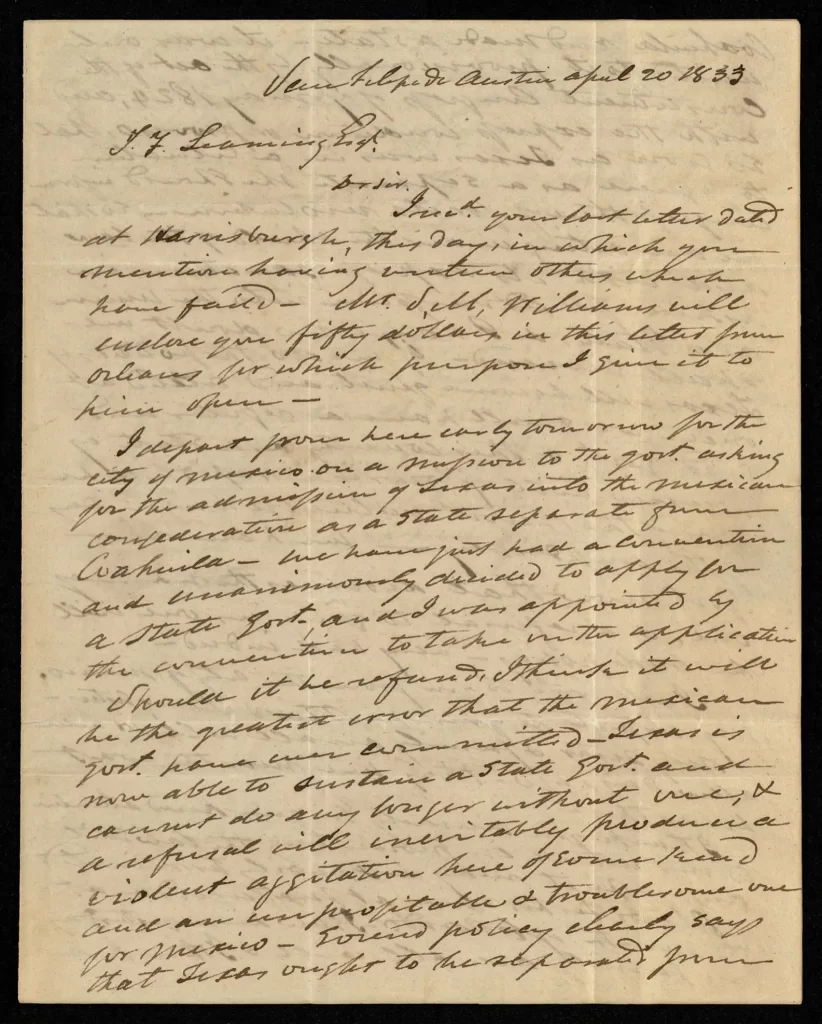
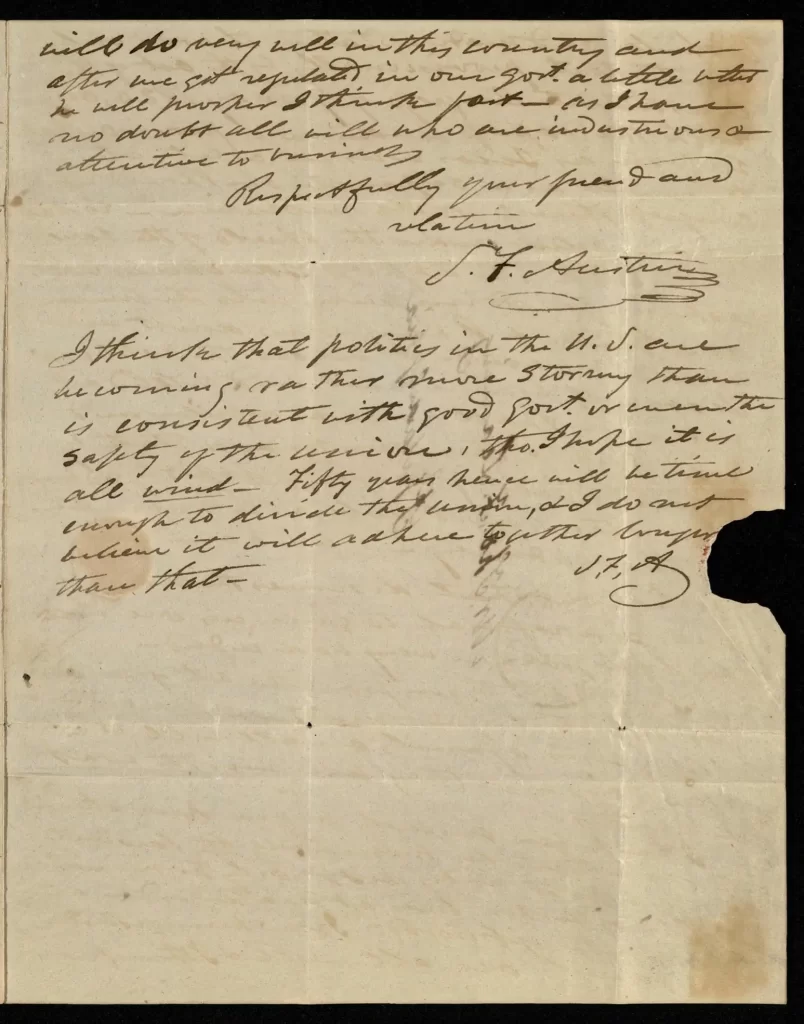
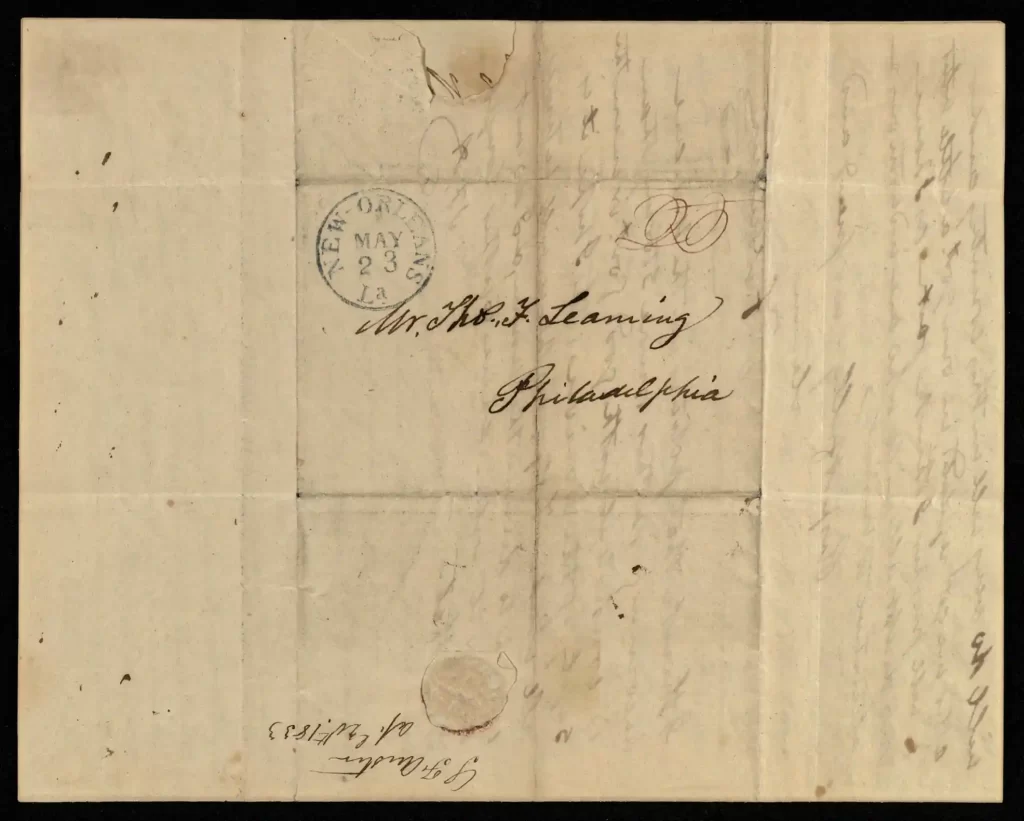
Stephen F. Austin Letter
San Felipe de Austin
April 20, 1833
T. J. Leming, Esqr.
Dear Sir:
I recd. your last letter dated at Harrisburgh, this day, in which you mention having written others which have failed. Mr. S. M. Williams will enclose your fifty dollars in this letter from Orleans for which purpose I give it to him open.
I depart from here early tomorrow for the City of Mexico on a mission to the govt. asking for admission of Texas into the Mexican confederation as a State separate from Coahuila. We have just had a convention and unanimously decided to apply for a State Govt. and I was appointed by the convention to take in the application.
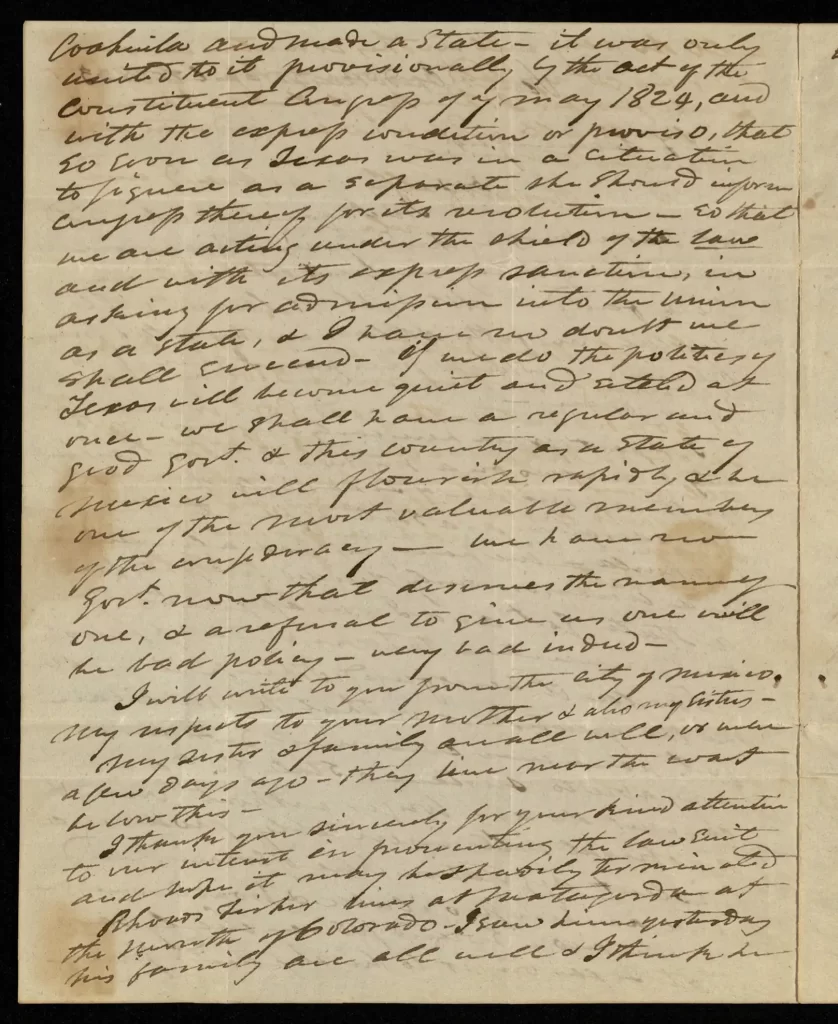
Should it be refused, I think it will be the greatest error that the Mexican Govt. have ever committed. Texas is now able to sustain a State Govt. and cannot do any longer without one, & a refusal will inevitably produce a violent aggitation (sic) here of some kind and an unprofitable & troublesome one for Mexico. Sound policy clearly says that Texas ought to be separated from Coahuila and made a State. It was only united to it provisionally by the act of the constituent Congress of 7 May 1824, and with the express condition or proviso, that so soon as Texas was in a situation to figure as a separate (state) she should inform Congress thereof for its resolution, so that we are acting under the shield of the law and with its express sanction, in asking for admission into the union as a state, & I have no doubt we shall succeed. If we do the politics of Texas will become quiet and settled at once. We shall have a regular and good Govt. & this country as a state of Mexico will flourish rapidly, & be one of the most valuable members of the confederacy. We have no Govt. now that deserves the name of one, & a refusal to give us one will be bad policy, very bad indeed.
I will write to you from the City of Mexico. My respects to your Mother & also my sisters.
My sister & family are all well, or were a few days ago. They live near the coast below this.
I thank you sincerely for your kind attention to our interest in prosecuting the law suit and hope it may be speedily terminated.
Rhoads Fisher lives at Matagorda at the mouth of Colorado. I saw him yesterday. His family are all well & I think he will do very well in this country and after we get regulated in our govt. a little better he will prosper I think fast, as I have no doubt all will who are industrious & attentive to business.
Respectfully your friend and
relative
S. F. AUSTIN
I think that politics in the U. S. are becoming rather more stormy than is consistent with good Govt. or even the safety of the union, tho, I hope it is all wind. Fifty years hence will be time enough to divide the union, & I do not believe it will adhere together longer than that.
S. F. A.
Thomas Leaming was a business associate and distant relative of Stephen Austin’s father, Moses. After the latter’s death, Leaming and Stephen developed a close business and personal relationship. He was one of several contacts in the United States whom Austin kept informed about developments within his colony, and within Mexico more broadly.
Leaming served as an agent for the Austin family, handling their affairs, including a lawsuit in New Jersey regarding land that once belonged to the family. He also played a role in promoting the Austin Colony to encourage further settlement.
This original letter is preserved in the Special Collections Repository of the University of Houston Libraries (1973-001, Box 1, Folder 88). The digital scan of the original letter was first made available online through the University of Houston Digital Collections.
This article is part of Texapedia’s curated primary source collection, which makes accessible both famous and forgotten historical records. Each source is presented with historical context and manuscript information. This collection is freely available for classroom use, research, and general public interest.