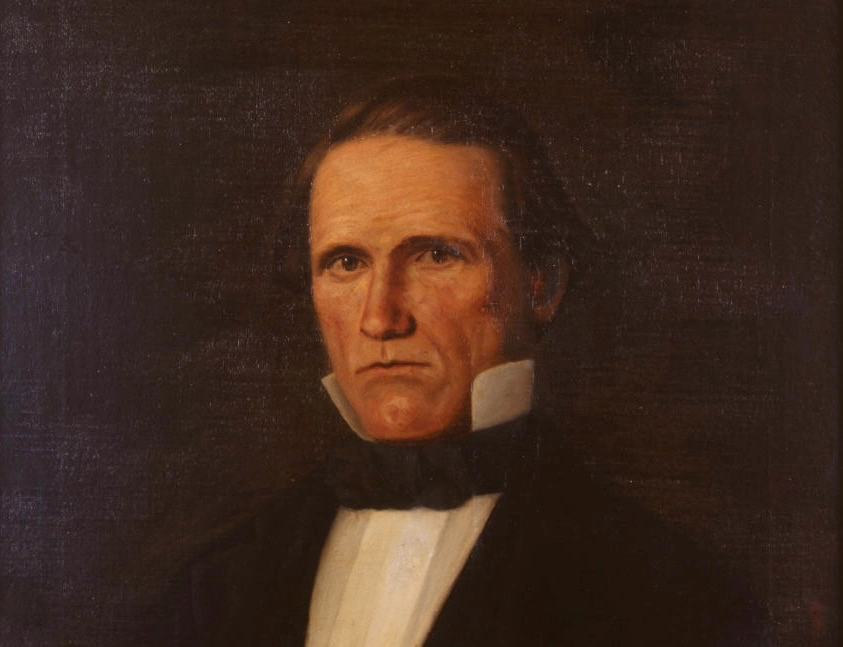
George Tyler Wood (March 12, 1795 – September 3, 1858) was an American soldier, planter, and politician who served as the second governor of Texas from 1847 to 1849. A participant in the Creek War and the Mexican–American War, Wood rose to statewide office during the early years of Texas statehood and presided over a government still in the process of institutional formation.
Early Life and Career
Wood was born near Cuthbert, Georgia, on March 12, 1795. His mother was Elizabeth Burris Wood, and his father died when he was a child. Much of his early life remains poorly documented due to the loss of records.
At the age of nineteen, Wood raised a company of volunteers to serve in the Creek War and participated in the Battle of Horseshoe Bend. According to later accounts, he met Sam Houston and Edward Burleson during the campaign.
After returning to Georgia, Wood established himself in the mercantile trade in Cuthbert. On September 18, 1837, he married Martha Evans Gindrat, a widow with three children. The couple had additional children together. Wood also served in the Georgia General Assembly from 1837 to 1838 and later studied law, gaining admission to the bar.
Migration to Texas and Republic Service
In 1839, Wood relocated with his family to the Republic of Texas, transporting his household and enslaved laborers by ship to the Texas coast before settling along the Trinity River near present-day Point Blank. There he developed a plantation and continued mercantile operations.
Wood entered public office in Texas in 1841, representing Liberty County in the Congress of the Republic of Texas. He also served as a delegate to the Convention of 1845, which drafted the state constitution in anticipation of annexation to the United States.
Following statehood, Wood was elected to the Texas Senate in 1846. During his legislative service, he sponsored a bill creating Tyler County. Both Woodville, the county seat, and Wood County were later named in his honor.
Mexican–American War Service
With the outbreak of the Mexican–American War, Wood resigned from the Senate and raised a company of mounted volunteers. He was commissioned colonel of the Second Texas Mounted Volunteers and served from July to October 1846, when the regiment was dissolved by order of General Zachary Taylor.
Wood participated in the Battle of Monterrey. During the campaign, he became involved in a dispute with Governor James Pinckney Henderson, who had taken leave from office to command Texas forces in the field. The disagreement over the conduct of operations became a matter of public attention.
Election as Governor
In 1847, Governor Henderson declined to seek another term, leaving an open race for the governorship. The contest initially included several candidates, but the death of Isaac Van Zandt shortly before the election reshaped the field. Much of Van Zandt’s support shifted to Wood, who went on to win the election.
Wood took office on December 21, 1847, as the second governor of the state of Texas.
Wood’s political rise was linked in part to his association with Sam Houston and other in the “Houston” faction of Texas politics, which emphasized a more cautious approach to expansion and favored strong relations with the U.S. federal government.
However, this association was only a loose one and Houston later became “lukewarm” toward the governor, contributing to his failure to win reelection in 1849, according to historian Randolph Campbell.
Governorship (1847–1849)
Wood’s administration took place during the early years of Texas statehood, when the structure of government and public institutions remained under development.
One of the principal issues facing the state was a large public debt inherited from the Republic of Texas. Wood proposed addressing the debt by selling public lands to the federal government, but the Texas Legislature declined to adopt this approach. Instead, it directed state officials to determine the precise amount of indebtedness before selecting a method of repayment.
Another major issue was the dispute over the western boundary of Texas. State officials asserted jurisdiction over parts of present-day New Mexico, while the federal government rejected these claims. In an effort to strengthen its position, the Texas Legislature created Santa Fe County and established a judicial district covering the area. When a Texas-appointed judge arrived in Santa Fe, he encountered United States troops already stationed there in support of federal authority.
Wood’s administration also addressed matters of internal governance, including the organization of counties and towns, the construction of public buildings, and the reform of governmental operations. During his term, steps were taken toward the establishment of a state library and a penitentiary. The legislature also enacted a reapportionment plan, which proved controversial among different regions of the state.
Frontier defense remained an ongoing concern, and requests were made to the federal government for the construction of forts to protect western settlements amid continuing conflicts with Native American tribes.
On February 21, 1848, Wood presided over the first state Democratic convention, marking an early stage in the formal organization of party politics in Texas.
Election of 1849
Wood sought reelection in 1849 but was defeated in a three-way race by Peter H. Bell, another military veteran and expansionist, who advocated for pro-slavery interests. Bell received 10,319 votes (47.5 percent), while Wood received 8,764 votes (40.4 percent). A third candidate, John T. Mills, received 2,632 votes (12.1 percent).
Though Wood himself was a planter and slave owner, his rival Peter Bell had earned a reputation as the stronger “pro-Southern” candidate and a more decorated soldier.
Wood’s defeat in the 1849 election to Bell, an aggressive soldier-governor, prefigured Sam Houston’s own final electoral contests of 1857 and 1859, in which Houston faced off twice against the arch-secessionist and pro-slavery politician Harden Runnels.
Later Life and Death
After leaving office, Wood returned to his plantation near Point Blank along the Trinity River, where he resumed agricultural and business activities. In addition to managing his plantation, he maintained mercantile interests, including operations in Galveston. He later made unsuccessful campaigns for the governorship in 1853 and 1855.
During this period, his wife, Martha Evans Wood, managed aspects of the household economy and was noted for raising silkworms and producing silk cloth, reflecting the self-sufficient practices common among some planter families in early Texas.
Wood died at his home on September 3, 1858, at the age of sixty-three. He was buried near his residence along the Trinity River.
Historical Notes
Some disagreement has existed regarding Wood’s middle name. While most contemporary and modern sources identify him as George Tyler Wood, some early twentieth-century accounts referred to him as George Thomas Wood. A monument erected at his gravesite in 1911 bears the name George Tyler Wood.