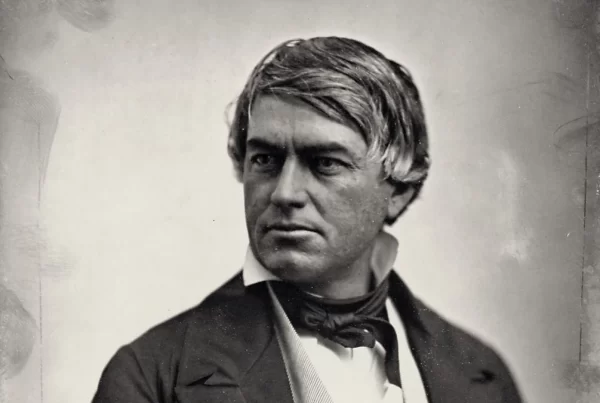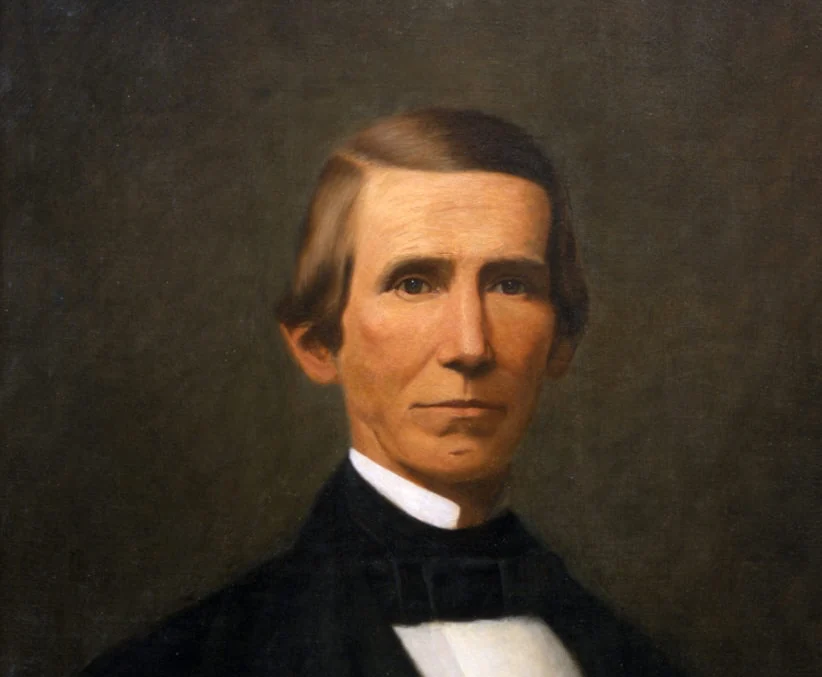
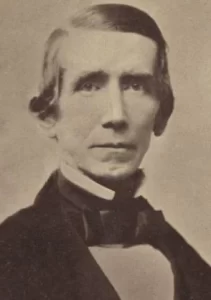
James Pinckney Henderson (1808–1858) served as the first Governor of Texas following its annexation to the United States in 1845. Prior to statehood, he held major posts in the Republic of Texas government, including attorney general, secretary of state, and minister to Europe.
A veteran of the Texas Revolution and later the Mexican-American War, Henderson played a central role in securing diplomatic recognition of the Republic abroad and helped guide Texas through its transition from an independent nation to a U.S. state. Though his term as governor was brief, his influence on the legal, diplomatic, and military development of early Texas was substantial.
Early Life and Move to Texas
Henderson was born on March 31, 1808, in Lincoln County, North Carolina. He studied law at the University of North Carolina and was admitted to the bar in his early twenties. In the early 1830s, he moved to Mississippi, where he practiced law and gained experience in the commercial and legal culture of the Old Southwest.
Drawn by the political upheaval in Mexican Texas and the opportunity to participate in a new republic, Henderson arrived in Texas in 1836, shortly after the Battle of San Jacinto. He was active in recruiting volunteers and acquiring supplies in support of the Texas Revolution. Though he did not participate in combat, his organizational contributions earned him recognition from provisional leaders.
Shortly after the Republic of Texas declared independence, President Sam Houston appointed Henderson as the new republic’s first attorney general. In that role, he helped establish basic prosecutorial standards, advised on statutory interpretations, and contributed to the early legal structure of the fledgling nation. Henderson soon developed a reputation as a capable legal administrator and political moderate.
Diplomatic Service in Europe
In 1837, President Mirabeau Lamar appointed Henderson as minister plenipotentiary to Great Britain and France—a major diplomatic assignment aimed at securing formal recognition of the Republic of Texas and promoting commercial treaties with European powers. Henderson spent more than a year abroad on this mission, which proved one of the most successful foreign efforts undertaken by the Republic.
In 1839, Henderson successfully negotiated a treaty with France, signed in Paris, which formally recognized the independence of the Republic of Texas. This treaty established diplomatic and economic relations between the two countries and allowed for the appointment of ambassadors and consuls. Although relations with France remained limited in practice, the treaty gave Texas a measure of international legitimacy and demonstrated that it was capable of acting as a sovereign power.
Henderson also met with officials in Great Britain, where the government offered informal recognition and initiated trade relations, though without a formal treaty like the one negotiated with France. British interest in Texas was driven in part by strategic and economic concerns, including the desire to counter U.S. influence in North America and to maintain access to Southern cotton markets.
During his time in Europe, Henderson also explored potential immigration initiatives and trade concessions but remained focused on the core goals of recognition and commerce. His successful diplomacy elevated his standing back home and positioned him for future leadership.
Return to Texas and Role in Annexation
Henderson returned to Texas in the early 1840s and resumed his legal practice in San Augustine, a leading commercial center in East Texas. While initially aligned with President Lamar’s vision of an independent Texas with European alliances, Henderson’s views evolved as economic pressures and military vulnerability made continued independence increasingly untenable. By 1844, he had become a leading proponent of annexation.
That same year, President Sam Houston appointed Henderson as a special envoy to Washington, D.C., alongside Isaac Van Zandt, to negotiate the terms under which Texas might enter the Union. Henderson and Van Zandt worked closely with U.S. Secretary of State John C. Calhoun to draft an annexation treaty. Although the initial treaty was rejected by the U.S. Senate, Henderson’s diplomatic efforts laid the groundwork for a renewed legislative approach that ultimately succeeded.
Following the election of President James Polk, Congress passed a joint resolution in early 1845 offering Texas admission as a state. After Texas voters approved annexation and a new state constitution later that year, Henderson ran unopposed in the first gubernatorial election. He took office on February 19, 1846, the day that sovereignty officially transferred from the Republic of Texas to the United States.
Governorship and Military Service
As governor, Henderson presided over the organization of state institutions, the transition of existing Republic offices into state agencies, and the selection of representatives to Congress. He clashed occasionally with the legislature. For instance, the Senate declined to confirm his first appointee:
“Governor Henderson had submitted the name of Volney E. Howard for attorney general, a post he wanted filled at once. Howard, then a member of the House of Representatives, had resigned his seat in expectation of assuming the new position. Howard, who had a history of brash confrontations, having fought duels with two successive governors of Mississippi, may have been personally unpopular, but in any event, a bare majority, eleven to ten, thought his action unconstitutional. Governor Henderson, suitably chastened, dropped the matter for a while and then submitted the name of [another candidate].”1
Henderson’s pick for attorney general perhaps says something about his own character. Despite his diplomatic service, he had an aggressive, confrontational streak and he may have even admired Howard for his dueling and brashness.
Henderson’s term was quickly overtaken by military concerns. The annexation of Texas had reignited tensions with Mexico, particularly over the disputed territory between the Nueces River and the Rio Grande. When hostilities broke out, the United States declared war on Mexico in May 1846. Henderson, a lifelong volunteer and advocate for the militia system, requested a leave of absence from the governorship in order to command a Texas volunteer division in the war. The Texas Legislature approved the request, and Lieutenant Governor Albert Clinton Horton served as acting governor during Henderson’s absence.
Henderson received a commission as a major-general in the U.S. Army under General Zachary Taylor, where he led a brigade of Texan volunteers in the northern Mexico campaign. After the Battle of Monterrey in September 1846, Henderson was appointed a commissioner to negotiate the surrender terms of Mexican troops. Later that year, he resigned his commission, having spent about six months in Mexico.
Upon his return to Texas, Henderson completed the remainder of his term but did not seek re-election in 1847, owing to ill health and exhaustion from the Mexican War. Henderson’s administration was notable for its orderly transition to statehood, expansion of the judiciary, and preliminary efforts to integrate Texas into the federal postal and revenue systems.
Historian Ralph A. Wooster, who taught history at Lamar University for more than 50 years, offered a generally positive assessment of Henderson’s governorship, writing,
“As he retired to his private law practice, the ex-governor could feel at least that a beginning in state government had been made. In his farewell message to the legislature he congratulated its members ‘upon the prosperous and happy condition of our country.’ The process of annexation had been completed, the Rio Grande as the southern boundary had been assured, frontier settlements had been advanced, state political offices had been filled and were functioning, and some steps had been taken toward party organization. Admittedly, many problems remained, paramount of which were the public debt and the New Mexican boundary dispute… But these were challenges that others would faces. Henderson’s role in state government had ended.”2
Views on Race and Slavery
Henderson was a slaveholder and a vocal defender of the practice of race-based slavery in the American South. During his diplomatic missions to Europe in the late 1830s, Henderson defended both the legality and morality of slavery in Texas when pressed by French and British officials, who had abolished the practice in their own empires. Despite these ideological differences, he succeeded in securing diplomatic recognition of the Republic of Texas from both powers.
In his 1847 State of the State Address to the Legislature—delivered during the Mexican-American War—Henderson advocated for extending slavery into territories recently conquered from Mexico, such as New Mexico and California.3 He sharply criticized Northern opposition to the spread of slavery into these areas, declaring: “Adopt their views, and no citizen of the South who is a slaveholder would be permitted to emigrate to any part of such acquired territory, without parting with that portion of his property which we generally regard as most valuable.”
Henderson argued that Texas would be “joint owners with the other States” of any newly acquired territory. At the time, the question of admitting new states loomed large in the national slavery debate, since each new state meant two additional senators. Whether those states permitted slavery would shift the balance of power in Congress. Rising tensions over the status of the western territories would later contribute to the outbreak of the Civil War in 1861.
Henderson closed his 1847 address with a defiant warning against Northern interference in Southern affairs. He stated:
“The people of Texas cannot be justly accused of being wanting in attachment to the Union. They have shown their attachment and devotion to it by voluntarily entering it. The South has not sought nor did they wish this dispute. It is the result of an unjust disposition on the part of some of the Northern States, to intermeddle with the rights and institutions of the South. Those Northern people are the aggressors, and it is our duty to join with the other States of the South, in resisting their efforts with manly firmness. When has any portion of the South presumed to dictate a change in any policy of any Northern State, or meddle with their laws or institutions?”
“If our Legislators commit political errors, they are only responsible to their constituents—if we sin by adopting any policy or law, we are responsible for the sin to God alone. The people of the North are neither our guardians, confessors, or our conscience keepers. In concluding upon this subject, I will repeat that the South has not sought or commenced this contest; but if the North will force it upon us, we will meet it with hearts prepared for its very worst dangers, confiding in the justness of our cause, and our ability to maintain our rights.”
This speech illustrates Henderson’s close alignment with Texas’s planter elite, their pro-slavery worldview, and their rejection of abolitionist moral critiques. Yet the menacing rhetoric and proto-secessionist tone of his 1847 address—delivered just two years after statehood—were unusually forceful for the time. His framing of the dispute as both a divine matter and a regional showdown foreshadowed the escalating sectional crisis that would soon engulf the nation.
U.S. Senate and Final Years
Following the end of his gubernatorial term in 1847, Henderson returned to San Augustine and resumed his legal practice, remaining active in East Texas political and business circles. Though he held no formal office during this period, he was frequently consulted by Democratic leaders and continued to build wealth through land speculation and legal work.
In 1857, the Texas Legislature appointed Henderson to the United States Senate to complete the unexpired term of Thomas J. Rusk, who had resigned. He entered the Senate amid mounting national tension over slavery, particularly debates over whether it should be permitted in newly acquired western territories. During his brief tenure, Henderson aligned with the Democratic majority and supported the principle of popular sovereignty—the idea that settlers in each territory should decide the slavery question for themselves.
Henderson also expressed concern over federal economic policy, including tariffs and internal improvements, siding with Southern Democrats who opposed increased federal spending and centralized banking authority. Though he served only a year, Henderson’s votes reflected a consistent defense of states’ rights and a limited federal role in shaping regional economies.
He did not seek election to a full term and voluntarily left the Senate in December 1858. Returning to his home in East Texas, Henderson resumed his legal practice and attended to business affairs, including land and real estate interests. His health soon declined, and he died on June 4, 1858, at the age of 50. He was buried in Oakwood Cemetery in Austin.
Sources Cited
- Patsy McDonald Spaw, ed., The Texas Senate Volume I: Republic to Civil War, 1836–1861 (College Station: Texas A&M University Press, 1990), 181 ↩︎
- Ralph A. Wooster, “Early Texas Politics: The Henderson Administration,” The Southwestern Historical Quarterly 73, no. 2 (October 1969), 192. ↩︎
- Journals of the Texas House of Representatives, Second Legislature, printed at the Telegraph Office, Houston, 26-28. ↩︎
📚 Curated Texas History Books
Dive deeper into this topic by purchasing any of these handpicked titles:
- Shifting Grounds: Nationalism and the American South, 1848-1865
- The Texas Republic: A Social and Economic History
- Wars of the Mexican Gulf: The Breakaway Republics of Texas and Yucatan, US-Mexican War, and Limits of Empire 1835-1850
- Storm over Texas: The Annexation Controversy and the Road to Civil War
- The Texas Lowcountry: Slavery and Freedom on the Gulf Coast, 1822–1895
- Adding the Lone Star: John Tyler, Sam Houston, and the Annexation of Texas
As an Amazon Associate, Texapedia earns a commission from qualifying purchases. Earnings are used to support the ongoing work of maintaining and growing this encyclopedia.