From 1865 to 1900, Texas was gripped by violence as outlaws, rustlers, and fugitives clashed with sheriffs, settlers, and the Texas Rangers across a frontier defined by fragile law and rough justice. In towns where courts were distant and jails insecure, communities turned to vigilance committees, posses, and the occasional mob to enforce their own brand of order.
A Postwar Frontier on the Edge of Law
The end of the Civil War brought dramatic upheaval to Texas. Confederate defeat and the collapse of the pre-war political order left vast stretches of the state in institutional disarray. Thousands of men returned from battle to find unclear property rights, unresolved debts, and new political hierarchies. In rural counties, elected law officers were absent, courts were backlogged, and the U.S. Army held tenuous authority during Reconstruction.
The result was a tenuous balance between formal law and informal control. Where sheriffs and constables were too few—or too cautious—residents often took matters into their own hands. Criminals and vigilantes alike flourished in this vacuum, leaving Texas with a reputation for lawlessness that would echo for generations.
The Landscape of Crime, 1865–1900
The most common frontier crimes were practical and violent: cattle rustling, horse theft, murder, and armed robbery. The explosive growth of the cattle trade in the 1870s made livestock a prime target, and rustling became a persistent plague in many counties. Stagecoach holdups, bank robberies, and train heists also became more frequent, particularly in Central and North Texas.
Some crimes were personal. Feuds between families or political factions sometimes escalated into years-long vendettas involving dozens of killings. Elsewhere, disputes over land, debt, or local elections turned deadly. In a society where firearms were common and retribution was culturally accepted, violence often begot violence.
Famous Outlaws of Texas
Some outlaws in 19th-century Texas became infamous for their violence, others for their evasion of lawmen. Most met brutal ends.
Sam Bass (1851–1878): Train and Stagecoach Robber
Sam Bass worked for years as a ranch hand around Denton before joining cattleman Joel Collins on an 1876 drive north — a venture that ended with the pair keeping the proceeds and turning to robbery. In 1877, their gang held up a Union Pacific train at Big Springs, Nebraska, taking over $60,000 in gold coin, the largest robbery in that railroad’s history. Collins was killed by soldiers in Kansas weeks later, but Bass returned to Texas, where he and a new gang robbed stagecoaches and four trains in the Dallas area within a matter of months. Despite efforts to maintain a courteous public persona, Bass’s actions triggered a statewide manhunt.

He was betrayed by gang member Jim Murphy, who informed on him to spare his own family from prosecution, and ambushed in Round Rock in July 1878 while scouting the town’s bank for what would have been his first bank robbery. In a shootout with Texas Rangers and local lawmen, Bass was mortally wounded and died two days later, on his 27th birthday.
His brief criminal career became one of the most publicized of the era, illustrating the growing effectiveness of coordinated law enforcement.
John Wesley Hardin (1853–1895): Texas’s Deadliest Gunman
Born in Bonham, Texas, in 1853, John Wesley Hardin killed his first man at age fifteen, a freedman named Maje, after the man had beaten the teenager in a wrestling match. He then ambushed the soldiers sent to arrest him. Over the next decade he was involved in dozens of shootings; he claimed more than forty killings, and historians credit him with at least twenty.
Unlike many outlaws of the era, Hardin was not a thief or robber; his violence was largely personal or political, often driven by racial animosity, perceived slights, or a refusal to submit to authority. His reputation as a volatile and dangerous gunman spread across East and Central Texas, where he routinely eluded lawmen. He also fought on the Taylor side of the Sutton–Taylor Feud (see below), killing several Sutton partisans and lawmen.
Captured in Florida in 1877 by Texas Rangers, Hardin was convicted of murdering a deputy sheriff and sentenced to 25 years. He served 17, studied law while imprisoned, and was pardoned in 1894. Upon release, he was admitted to the bar and moved to El Paso to practice law.
In 1895, Hardin was shot in the back of the head at the Acme Saloon by Constable John Selman, reportedly in retaliation for a personal dispute. Hardin’s violent life and abrupt death underscored the thin line between outlaw and officer in postwar Texas—where personal grudges, local politics, and informal justice often trumped legal order.
Cullen Baker (1835–1869): The Red River Marauder
Cullen Baker’s postwar crime spree in East Texas and Arkansas was marked by brutality, particularly toward Union sympathizers and freedmen. Sometimes described as a Confederate partisan, he transitioned into outright lawlessness, leading a gang that terrorized civilians and law officers alike.
His career of violence ended in 1869 under murky circumstances—either poisoned at his in-laws’ house or ambushed by local men seeking justice. His body was paraded through the streets of Jefferson, Texas, as a warning to others.
Bill Longley (1851–1878): Reconstruction Gunman
William Preston “Bill” Longley of Austin County began killing during Reconstruction, targeting freedmen and federal authority with a reputation for sudden, unprovoked violence. In 1875, an uncle implored him to avenge the death of his son, and Longley obliged, shotgunning the suspected killer, Wilson Anderson, as Anderson plowed a field. The next year, jailed in Delta County over a dispute about a girl, Longley burned his way out and murdered the Reverend William R. Lay, the farmer he had been sharecropping for, as Lay milked a cow.
Captured in Louisiana in 1877, Longley was returned to Lee County and tried for Anderson’s murder. From jail he boasted in letters to a newspaper of thirty-two killings; on the eve of his hanging, he put the count at eight. He was executed at Giddings on October 11, 1878, before a crowd of thousands.
Ben Thompson (1843–1884): Gunfighter Turned Marshal
A professional gambler and deadly shot, Ben Thompson fought for the Confederacy, spent time in prison, and later served as City Marshal of Austin—a rare transition from outlaw to lawman. While in office, he maintained a strict order, but remained involved in personal vendettas and gambling feuds.
In 1884, he was ambushed and killed in San Antonio in a retaliatory attack by men linked to a theater shooting from two years earlier. Thompson’s life illustrates the fluid boundary between criminality and authority in Texas’s urbanizing towns.
Jim Miller (1866–1909): The Smiling Assassin
“Deacon Jim” Miller was a professional assassin who dressed and lived like a churchman — a devout Methodist in a black frock coat who neither drank, smoked, nor swore, and killed for hire. His early career included a murder conviction overturned on appeal and a feud with a Pecos sheriff, Bud Frazer, who shot Miller repeatedly only to discover he wore a steel plate beneath his coat; Miller finished the feud with a shotgun in 1896.
Through his marriage he was kin to the Clements family, relatives of John Wesley Hardin. Over the following years he was linked to a string of killings across Texas and New Mexico, and is widely believed to have fired the shot that killed former lawman Pat Garrett — famous as the sheriff who slew Billy the Kid — in 1908.
Miller’s end came the next year at Ada, Oklahoma, where he had been hired to kill Gus Bobbitt, a rancher and former deputy U.S. marshal. Arrested with the three men who paid him, Miller was awaiting trial when a mob stormed the jail and hanged all four in a livery stable — a lynching whose photograph became one of the era’s most notorious images.
The Taylor Family (Sutton–Taylor Feud, 1868–1876)
The Taylors were central to the long-running Sutton–Taylor Feud in DeWitt County, a deadly conflict over cattle, law enforcement, and pride. At its height, both sides were aligned with factions of local law—blurring the line between outlaws and officials.
Members of the Taylor family were involved in ambushes, assassinations, and public shootouts. The feud finally ended after Texas Rangers intervened and several leaders were killed or driven out. The Taylors, unlike more mobile bandits, illustrate how criminality could become embedded in community structures.
The Horrell Brothers (1870s): The Lampasas Trouble
Five brothers from Lampasas County, the Horrells first gained notoriety in 1873, when they shot four Reconstruction State Police officers in a Lampasas saloon. Fleeing to Lincoln County, New Mexico, they waged a brief race war against Hispanic residents before returning to Texas, where the Horrell–Higgins Feud with rancher Pink Higgins brought killings on both sides through 1877.
Several Horrells were eventually killed in shootouts or executed by vigilantes. Their story reflects both the ethnic tensions of the era and the volatility of local justice, where family alliances and vendettas often overruled formal process.
Gregorio Cortez (1875–1916): Folk Hero
More often remembered in Chicano and borderlands history, Gregorio Cortez became famous after a deadly misunderstanding in 1901. Questioned about a horse trade, Cortez was misunderstood by an interpreter who confused the Spanish words for “horse” and “mare”; in the confrontation that followed, Karnes County sheriff W. T. Morris shot Cortez’s unarmed brother, and Cortez shot Morris. He then evaded hundreds of pursuers on horseback across South Texas in a ten-day, multi-county manhunt.

Captured and imprisoned, Cortez drew widespread attention among Mexican Americans, who raised funds for his defense and celebrated him in “El Corrido de Gregorio Cortez,” one of the most famous of all border ballads. Governor Oscar Colquitt pardoned him in 1913. His story sits at the edge of the Wild West timeline, marking a shift toward politicized crime narratives in Texas.
The Wild Bunch (1890s-1900s): Last of the Train Robbers
While most of the Wild West’s outlawry had faded by the turn of the century, remnants of organized banditry persisted into the early 1900s. Among the most notorious was the Wild Bunch, a loosely affiliated group led by Butch Cassidy and Harry Longabaugh, better known as ‘the Sundance Kid.’

Though most of their activity took place in the Rocky Mountain states, members of the gang occasionally operated or passed through Texas. Their robberies were notable not only for their daring, but for their coordination and use of modern tools—telegraphs, trains, and updated firearms. Cassidy and Longabaugh famously evaded capture for years, with reports of their movements stretching from the Dakotas to the borderlands of Texas.
Before fleeing to South America, gang members posed for a formal group portrait at a Fort Worth photography studio in 1900 — the famous “Fort Worth Five” photograph, which the Pinkerton Detective Agency obtained and reproduced on wanted posters. Cassidy and Longabaugh were killed in a shootout in Bolivia in 1908. Another member of the gang, Ben Kilpatrick, served a prison sentence and returned to crime afterwards. A native of Texas, Kilpatrick was killed by a railroad employee with an ice mallet during a train robbery in Sanderson, Texas in 1912.
Lawmen on the Frontier
In addition to these infamous outlaws, countless lesser-known rustlers, robbers, feuding neighbors, and hired guns shaped the day-to-day realities of 19th century Texas. Some operated alone, others moved in gangs, and many vanished into obscurity after a single violent act. Their stories rarely made headlines, or the history books. But they fueled the rise of law enforcement institutions across the frontier.
Formal law enforcement in Texas during this period was a patchwork of local sheriffs, constables, and the Texas Rangers. Sheriffs were elected by county voters and carried broad responsibilities: arresting suspects, serving warrants, leading posses, and maintaining jails. In remote areas, constables or even deputized civilians filled these roles. With limited personnel and budgets, many relied on community backing—or looked the other way.
The Texas Rangers, reorganized in 1874, formed the backbone of frontier enforcement. The new Frontier Battalion and Special Force units operated as paramilitary squads tasked with suppressing banditry, tracking fugitives, and pacifying hostile regions. Under figures like Leander H. McNelly, they achieved notoriety for bold tactics and extrajudicial actions. Though often praised for results, Rangers were also criticized for brutal interrogations, racially motivated violence, and their tendency to operate above the law.
Rangers and sheriffs occasionally clashed over jurisdiction or tactics. In some areas, local politics shaped who enforced the law—and how far they were willing to go.
Vigilantes and Rough Justice
When law enforcement failed or appeared compromised, communities sometimes turned to vigilante groups. These “committees of safety” or “regulators” aimed to enforce order through threat, violence, and spectacle. Their targets were accused rustlers, murderers, arsonists—or anyone seen as disruptive.
The town of Fort Griffin witnessed a wave of vigilante hangings in the late 1870s, as residents responded to cattle theft with frontier gallows. In Mason County, a German-led vigilance committee executed suspected rustlers during the Hoodoo War of 1875–76, leading to retaliatory killings and further breakdown of local order.
While some vigilantes operated under a veneer of due process—holding mock trials or public votes—others acted secretly and swiftly. Accused men were dragged from jails or intercepted on the road, lynched beneath oak trees, and left as warnings.
Although most vigilante actions during this period involved theft or local feuds, racial violence was an ever-present feature of frontier justice. During the Reconstruction and Jim Crow eras, Black Texans were disproportionately targeted by lynch mobs, often without credible evidence or trial. However, most anti-Black violence in Texas took place farther from the frontier, in the eastern and coastal regions, which had the largest Black populations.
In South and West Texas, Mexican Americans were likewise vulnerable to extrajudicial violence, particularly in land disputes or when accused of cattle theft.
Courts and the Rule of Law
The evolution of Texas’s court system between 1865 and 1900 marked a slow but significant shift toward formal justice. After the Civil War, Texas courts faced deep dysfunction. Many counties lacked full slates of officials; records had been destroyed, and laws rewritten under federal oversight. During Reconstruction, military governors appointed judges in many districts, undermining legitimacy in the eyes of locals.
But by the late 1870s, Texas began to rebuild its judicial institutions. The 1879 Penal Code and Code of Criminal Procedure standardized definitions of crimes, rules for evidence, and trial procedures. County and district courts expanded their jurisdictions, and appeals processes were formalized. By the 1890s, a growing caseload prompted the creation of intermediate courts of appeals to relieve the overburdened state Supreme Court.
Local justice remained uneven. Sheriffs and justices of the peace held wide discretion, especially in rural counties. Trials could be swift or indefinitely delayed. Some communities lacked court buildings altogether, using churches or saloons for proceedings. Yet the increasing frequency of legal executions and prison sentences signaled a move away from vigilante justice and toward institutional punishment.
The End of the Frontier
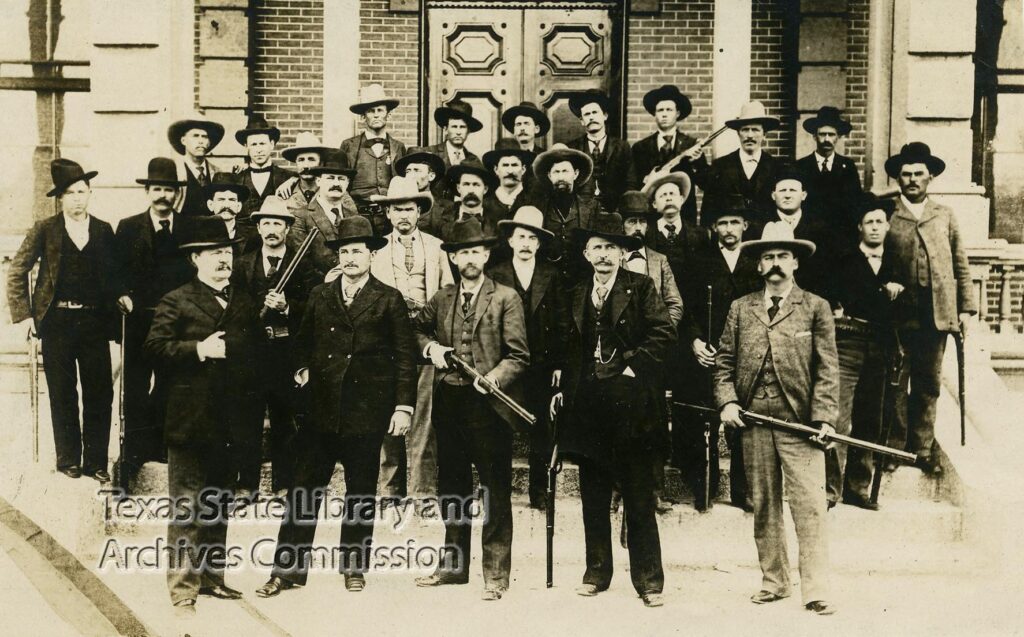
By 1900, Texas was no longer a frontier in the classic sense. Railroads connected distant towns. Oil discoveries shifted the state’s economy from cattle to industry. The law reached more firmly into rural areas, and law enforcement agencies began to professionalize. The Texas Rangers themselves transitioned from a frontier force to a more bureaucratic body—particularly after the legislature’s Canales Investigation of 1919, which exposed abuses committed against Mexican-American communities in the Rio Grande Valley in the 1910s.
The era of the outlaw did not end overnight. But the conditions that had sustained it—vast lawless terrain, weak institutions, and cultural acceptance of violence—began to fade. Juries grew more assertive. Governors granted fewer pardons. And communities, increasingly tied to state and national systems, grew more willing to entrust justice to the courts.
The legends of this era remain deeply embedded in popular imagination. The ‘Wild West’ inspired countless novels, corridos, and films, which romanticized the era while also raising real questions about power, justice, and the responsibility of individuals when faced with lawlessness and injustice. The Wild West era may be over, but its influence on Texan identity, law enforcement culture, and public memory endures to this day.