William P. Clements Jr., a wealthy oil executive turned political outsider, became the first Republican governor of Texas since Reconstruction, serving two nonconsecutive terms from 1979 to 1983 and again from 1987 to 1991. His election marked a turning point in the state’s political realignment, foreshadowing the Republican dominance that would emerge in the decades to follow.
Clements blended business pragmatism with law-and-order conservatism, helping to redefine the image of a Texas governor and shifting the state’s political center of gravity.
From Oilman to the Pentagon
Born in Dallas in 1917, Clements studied at UT-Austin and Southern Methodist University, but dropped out because of financial hardships during the Great Depression. Beginning as a roughneck in the South Texas oilfields, he worked for about a decade in the industry before buying two used rigs and establishing his own drilling company, SEDCO.
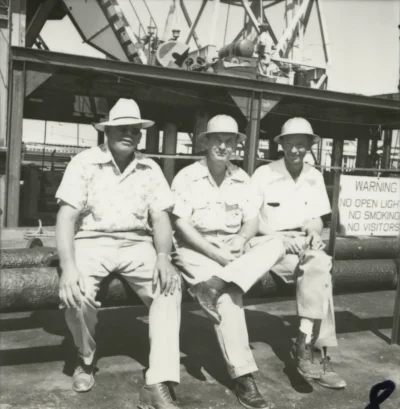
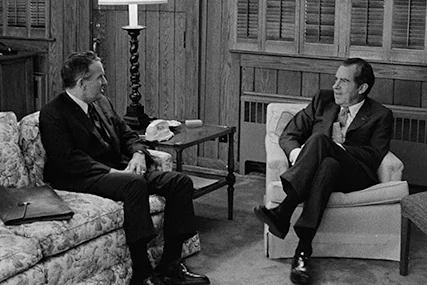
This made him a multimillionaire by the early 1970s, and an influential donor in Republican politics in Texas, at a time when the party was still in the minority. Clements raised money for George Bush’s losing 1964 Senate bid, and then for Richard Nixon’s 1968 presidential campaign. By 1972, he had become a bona fide power broker in the Texas Republican Party, serving as Nixon’s Texas co-chair that year — which is what led directly to his appointment and confirmation as Deputy Defense Secretary in January 1973.
Though lacking a military or foreign policy background, Clements, age 55, was already a seasoned executive at the time of his appointment. He served as the chief management officer of the department, overseeing an enormous budget, complex procurement processes, and three million employees.
Clements later called his time at the Pentagon “the most fulfilling years of my life.” His tenure (1973-1977) coincided with Nixon’s efforts to extract the U.S. from Vietnam, the Watergate scandal, the Yom Kippur War, and a series of arms control talks with the Soviet Union, during a period of Cold War détente. He served under two presidents and three secretaries of defense, and at times served as acting secretary of defense.
Clements helped guide the transition from a wartime military posture, which involved base closures and a transition to an all-volunteer military (rather than a conscripted force). He opposed the admittance of women to West Point and the other academies.1
1978 Run for Governor
By 1978, the Democratic Party’s grip on Texas was loosening. The Sharpstown scandal of the early 1970s had badly damaged the party’s image, implicating a raft of prominent Democratic officeholders in a bribery scheme and fueling a wave of public cynicism about Democratic machine politics in Austin. The party brand had never fully recovered.
Compounding this, Texas Democrats were increasingly split between a conservative rural base and a growing liberal urban wing, a fault line that made unified campaigns difficult and handed openings to ambitious outsiders. At the national level, the Carter administration’s struggles with inflation, energy prices, and a perception of weakness abroad had dampened enthusiasm for Democratic candidates across the South.
Against this backdrop of Democratic disarray, Clements presented a strikingly different image. Though never elected to office before, Clements’ had cultivated a reputation for managerial efficiency and national security hawkishness—credentials that appealed to a growing base of conservative Texans frustrated with Democratic rule.
Clements ran a well-financed campaign against Democrat John Hill, the sitting attorney general, and narrowly won the general election. He benefited from divisions within the Democratic Party and growing public unease over crime, school discipline, and liberal social policies. His victory broke a 104-year streak of Democratic governors, sending shockwaves through the state’s political establishment.
A Businessman’s Approach to Government
According to biographer Carolyn Barta, a veteran Texas political writer who teaches journalism at Southern Methodist University, Clements had the ability “to project with certitude what he thought. That proved to be both his strength and his albatross. But as former President George H.W. Bush told me almost two decades ago, ‘When you come in as the first Republican governor since Reconstruction, you’ve got to break a little china; you’ve got to call ’em as you see ‘em.’”2
Clements brought a corporate, hierarchical style to state government. He emphasized budget discipline, accountability, and tough-on-crime policies. During his first term, he pushed for increased prison construction, teacher competency testing, and restrictions on state spending. His administration also streamlined agency operations and sought to limit the power of public-sector unions and state regulatory boards.
Although popular among conservatives, Clements sometimes clashed with the Democrat-controlled legislature, leading to gridlock on certain policy fronts. He also made political appointments that prioritized ideological loyalty, contributing to a perception of partisanship that alienated some moderate voters. In 1982, he lost his bid for reelection to Democrat Mark White, amid dissatisfaction with the economy and growing concern over the state’s education system.
Return to Office and Education Reform
Clements made a political comeback in 1986, defeating Mark White in a rematch. By then, the winds of party realignment were blowing more strongly in his favor. His second term coincided with the early stages of Texas’s shift toward a Republican identity at both the state and national level.
Clements presided over an ambitious education reform package passed during a 1984 special session—known as House Bill 72—which included standardized testing, a controversial “no-pass, no-play” rule for student athletes, and performance-based teacher pay. Though largely initiated under White, Clements continued and defended these reforms, framing them as essential for workforce development and global competitiveness.
His second term was overshadowed by the unfolding SMU football scandal, in which Clements—then a university board member—was implicated in a scheme to continue paying players despite NCAA sanctions. Although the payments predated his second governorship, the revelations damaged his reputation and contributed to a perception of ethical compromise.
Legacy and Political Impact
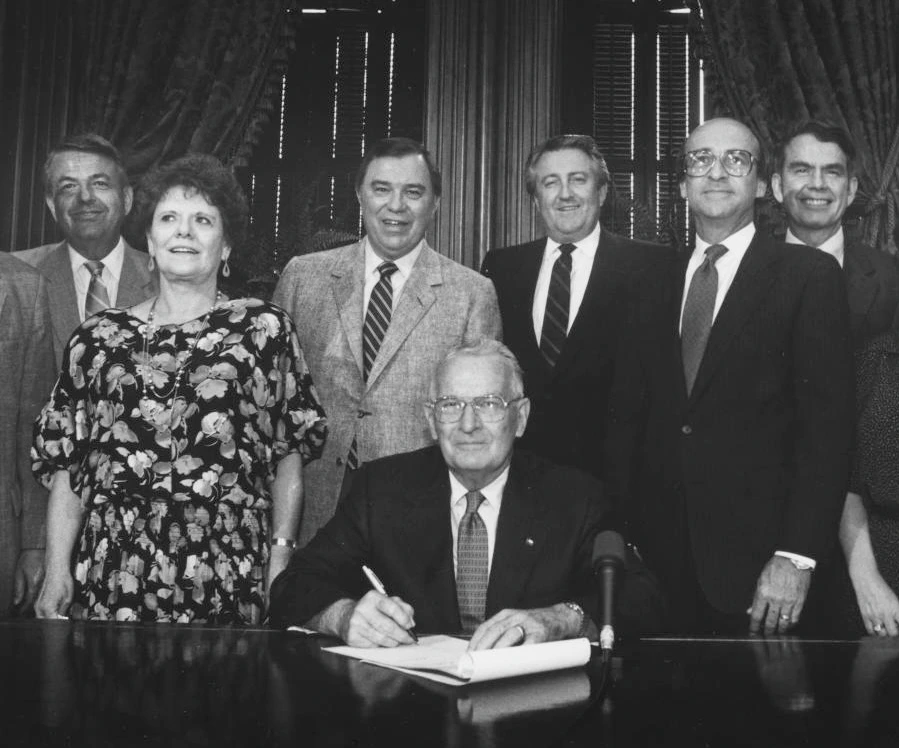
Clements left office in 1991 and did not seek further political roles, but the imprint of his career was unmistakable. His victories proved that Republicans could win statewide races in Texas, and his style—blunt, corporate, and ideologically consistent—helped shape the archetype of a Texas GOP executive. He opened the door for a generation of Republican leaders, including George W. Bush and Rick Perry, and inspired conservative donors and operatives to build long-term infrastructure for party dominance.
Though not a policy visionary, Clements was a transitional figure. He didn’t create the Republican realignment in Texas, but he embodied it early and gave it gubernatorial legitimacy. His campaigns, appointments, and clashes with Democratic institutions all signaled that Texas was no longer a one-party state.
Personal Life and Later Years
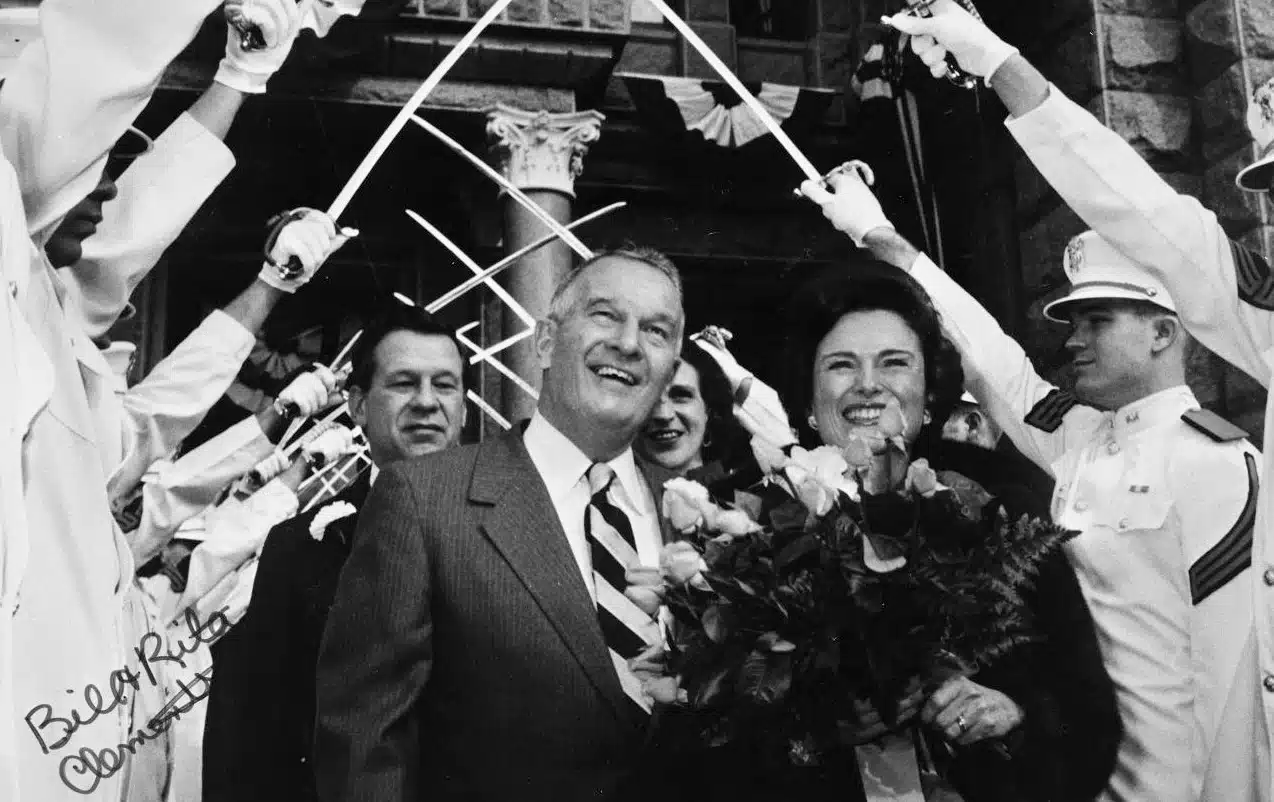
Clements married Pauline Allen Gill of Terrell, Texas, in April 1940, having met her at the University of Texas at Austin. During the first decade of their marriage, the couple moved thirteen times, and their two children, Ben Gill and Nancy, were born in 1941 and 1942. The marriage ended in divorce in February 1975, and Clements married Republican National Committee member Rita Crocker the following month.
Rita, who had previously been married to Texas resort magnate Dick Bass, became Clements’ most trusted and influential political advisor, and was widely credited with helping engineer his return to the governorship in 1986. Through his two marriages, Clements fathered two children and helped raise four stepchildren.
After leaving office in 1991, Clements returned to Dallas and remained active in business, Republican politics, and philanthropy. In 1996 he established the William P. Clements Center for Southwest Studies at Southern Methodist University, and in 2009 he and Rita donated $100 million to UT Southwestern Medical Center — the largest civic donation in Dallas history at the time.
His final years were shadowed by personal tragedy. In 2010, his son Gill Clements was murdered at the age of 69 near his ranch in Athens in Henderson County, east Texas. “He was my best and my most trusted friend. We had a very special relationship for a father and a son,” the ex-governor said, as quoted by his eulogist, Rev. Willam Power. “He was my only son you know. He was my only son.”3
The governor died in Dallas just seven months later, on May 29, 2011, at the age of 94. He was survived by his wife Rita and his daughter, Nancy Clements Seay.
- Carolyn Barta, “William P. Clements, Jr.: Biography,” Clements National Security Papers Project, 2015, https://ns.clementspapers.org/william-p-clements-jr. ↩︎
- Carolyn Barta, “Why Bill Clements Mattered,” Texas Tribune, May 30, 2011, https://www.texastribune.org/2011/05/30/guest-column-why-bill-clements-mattered/. ↩︎
- Jamie Stengel, “Clements’ heartbreak over slain son recalled at ex-gov’s funeral,” Associated Press, July 2, 20211, https://www.chron.com/news/houston-texas/article/clements-heartbreak-over-slain-son-recalled-at-1407455.php ↩︎