In 1964, Texas stood at the crossroads of national transformation. The Civil Rights Act had just been signed into law, the Cold War was intensifying, and the Democratic Party was undergoing a profound ideological reorientation. It was in this charged context that Senator Ralph Yarborough, the most prominent liberal in Southern politics, faced a challenge from an ambitious Houston oilman named George H. W. Bush.
While Bush would ultimately lose the election, the campaign marked a critical inflection point in both Texas politics and the evolution of American conservatism. For Yarborough, the race affirmed the short-lived viability of liberalism in Texas during the Cold War. For Bush, it was a formative experience that helped catalyze a national political career culminating in the presidency.
Ralph Yarborough and the Liberal Crescent of the Democratic South
Ralph Webster Yarborough was, by 1964, a rare figure in Southern politics: a committed liberal in the mold of Franklin Roosevelt and Hubert Humphrey, representing a state whose political culture had long leaned toward economic conservatism and racial traditionalism. A former assistant attorney general of Texas and perennial gubernatorial candidate in the 1950s, Yarborough finally secured statewide office in a 1957 special election to the U.S. Senate.
His victory marked the emergence of a liberal-populist faction within the Texas Democratic Party, one that would clash repeatedly with the dominant conservative wing aligned with figures like Governor Allan Shivers and, later, John Connally.
Yarborough’s political identity rested on a blend of progressive federalism and Texas-style populism. He consistently supported civil rights legislation, labor protections, federal public education measures, and environmental conservation. In a region where many senators signed the 1956 Southern Manifesto and opposed racial integration, Yarborough refused to follow suit. He voted in favor of the Civil Rights Acts of 1957, 1960, and 1964—becoming the only senator from the former Confederate states to vote for all three.
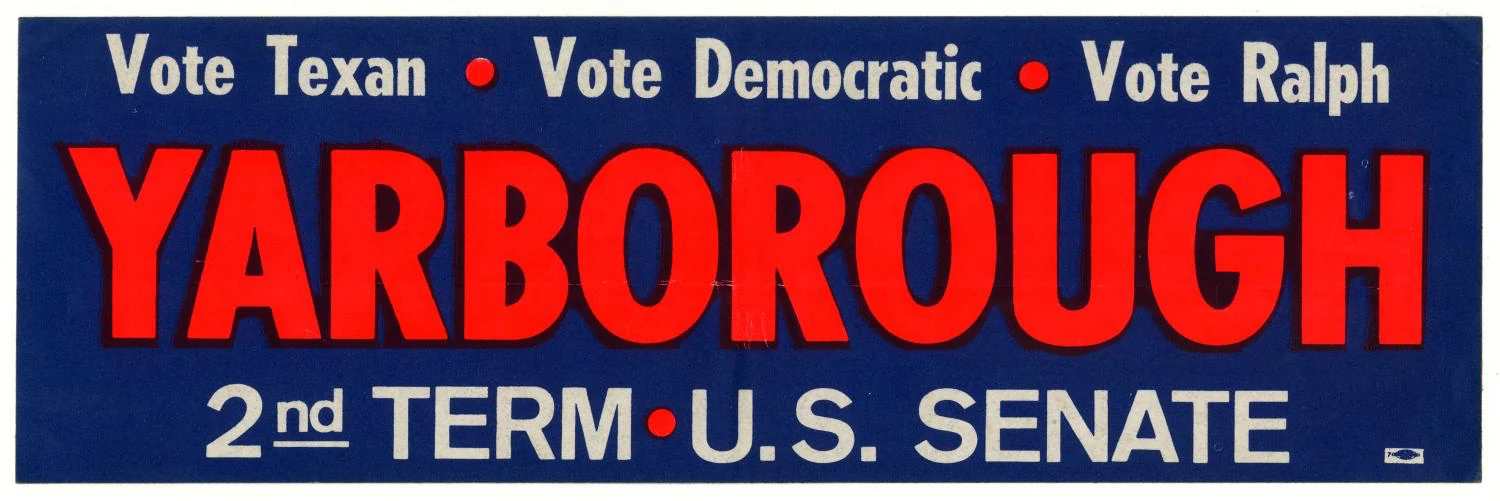
Yarborough’s support for desegregation, ‘Great Society’ legislation, and federal education measures, as well as his sponsorship of landmark environmental bills, reflected a vision of governance at odds with the Southern norm. Yarborough’s national profile grew in tandem with his legislative work. As a member of the Senate Labor and Public Welfare Committee, he was a key ally of the Johnson Administration and a consistent supporter of President Kennedy’s agenda prior to 1963.
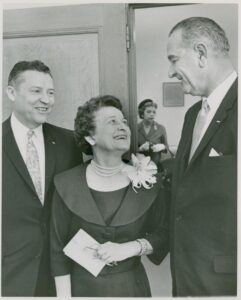
At the same time, his position in Texas politics remained precarious. The Democratic Party in Texas was deeply divided, with Yarborough representing an insurgent liberal bloc increasingly at odds with the conservative establishment, led by Governor John Connally. The intra-party feuding became so pronounced that Yarborough refused to ride in a limousine with Johnson or Connally during President Kennedy’s 1963 trip to Texas, which ended tragically in Dallas— until Kennedy personally intervened. After Kennedy’s death, Johnson made a show of unity with Yarborough, and supported his 1964 reelection campaign. Despite intra-party tensions, Johnson recognized the strategic importance of keeping the seat in Democratic hands.
Listen to a taped endorsement of Yarborough by President John F. Kennedy, recorded at the White House in October 1963. In this brief speech, intended for radio broadcast, Kennedy discusses Yarborough’s role in creating the Padre Island National Seashore, as part of a push for the establishment of more coastal preserves, such as the Cape Code National Seashore—a priority for Kennedy’s Administration.
The Republican Challenger: Bush’s First Bid for High Office
Into this contested political terrain entered George Herbert Walker Bush. At 40 years old, Bush had built a successful career in the Texas oil industry after moving from Connecticut in 1948. The son of U.S. Senator Prescott Bush, he came to Texas with a patrician pedigree and Eastern mannerisms at odds with Texan populism and folksiness.
By the early 1960s, Bush was active in the Harris County Republican Party and had begun laying the groundwork for a larger political role. The Republican Party in Texas was still in its infancy, with only Senator John Tower holding statewide office, but the rise of Barry Goldwater’s brand of conservatism suggested that realignment was underway.
Bush won the 1964 Republican primary with the support of party activists eager to challenge the liberal incumbent. He ran on a platform that mirrored Goldwater’s, though with a less incendiary rhetorical style. Bush criticized Yarborough as a “left-wing radical” and denounced the expansion of federal programs and support for organized labor.
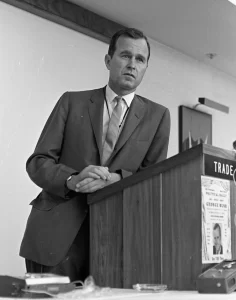
Bush’s campaign emphasized limited government, fiscal conservatism, and moral order. He spoke against the Nuclear Test Ban Treaty, criticized the United Nations, and called for more aggressive anti-communist policies abroad. He also tried to link Yarborough to scandal, suggesting that the senator had accepted illegal contributions from the disgraced Texas financier Billie Sol Estes, though the accusations were never substantiated.
Despite his energetic campaign and increasing name recognition, Bush faced structural disadvantages. Johnson’s landslide victory over Goldwater in Texas provided Yarborough with a powerful coattail effect. Moreover, Bush’s background and relatively recent arrival in Texas opened him to charges of carpetbagging. Yarborough mocked his opponent’s elite lineage, calling him “Little Georgie” and warning that the Senate was not for sale. Bush, for his part, struggled to broaden his appeal beyond the growing but still minority conservative base.
In the end, Yarborough defeated Bush with 56% of the vote to Bush’s 44%. While the margin was comfortable, Bush had nonetheless performed better than Goldwater in Texas, revealing that the Republican brand, when divorced from overt extremism, was gaining traction. More importantly, the race provided Bush with invaluable experience and exposure. Within two years, he would win a seat in the U.S. House of Representatives.
Civil Rights and Segregation
Though not the central issue of the 1964 senate race, civil rights loomed in the background. Yarborough’s record on civil rights was unambiguous: he had supported every major piece of legislation aimed at dismantling segregation and expanding voting rights. This made him a target for conservative Democrats and Republicans alike, but also a hero to Black and Mexican-American communities in Texas, who were increasingly entering the political arena.
Bush’s opposition to the Civil Rights Act of 1964 placed him in line with much of the White Southern electorate, though it later became a political liability. At the time, he justified his position on constitutional and libertarian grounds, arguing that the federal government was exceeding its authority. Yet his subsequent support for civil rights legislation in Congress suggested an evolving stance. After the assassination of Martin Luther King Jr., Bush voted for the 1968 Civil Rights Act, also called the Fair Housing Act, despite opposition by many of his constituents, and most other Southern congressmen. Later in life, Bush conceded that he “took some far-right positions to get elected” and hoped “not to do it again.”
The racial dynamics of the 1964 campaign were reflective of broader national shifts. While Johnson’s support for civil rights alienated parts of the Democratic South, it also attracted Black votes and bolstered its standing nationally. Yarborough’s victory, therefore, was not only a personal triumph but also an endorsement of the Democratic Party’s new direction. However, it would prove to be one of the last such endorsements in Texas statewide elections. By 1970, Yarborough would lose his seat in a primary challenge, signaling the collapse of the liberal coalition that had briefly flourished in Texas.
Yarborough’s successor, Lloyd Benson, was more fiscally conservative and he opposed busing (while supporting most other civil rights measures). He belonged to a generation of conservative Democrats during the transition between one-party Democrat rule in Texas (1870s–1980s) and the long period of one-party Republican rule that has followed (1990s–present).
Aftermath and Historical Significance
In retrospective analyses, historians have noted that the Yarborough-Bush contest foreshadowed the long-term ideological polarization of American politics. The 1964 campaign revealed deepening fissures between competing visions of government: On one side stood Yarborough, the emblem of Southern liberalism rooted in New Deal populism, civil rights expansion, and federal investment in education, health, and environmental conservation. On the other side was Bush, articulating a conservative critique centered on limited government, free enterprise, and traditional social order—paired with a more hawkish Cold War posture.
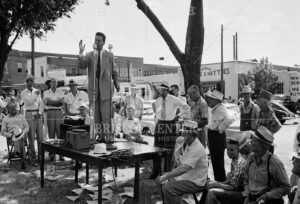
The race exposed growing partisan divergence on both domestic policy and foreign affairs, where internationalism and conservative anticommunism were beginning to define Republican Party identity. Yarborough’s victory showed that liberalism could still command a statewide majority, but only narrowly and for one of the last times.
Meanwhile, Bush’s respectable showing previewed a future Republican majority built on suburban voters, anti-tax sentiment, and assertive foreign policy. The ideological boundaries traced in this race—between government activism and restraint, federal activism and states’ rights, diplomacy and confrontation—would soon become the dominant axes of American political conflict.
Bush’s campaign, though unsuccessful, set the stage for that transformation. His ability to attract a substantial vote share as a first-time candidate reflected the growing disaffection with national Democratic policies among Texas voters. More importantly, the campaign taught Bush the importance of message discipline, grassroots organization, and ideological flexibility.
Subsequently, Bush demonstrated a remarkable ability to learn from and recover from failures, earning him the epithet “Comeback Kid.” In later campaigns, Bush would moderate his tone, support civil rights legislation, and position himself as a pragmatic conservative—qualities that would distinguish him from the more doctrinaire elements of his party.
Bush won election to a Houston congressional seat in 1966 and served until 1970. He lost his seat after running unsuccessfully again for U.S. Senate in 1970, this time at the urging of President Richard Nixon. As a consolation prize, Nixon appointed him U.N. Ambassador. Bush then served for a year as the CIA Director under President Gerald Ford and as vice president from 1981 to 1989 before winning the presidency in 1989.
Related Books
Dive deeper into this topic by purchasing any of these recommended books. As an Amazon Associate, Texapedia earns a commission from qualifying purchases. Earnings are used to support the ongoing work of maintaining and growing this encyclopedia.