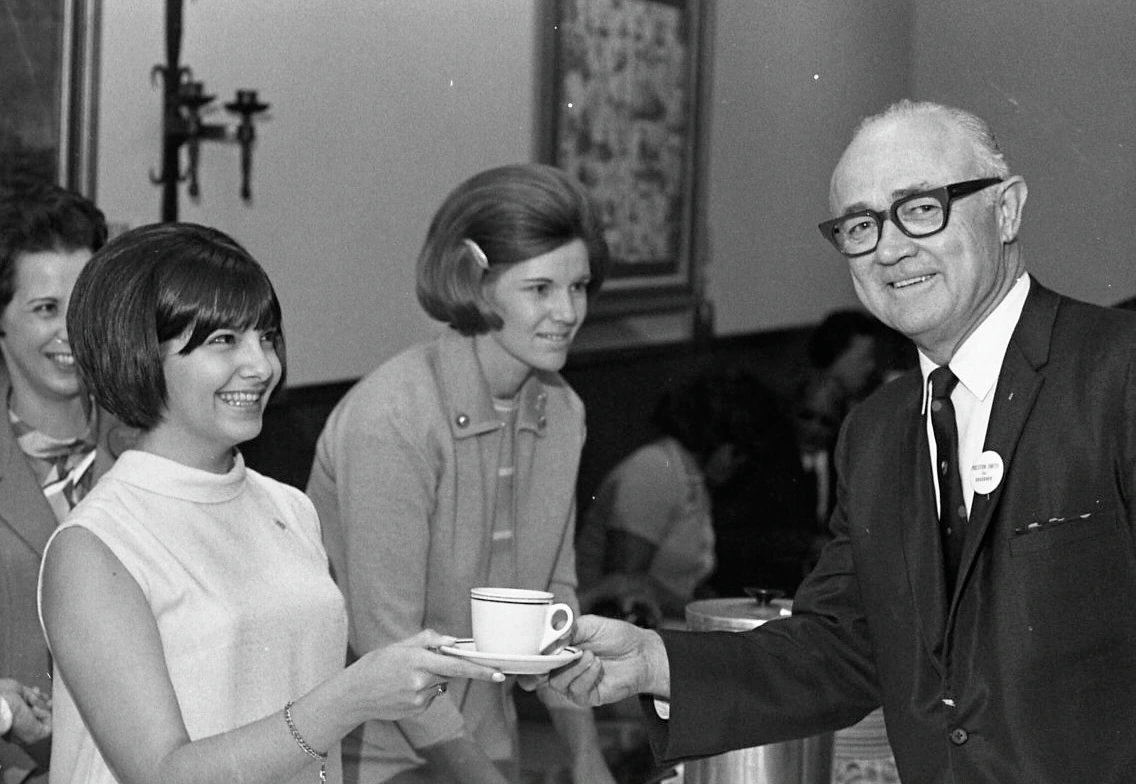
Preston Earnest Smith rose from the cotton fields of West Texas to occupy the Governor’s Mansion during one of the most turbulent periods in modern state politics, serving from 1969 to 1973. A conservative Democrat with a plainspoken demeanor and a strong affinity for everyday Texans, Smith became widely known for his accessibility, his trademark polka-dot ties, and—more substantively—for an ambitious push to expand Texas’s higher education system.
Though his reputation was badly damaged during his second term as a result of the Sharpstown stock-fraud scandal, Smith left an imprint on Texas’s medical schools, technical training programs, and university infrastructure. His story traces a classic mid-century arc: modest rural beginnings, entrepreneurial ascent, relentless political networking, and a governorship defined by institution-building.
Early Life and Formative Years
Smith was born on March 8, 1912, in Corn Hill, a small Williamson County community later absorbed into Jarrell. He was the seventh of thirteen children born to Charles Kirby and Effie Smith, tenant farmers whose financial circumstances were modest even by the standards of rural Texas. When Preston was twelve, the family relocated to a 320-acre tenant farm along the Dawson–Gaines county line, where the children shared the demanding rhythms of agricultural labor. Smith later remarked that the Great Depression hardly altered their lives; the family had been poor enough that national economic collapse only marginally changed their daily reality.
Despite limited means, Smith demonstrated early ambition. He graduated from Lamesa High School in 1930 and soon afterward boarded a bus for Lubbock with his life savings—just fifty dollars—and the hope of earning a degree. At Texas Technological College (now Texas Tech University), he pursued a business curriculum, graduating in 1934 with a bachelor’s degree. A seating chart placed him alphabetically beside another Smith—Ima Smith, no relation. Their acquaintance grew into a partnership that endured more than six decades. The two married in 1935 and made Lubbock their permanent home.
Smith’s early entrepreneurial streak emerged quickly. He managed and later owned a small chain of movie theaters in Lubbock, investments that gave him both financial stability and prominent visibility. The theater business, along with real estate ventures, made his name familiar to many Lubbock residents and helped him cultivate relationships essential to his political future. By the early 1940s, Smith had transformed himself from a tenant farmer’s son into a respected local businessman, active in civic groups and increasingly drawn toward public life.
Legislative Career
Smith first entered statewide politics in 1944, winning election to the Texas House of Representatives. A conservative Democrat in an era when the Democratic Party spanned the full breadth of Texas political identity, Smith positioned himself as a diligent, attentive representative. He served three consecutive terms, developing a reputation for being responsive to constituents and methodical in committee work.
After a six-year hiatus from public office, Smith captured a seat in the Texas Senate in 1956. His Senate years were pivotal. They expanded his statewide profile, deepened his understanding of budgetary and institutional policy, and allowed him to form alliances that would later help propel him into statewide office. Smith’s core interests—education, vocational training, and institutional expansion—began to take clearer shape. His legislative focus on building durable state institutions became a hallmark of his later governorship.
In 1962, voters elevated Smith to the lieutenant governorship just as John Connally assumed the governorship. Although the two men differed in temperament—Connally charismatic and polished, Smith plainspoken and understated—they formed an effective team. Smith’s relentless work ethic, constant Capitol presence, and collegial relationships in the Senate made him a key figure in shepherding administration priorities.
During this period, Smith also adopted the distinctive personal branding that became synonymous with his public persona. Former Governor Price Daniel reportedly advised him to adopt something recognizable to stand out on the campaign trail. Smith chose polka-dot ties, which soon became both a trademark and a playful visual counterpoint to his otherwise conservative, bespectacled appearance.
Campaigning in Polka Dots: The 1968 Gubernatorial Race
When Connally declined to seek reelection in 1968, Smith entered a crowded Democratic primary for governor. His candidacy leaned heavily on name recognition, rural appeal, and an image of steady, unpretentious competence. One memorable campaign tactic involved sending letters to nearly fifty thousand Texas households with the surname Smith, asking: “Don’t you think it’s about time one of us was governor?”
The strategy worked. Smith secured the nomination and, subsequently, the governorship—becoming both the first lieutenant governor to ascend directly to the governorship by election and the first West Texan to win the office. His inauguration on January 21, 1969, captured the essence of his regional roots: the Texas Tech marching band, a mounted Red Raider mascot, and the Lamesa High School band featured prominently in the parade. For many West Texans, Smith’s victory felt like long-awaited recognition.
Governing Philosophy and Administrative Style
Smith governed with a style that combined accessibility, modesty, and procedural attentiveness. He held frequent press conferences, answered every phone message, and welcomed Capitol visitors with an ease that earned him the nickname “the people’s governor.” Journalists and aides alike described him as tireless—always working, always present, always moving between meetings with a stack of notes in hand.
Ideologically, Smith fit comfortably within the conservative wing of the mid-century Democratic Party. He was fiscally cautious yet willing to expand state institutions; pragmatic rather than doctrinaire; and inclined toward incremental reforms rather than sweeping ideological programs. His humor—corny, self-deprecating, endearingly dry—softened his political edges and helped him maintain friendly relations across factional lines.
Expansion of the Public University System
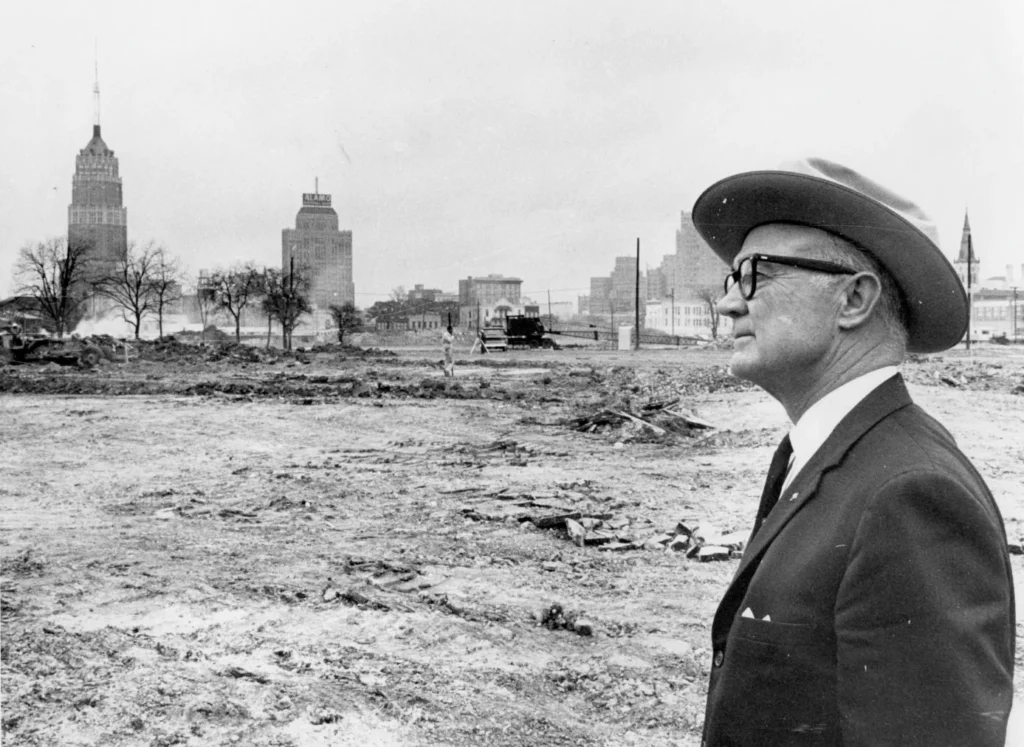
Smith’s most enduring achievements lie in higher education. Few governors in Texas history have presided over such a concentrated burst of institution-building. During his legislative career and through his governorship, Smith championed:
- The Texas Tech University School of Medicine in Lubbock, which eventually evolved into the Texas Tech University Health Sciences Center.
- The University of Texas Medical School at Houston and expansions to the UT medical branch in Galveston.
- A new UT dental branch, expanded nursing programs, and additional vocational and training centers across the state.
He also supported a ten-year teacher pay raise plan, sought a permanent building fund for state colleges, and pressed for the expansion of vocational education, believing that Texas’s economic future depended on technical training and a modernized workforce.
Smith’s focus on institutional development stemmed partly from personal experience. As a Texas Tech graduate who had arrived in Lubbock with almost nothing, he believed universities could transform both individuals and regions. His efforts helped establish a durable higher-education infrastructure that continues to shape Texas’s medical and scientific landscape.
Water Policy and Other Domestic Initiatives
Beyond education, Smith pursued a series of more modest policy reforms. His administration submitted a comprehensive state water plan, reflecting long-standing concerns about water scarcity, regional imbalances, and population growth. Though the plan ultimately failed to pass, it reflected the broader modernization efforts of the era.
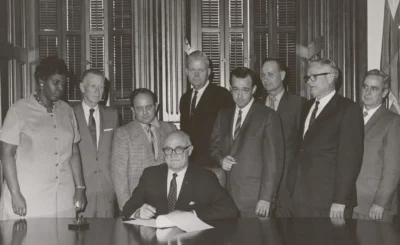
He signed legislation allowing liquor-by-the-drink sales on a local-option basis, an incremental but consequential shift in state alcohol policy. He also supported Texas’s first minimum wage law and various measures intended to promote economic development and professional training.
These initiatives underscored Smith’s administrative pragmatism: he tended to embrace policies that improved infrastructure, expanded opportunities, or modernized existing systems, rather than seeking ideological confrontation.
Sharpstown: Crisis, Collapse, and the Anti-Incumbent Wave
Smith’s second term was dominated—and ultimately undone—by the Sharpstown scandal, a sprawling stock-fraud scheme involving Houston financier Frank Sharp. The scandal centered on allegations that Sharp arranged quick-profit stock deals for lawmakers and state officials in exchange for favorable banking legislation.
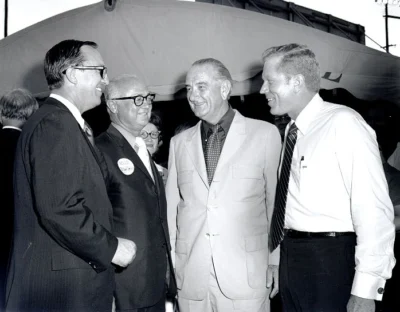
Though Smith himself was never criminally charged, he was identified as an “unindicted co-conspirator,” a label that proved politically devastating. Public trust in state government plummeted, and 1972 produced one of the most sweeping anti-incumbent waves in Texas history. Half the Texas House lost reelection or declined to run again.
Smith, seeking a third term, faced voters in a climate defined by suspicion and frustration. He lost the Democratic primary to Uvalde rancher Dolph Briscoe, ending his tenure as governor in January 1973. A later attempt at a political comeback in 1978 also failed, signaling that Sharpstown had permanently altered his political trajectory.
Later Life: Civic Leadership and Institutional Stewardship
After leaving office, Smith returned to Lubbock, where he immersed himself in business ventures, including real estate, banking, and oil and gas. Yet he remained most publicly visible through his work on behalf of Texas Tech University.
From the late 1970s onward, Smith served as a fundraiser and ambassador for the university, ultimately helping to raise roughly half a billion dollars for institutional growth. In 1981, Governor Bill Clements appointed him to the Texas Higher Education Coordinating Board, where Smith later served as chairman until 1985. His service on the board aligned naturally with the commitments that had defined his public life—expanding educational opportunity and shaping long-term planning for state institutions.
Texas Tech honored him with a statue in the Administration Building courtyard, a visible acknowledgment of the role he played in elevating the university to statewide prominence.
Smith’s marriage to Ima Smith endured until her death in 1998. The couple raised two children and remained deeply connected to the Lubbock community. In October 2003, Smith died at age 91 after being hospitalized with pneumonia. He was buried in the Texas State Cemetery in Austin, joining the state’s long line of former leaders.