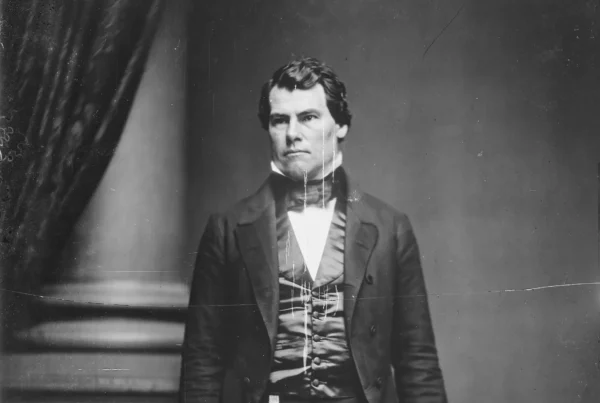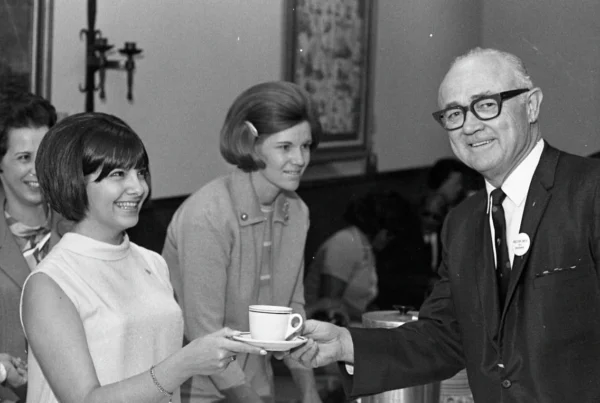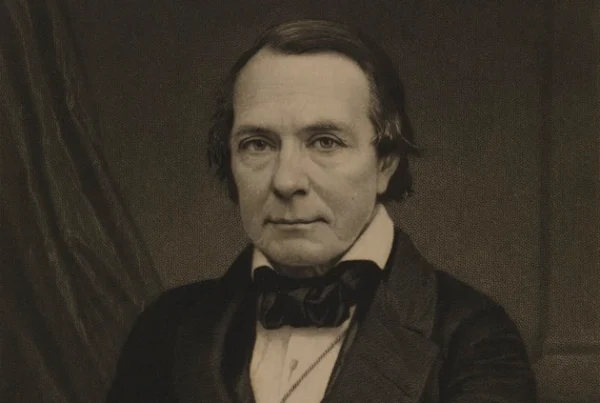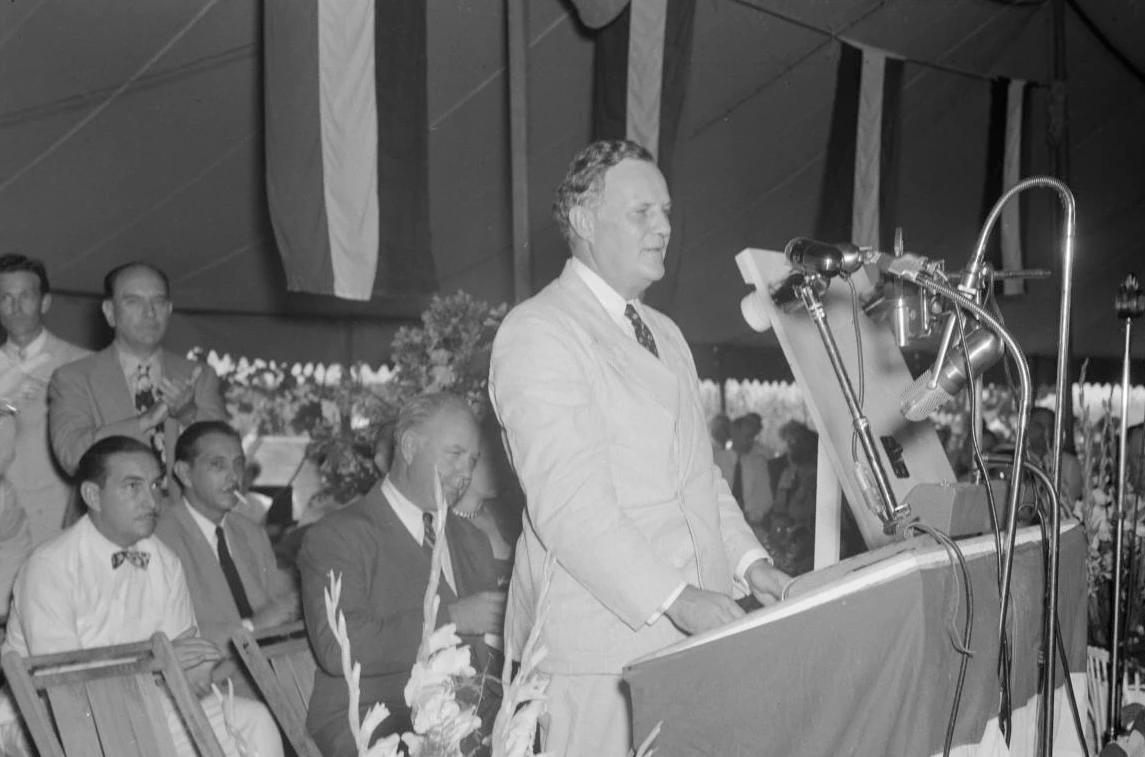
Beauford Jester (1893–1949) served as the 36th Governor of Texas from 1947 until his death in 1949, presiding over a period of institutional growth, educational reform, and expanding state responsibilities in the years following World War II.
A lawyer, ranch manager, and public official with prior service on the Texas Railroad Commission and the University of Texas Board of Regents, Jester entered the governorship as a consensus-oriented Democrat. His administration reflected the demands of a rapidly changing state, balancing fiscal oversight with substantial investments in infrastructure, education, and public institutions during a time of postwar expansion.
Early Life and Military Service
Beauford Halbert Jester was born on January 12, 1893, in Corsicana, Texas, into a family with deep roots in Texas public life. His father, George Taylor Jester, served two terms as Lieutenant Governor from 1894 to 1898 under Governor Charles A. Culberson, and had earlier helped establish the Texas Railroad Commission as a state legislator in 1891 — an institution his son would later serve.
Jester attended public schools in Corsicana before enrolling at the University of Texas at Austin, where he played baseball and earned a Bachelor of Arts degree in 1916. He then entered Harvard Law School, but was within roughly a month of completing his degree when the United States entered World War I in 1917 and he enlisted.
Commissioned as a captain, Jester commanded Company D, 357th Infantry, 90th Division, seeing combat in the Battle of St. Mihiel and the Meuse-Argonne Offensive, before serving with the American Army of Occupation in Germany. The strength of the bonds forged during that service was evident at his 1947 inauguration, when fellow veterans carried him on their shoulders into the Governor’s Mansion.
After returning home, Jester completed his legal education at the University of Texas School of Law, receiving his LL.B. in 1920, and established a law practice in Corsicana. In addition to his legal work, Jester managed family agricultural and ranching operations, as well as business holdings tied to land and natural resources.
Government Service in the ‘New Deal’ Era
Jester’s first major role in public service came through education rather than electoral politics. In 1929, Governor Dan Moody appointed him to the University of Texas Board of Regents, where he served until 1935 and chaired the board from 1933 to 1935. During this period, he supported a significant building program that expanded the university’s physical and institutional capacity.
His service on the Board of Regents provided experience in managing large public institutions and overseeing complex budgets, while also placing him within statewide networks of political and civic leadership. These years marked his gradual transition from private professional life into public administration.
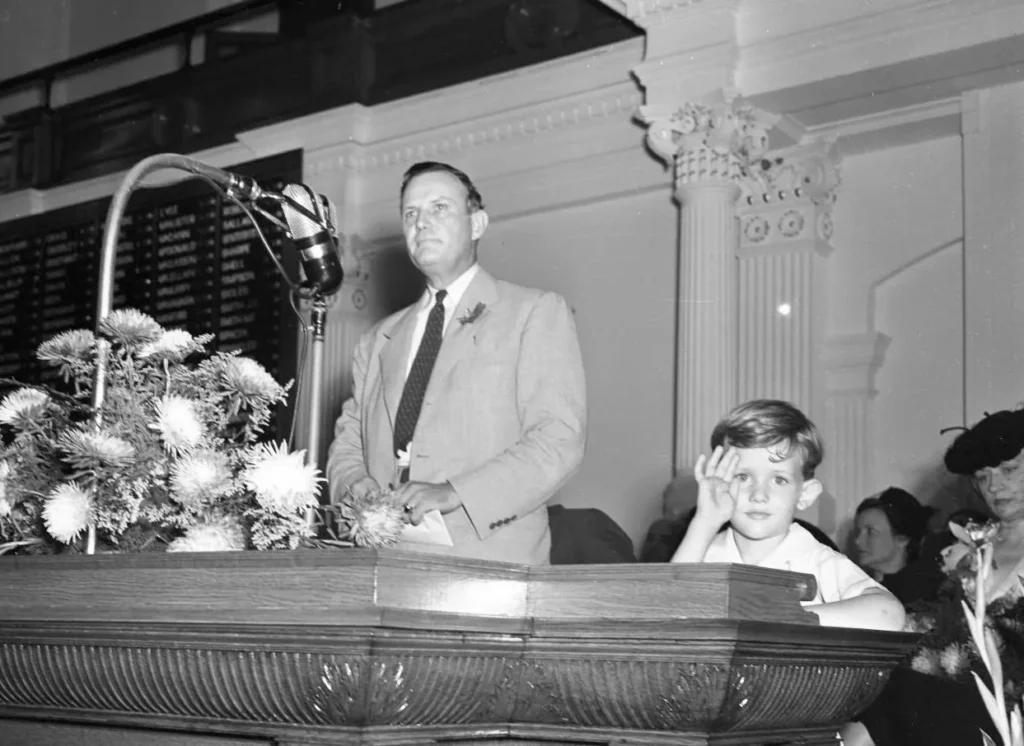
In 1942, Jester was appointed to the Texas Railroad Commission, one of the most powerful regulatory bodies in the state due to its authority over oil and gas production. He later won election to the position, serving until 1947.
At the Commission, Jester dealt directly with the regulation of Texas’s most important industry. His work involved balancing production levels, stabilizing markets, and addressing conservation concerns during a period shaped by wartime demand and postwar adjustment. The position required technical knowledge, negotiation, and administrative coordination, reinforcing his reputation as a capable and measured public official.
1946 Gubernatorial Campaign
Jester entered the 1946 Democratic primary for governor after Governor Coke Stevenson announced that he would not seek a third term. The outgoing governor was reported to have favored Jester and provided behind-the-scenes support.
During the 1946 campaign, Jester was considered a moderate compromise candidate in a crowded field. Texas remained effectively a one-party state at the time, and the Democratic primary functioned as the decisive electoral contest. Running on a platform emphasizing clean government, administrative competence, and fiscal responsibility, Jester appealed to voters seeking stability after an era of war and institutional strain.
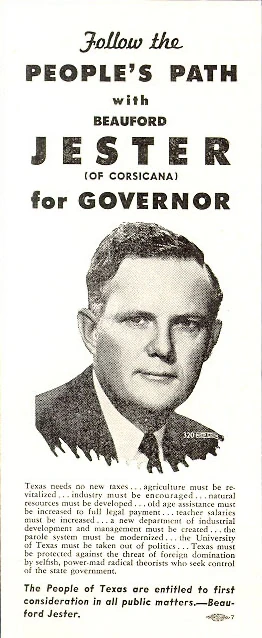
He advanced through the primary and defeated former University of Texas president Homer P. Rainey in the runoff, securing the Democratic nomination. He then won the general election, entering office with broad support across the party’s factions.
Governorship (1947–1949)
Jester took office in January 1947 at a time when Texas faced mounting pressures associated with population growth, urbanization, and economic expansion. Returning veterans, industrial development, and increased mobility placed new demands on public institutions, requiring both expanded services and improved administrative coordination.
Early Crisis: The Texas City Disaster
Early in his first term, the Texas City disaster underscored the risks accompanying Texas’s rapid industrial growth. On April 16, 1947, a cargo ship carrying ammonium nitrate exploded at the port of Texas City, triggering fires and additional blasts across nearby refineries and chemical facilities. The disaster killed more than 500 people and injured thousands, making it one of the deadliest industrial accidents in United States history.
The scale of the explosion overwhelmed local response capacity and required coordination across municipal, state, and federal authorities. The disaster became an early and defining episode of Jester’s governorship, illustrating both the economic importance and the inherent dangers of the expanding petrochemical industry along the Gulf Coast. It also highlighted the growing complexity of state oversight in an industrializing economy.
Legislative Program and State Expansion
Jester’s administration worked with the 51st Texas Legislature to enact a wide-ranging program of state investment and institutional development. The legislature passed what was, at the time, the largest appropriations bill in Texas history, directing funds toward education, infrastructure, public health, and corrections.
In education, the period was marked by the passage of the Gilmer-Aikin laws, which reorganized the public school system and increased funding for teacher salaries. Jester supported these measures and advocated for broader improvements in educational access and quality. His administration also backed the expansion of higher education, including construction projects at colleges and universities across the state.
Jester did not challenge the reigning system of segregated schools and universities in Texas. He supported the development of a major institution for African American students (which became Texas Southern University).
Infrastructure development remained a central concern. The state invested in rural roads and transportation networks, reflecting the growing importance of automobile travel and the need to connect agricultural and urban regions. At the same time, funding was directed toward state parks and public lands, expanding recreational and conservation resources.
The administration also oversaw improvements in correctional facilities and supported the creation of new administrative bodies, including a youth development council and a separate board for state hospitals and special schools.
When Jester took office, the Texas prison system was widely regarded as one of the worst in the nation, with inmates on agricultural farm assignments subject to brutal conditions and physical abuse. Reform pressure came partly from the Texas Council of Methodist Women, who commissioned nationally recognized criminologist Austin MacCormick to investigate. His report was damning, and Jester embraced its findings, working with the 51st Legislature to appropriate more than four million dollars for prison improvements. His commitment to the effort was recognized posthumously when the Texas Department of Corrections named a major prison complex the Jester Prison Farm in his honor.
Administrative Style and Governance
Jester’s approach to governance emphasized coordination and incremental change rather than sweeping reform. He worked with the legislature to implement policies through negotiation and consensus, avoiding the more confrontational style associated with some earlier Texas governors.
Jester’s successor, Lieutenant Governor Allan Shivers, later said that Jester “didn’t like to make people mad or turn them down on almost any request” — an approach that opened him up to influence by “interested groups.” Shivers, who was more fiscally conservative, said that Jester had submitted numerous “a whole armload of so-called emergency appropriations” to the legislature in 1949, which he questioned.1
Ideologically, Jester was much like his predecessor, Coke Stevenson, who had supported his candidacy. Although both of these governors oversaw an expansion of the administrative state, neither of them was a staunch New Deal liberal, nor were they fiscal hawks or states’-rights zealots of the Dixiecrat variety (like Shivers). Instead, they occupied a middle ground between these two extremes.
Jester’s record on organized labor and civil rights reflected this balance. Although he belonged to the party of Roosevelt, which was generally pro-labor, Jester campaigned in 1946 for a state board for labor arbitration. When the legislature moved in 1947 in an even more restrictive direction, Jester agreed, supporting the passage of a right-to-work law that prevented unions from requiring membership as a condition of employment.
On civil rights, Jester opposed President Harry Truman’s national civil rights program, but he supported state civil rights legislation, including an antilynching law and a proposed constitutional amendment to repeal the poll tax.
Reelection in 1948
In 1948, Jester sought a second term and won reelection with relative ease. His campaign emphasized continuity and the importance of maintaining effective administration during a period of ongoing growth. Voters returned him to office amid continued expansion in population and economic activity, suggesting confidence in his leadership during a time of transition.
Personal Life
Jester married Mabel Buchanan of Texarkana in 1921, and the couple had three children. A lifelong Methodist, he maintained membership in a wide range of fraternal and civic organizations including the American Legion, the Veterans of Foreign Wars, the Freemasons, the Shriners, Rotary, and the Lions Club — a breadth of associational life characteristic of many mid-twentieth-century public men.
In private, Jester was known for a reserved demeanor and a preference for administrative work over public spectacle. He had been an avid baseball player in his younger years and retained the ranching and land management responsibilities of the family’s Navarro County holdings throughout his public career. From 1940 until his death, singer Caroline Roget served as his secretary and, according to papers at the Texas State Archives, his romantic partner. The relationship was kept private during his lifetime and came to light only through archival records examined after his death.
Death in Office
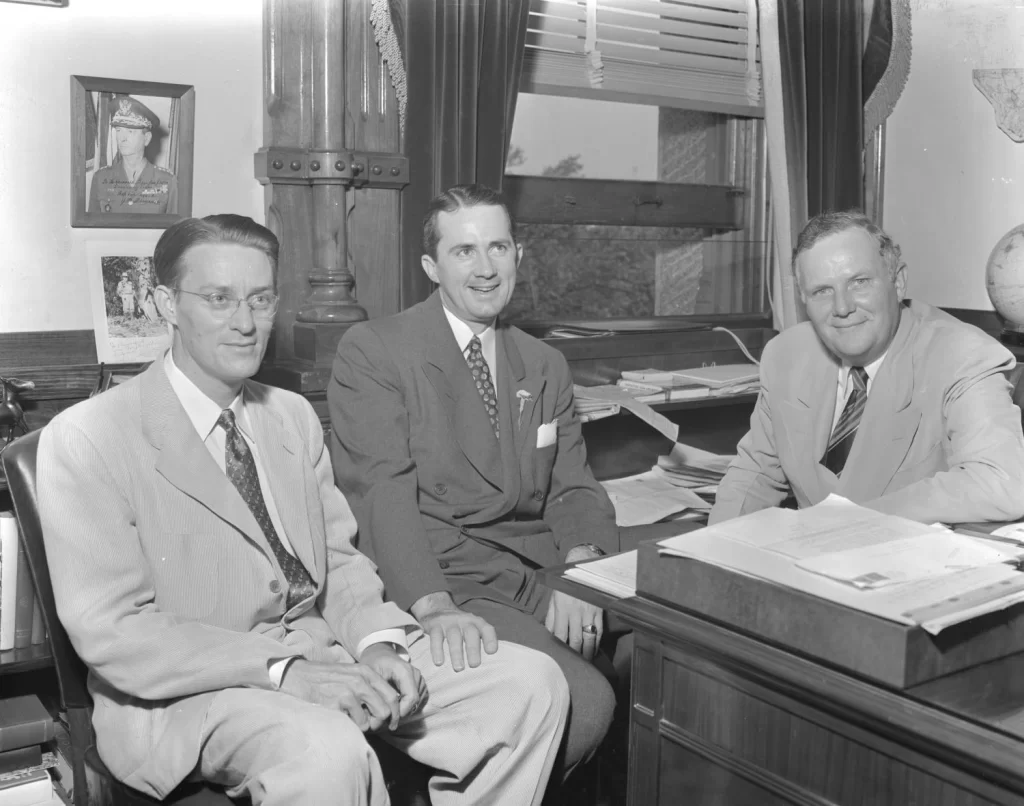
On July 11, 1949, during his second term, Jester died of a heart attack on a train. His death marked a rare moment in Texas political history, as he became the first sitting governor of the state to die in office. Lieutenant Governor Allan Shivers succeeded him, ensuring continuity in leadership as Texas continued to navigate the challenges of postwar expansion.
Beauford Jester’s career reflects a progression from legal practice and business management into public administration at a time when Texas government was taking on broader responsibilities. His tenure as governor coincided with significant developments in education, infrastructure, and institutional organization, situating his administration within a wider period of growth and adjustment in the state’s history.
- Interview with Allan Shivers, April 12, 1965, University of North Texas Oral History Program, pg. 27-28. ↩︎