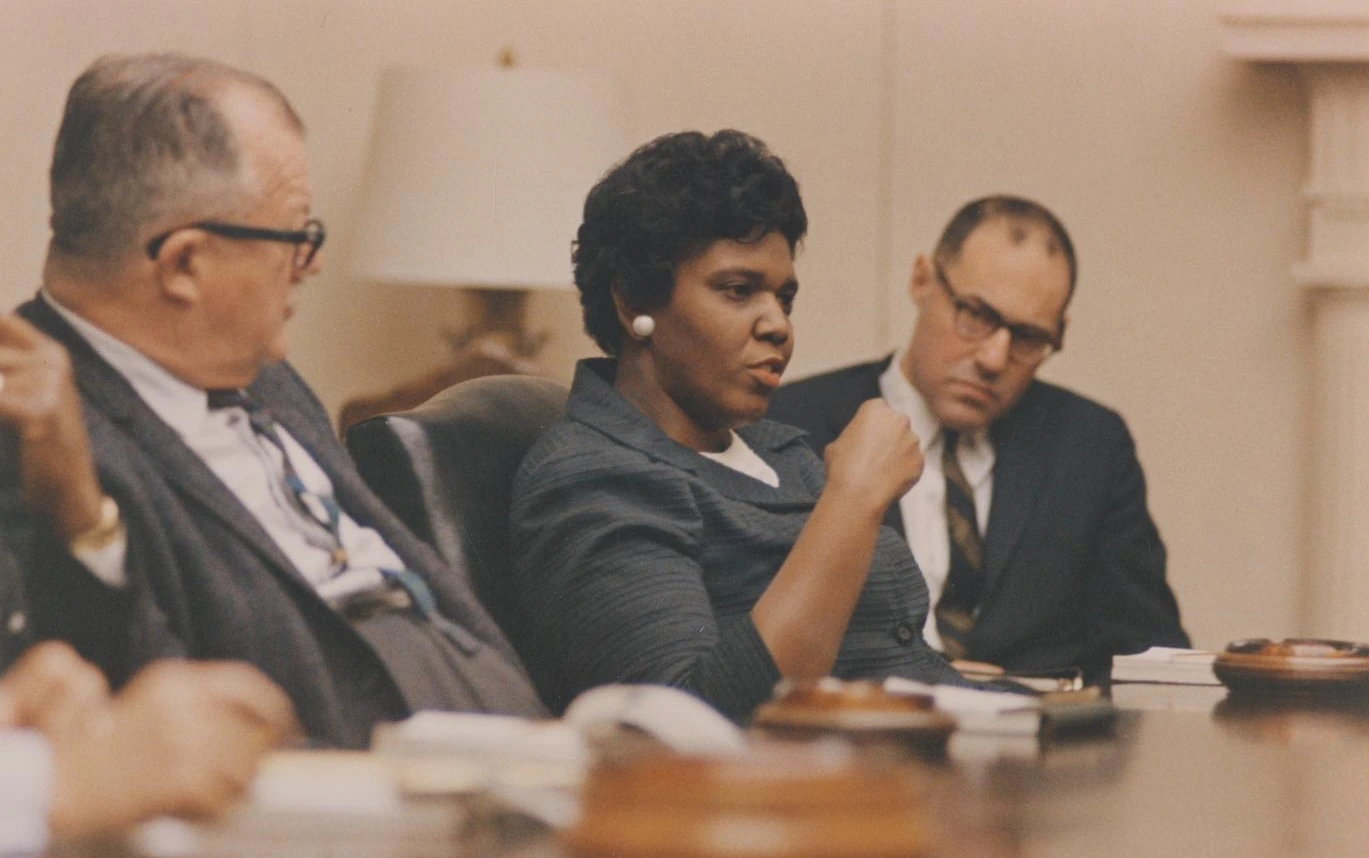
Barbara Jordan (1936–1996) was a Texas Democrat known for her commanding oratory, discipline, and professionalism while serving as a state legislator and member of Congress. Jordan was the first African American woman elected to the Texas Senate and the first Black woman from the South to serve in the U.S. House of Representatives. She became a national figure during the 1970s and 1980s but her political career was cut short by declining health.
Early Life and Education
Barbara Charline Jordan was born on February 21, 1936, in Houston’s Fifth Ward, a historically Black neighborhood. The youngest of three daughters of Benjamin Jordan, a Baptist minister, and Arlyne Patten Jordan, a church teacher, she grew up in a home that valued education, faith, and public service. Jordan attended Phillis Wheatley High School, where she excelled in debate and gained early recognition for her skill in persuasive speaking.
She enrolled at Texas Southern University (TSU), a historically Black institution, graduating magna cum laude in 1956 with a degree in political science and history. At TSU she won numerous national debate championships, defeating teams from Yale, Brown, and the University of Minnesota. She then attended Boston University School of Law, earning her LL.B. in 1959, one of only a small number of Black women in her class.
Early Career and Entry into Politics
Returning to Houston, Jordan opened a private law practice and became active in Democratic Party politics. She volunteered for the 1960 John F. Kennedy presidential campaign and worked to register Black voters. Twice she ran unsuccessfully for the Texas House of Representatives before winning a seat in the Texas Senate in 1966. She was the first African American elected to that body since Reconstruction and the first Black woman ever to serve there.
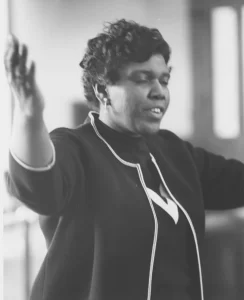
As a state senator, Jordan gained a reputation for discipline, legislative preparation, and her ability to navigate complex political situations. She was instrumental in passing a state minimum wage law that extended coverage to workers excluded from the federal minimum wage. In 1972 she was elected president pro tempore of the Senate, making her the first Black woman to preside over the chamber and, briefly, to act as governor when the governor and lieutenant governor were out of the state.
Election to Congress and National Recognition
In 1972 Jordan was elected to represent Texas’s newly created 18th congressional district, a majority-Black district in Houston. She became the first Black woman from the South elected to the U.S. House of Representatives. Her committee assignments included the House Judiciary Committee, a platform from which she would gain national prominence.
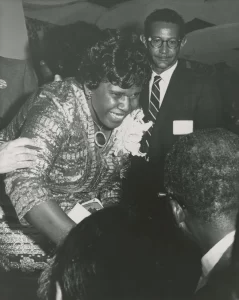
Jordan’s defining public moment came during the 1974 impeachment proceedings against President Richard Nixon. In a nationally televised address before the Judiciary Committee, she delivered a meticulous, principled argument on the constitutional grounds for impeachment. Drawing on the Federalist Papers and the intent of the Framers, she declared, “My faith in the Constitution is whole, it is complete, it is total.” The speech was widely praised for its moral authority and legal clarity, establishing Jordan as a voice of constitutional integrity.
Key Speeches and Invitations
Jordan’s reputation as one of the nation’s most compelling political speakers led to high-profile invitations well beyond her committee work. In 1976 she became the first African American woman to deliver the keynote address at a major party convention, speaking at the Democratic National Convention in New York. Her speech emphasized unity, national purpose, and the responsibilities of citizenship, drawing standing ovations and national press acclaim. Many observers considered it among the best political speeches of the 20th century.

Jordan was invited back to deliver the keynote at the 1992 Democratic National Convention in New York. In that address, she revisited themes of community and responsibility, warning against political cynicism and emphasizing the importance of public trust. Though her health was in decline and she used a wheelchair, her voice retained the same resonance and force that had defined her career.
She was also a sought-after commencement speaker, delivering addresses at institutions including Harvard University, Yale University, and Spelman College, where she often linked the pursuit of education to the obligations of democratic citizenship.
Legislative Priorities
Jordan served three terms in the House, focusing on civil rights, urban development, and governmental ethics. She played a major role in the 1975 reauthorization of the Voting Rights Act, successfully advocating to extend its protections to Hispanic and other language-minority voters. She also worked on legislation related to consumer protection, minimum wage standards, and public works projects in Houston.
Her legislative style emphasized thorough preparation, constitutional grounding, and cross-party cooperation. While considered a liberal by voting record, she avoided partisan rhetoric in favor of appeals to shared democratic principles.
Later Career and Public Service
Jordan declined to seek re-election in 1978, citing a desire to return to Texas and teach. In 1979 she joined the faculty of the Lyndon B. Johnson School of Public Affairs at the University of Texas at Austin, where she taught courses on political values and intergovernmental relations. She remained active in public affairs, serving on the Commission on Immigration and Refugee Policy under President Jimmy Carter and later chairing the U.S. Commission on Immigration Reform under President Bill Clinton.

As chair of the commission in the 1990s, Jordan advocated for a balanced approach to immigration policy—combining enforcement measures with continued avenues for legal immigration—earning respect from both major political parties.
Honors and Recognition
Jordan received the Presidential Medal of Freedom in 1994 and was inducted into both the Texas Women’s Hall of Fame and the National Women’s Hall of Fame. She was awarded over 20 honorary degrees, and a U.S. postage stamp bearing her likeness was issued in 2011. Numerous schools, public buildings, and scholarships are named in her honor, including the Barbara Jordan Terminal at Austin–Bergstrom International Airport.
Later Years, Family, and Death
Jordan had a negative view of marriage and had no children. She shared a home in Austin with a female companion, Nancy Earl, from 1976 until her death in 1996. Although some publications have called Jordan a lesbian, she never identified as such, and Earl called herself Jordan’s “good friend.” Biographer Mary Beth Rogers wrote in her 2000 biography of the lawmaker, “Speculation on the sex lives of public figures is a popular pastime. I declined to do that in my work on Barbara Jordan.”

Jordan’s health deteriorated in her later years due to multiple sclerosis and leukemia. She used a wheelchair from the early 1990s onward. Despite her illnesses, Jordan continued to speak publicly and advise on political matters until shortly before her death.
Barbara Jordan died on January 17, 1996, at the age of 59, from pneumonia related to her illnesses. She was buried in the Texas State Cemetery, the first African American woman to receive that honor. She was survived by her mother Arlyne Patten Jordan, and two sisters, Rosemary McGowan and Bernie Creswell.
Related Reading
📚 Curated Texas History Books
Dive deeper into this topic by purchasing any of these handpicked titles:
- She Changed the Nation: Barbara Jordan’s Life and Legacy in Black Politics
- Barbara Jordan: Speaking the Truth with Eloquent Thunder
- “My Faith in the Constitution Is Whole”: Barbara Jordan and the Politics of Scripture
As an Amazon Associate, Texapedia earns a commission from qualifying purchases. Earnings are used to support the ongoing work of maintaining and growing this encyclopedia.