
The Electric Reliability Council of Texas (ERCOT) is the primary electric grid operator for the vast majority of the state of Texas, serving more than 26 million customers—roughly 90% of the state’s total electric load.
As the nerve center of the Texas power system, ERCOT plays a pivotal role in ensuring reliable electricity delivery, managing supply and demand in real-time, and coordinating energy markets across a complex and largely independent grid.
What ERCOT Does
ERCOT schedules the flow of electricity on a network that includes over 46,500 miles of high-voltage transmission lines and more than 680 generation units, including natural gas plants, wind farms, solar installations, and other sources.
Although Texas has a deregulated electricity market—allowing consumers to choose their retail electricity providers—the transmission and grid operations remain regulated. ERCOT serves as the regulated central operator, or “middle tier,” between the private generation companies and the consumers or retailers who buy the power.

In addition to real-time grid management, ERCOT performs several critical functions:
- Market Settlement: ERCOT handles the financial settlement process for the wholesale electricity market, where power generators and retailers buy and sell electricity at market-driven prices.
- Retail Switching: It manages the retail switching platform, allowing millions of Texans to choose their electricity provider in competitive retail areas.
- Grid Reliability Planning: ERCOT is also responsible for conducting long-term forecasting and planning to maintain grid reliability and accommodate growth.
Governance and Oversight
ERCOT is a membership-based nonprofit corporation, operating under the oversight of the Public Utility Commission of Texas (PUC) and the Texas Legislature. It does not generate electricity or own transmission lines; instead, it functions as an independent system operator (ISO) with authority to direct grid operations and enforce reliability standards.
ERCOT’s membership includes a broad range of stakeholders in the energy sector:
- Investor-owned utilities (IOUs)
- Municipal utilities
- Electric cooperatives
- Independent power generators
- Retail electric providers
- Transmission and distribution service providers (TDSPs)
- Power marketers
The organization is governed by a board of directors, with membership and voting structures that aim to balance representation across industry segments.
Energy Sources and Grid Composition
As of early 2024, the ERCOT grid drew power from a diverse and evolving portfolio of energy sources. Natural gas-fired power plants remain the dominant source, accounting for approximately 40% to 45% of total electricity generation.
Wind energy contributes around 25% to 29%, maintaining Texas’s national leadership in installed wind capacity.
Solar power has grown significantly, rising to about 7% to 8% of ERCOT’s generation mix—nearly doubling its share since 2021. Coal and lignite have continued to decline, now making up roughly 12% to 14%, while nuclear energy remains steady at just under 10%.
In total, renewable energy sources (wind, solar, and hydro) now supply more than one-third of ERCOT’s electricity, reflecting a continued shift toward cleaner and more diversified power generation across the Texas grid.
This mix gives ERCOT both strengths and vulnerabilities. The grid benefits from low-cost renewable energy and abundant natural gas, but faces challenges in weather resilience, particularly during extreme conditions such as winter storms or summer heat waves.
Geographic Scope and Interconnections
ERCOT’s jurisdiction covers most of Texas, but not all of it. Small portions of eastern, western, and northern Texas are served by other grid operators such as the Southwest Power Pool (SPP) and the Western Electricity Coordinating Council (WECC).
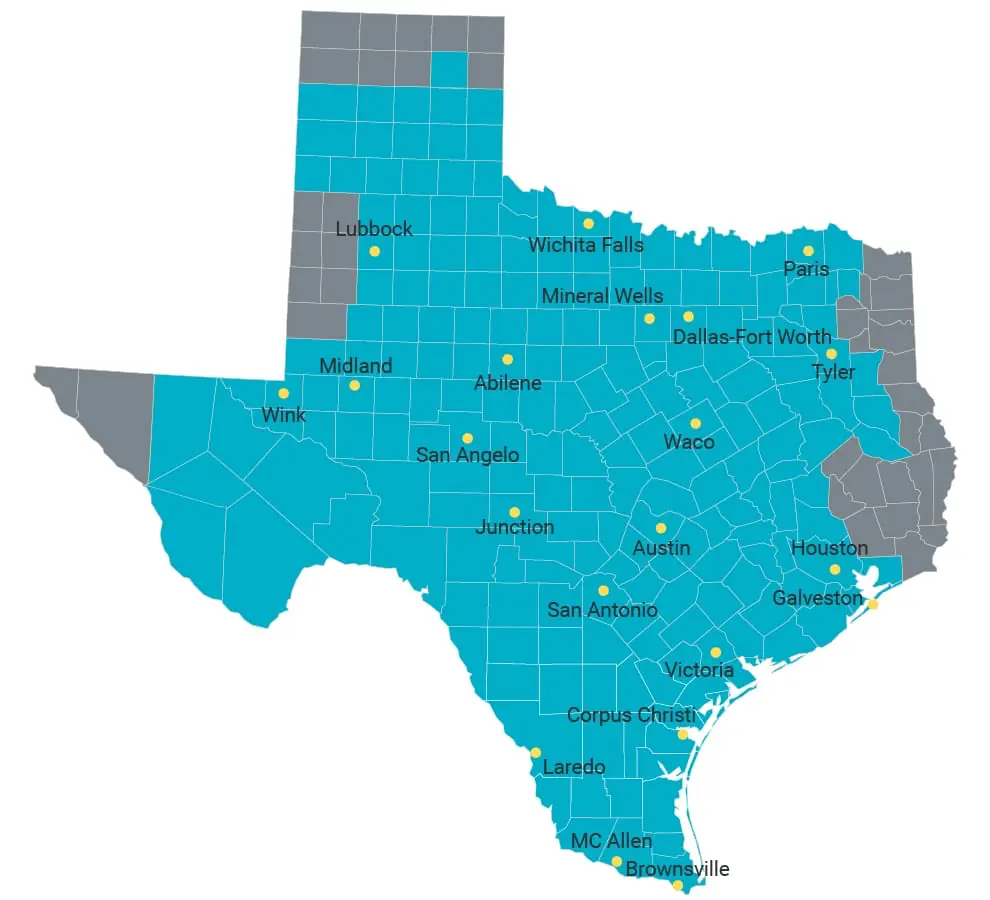
Unlike most U.S. grid operators, ERCOT is largely isolated from other interstate grids, which limits the state’s ability to import or export large amounts of electricity during emergencies. This electrical independence stems from a long-standing desire in Texas to avoid federal regulation under the Federal Energy Regulatory Commission (FERC).
However, ERCOT does maintain limited interconnections with neighboring grids. These ties are primarily made through DC ties, or high-voltage direct current connections, which allow small amounts of power to flow between ERCOT and adjacent regions without subjecting ERCOT to full federal jurisdiction under the Federal Energy Regulatory Commission (FERC).
The largest of these are the Northwest DC Tie (connecting to SPP), the Eagle Pass DC Tie, and the Laredo DC Tie (both connecting to Mexico). While these interconnections provide some operational flexibility and emergency support, they are not large enough to significantly import or export power during major grid events.
Headquarters and Operations
ERCOT’s administrative headquarters is located in Austin, Texas, while its grid operations center is based in Taylor, Texas. The Taylor facility is designed to withstand extreme events and houses the control rooms that monitor and direct the state’s electric system 24/7, every day of the year.