County governments in Texas form the backbone of local administration and public services, overseeing everything from law enforcement and elections to property tax collection and road maintenance. With 254 counties—the most of any U.S. state—Texas relies on its county system to deliver essential functions across urban, suburban, and rural areas alike.
Each Texas county serves as a local administrative subdivision of the state, carrying out a wide range of responsibilities assigned by the Texas Constitution and Legislature. These include managing courts and jails, maintaining county roads and bridges, operating sheriff’s offices, and administering elections and public records. While the importance of county government is especially pronounced in unincorporated areas, counties also provide critical infrastructure and legal functions within densely populated urban regions.
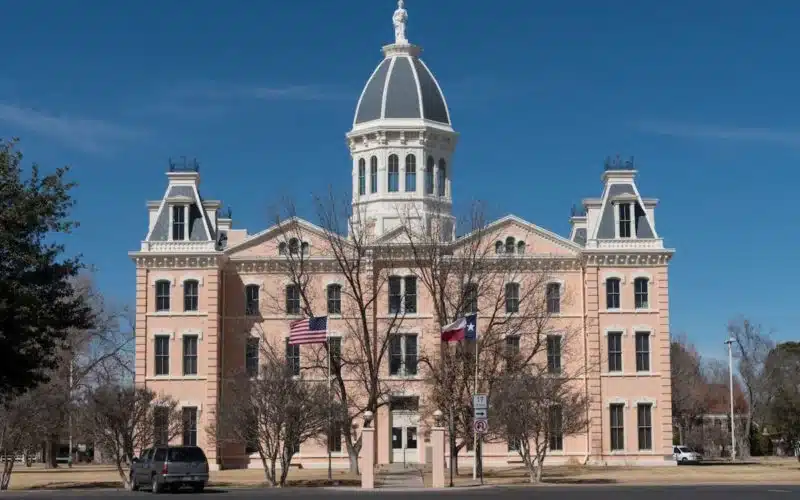
Every county has a designated county seat, which serves as the location of the main courthouse and government offices. The average geographic area of a county in Texas is 1,057 square miles (2,738 square kilometers). The average (mean) population of a Texas county is roughly 120,000 people, though the figure is skewed by highly populous urban counties like Harris County, which has nearly 5 million residents. In contrast, some rural counties have populations under 10,000, with Loving County being the least populous, housing fewer than 100 residents.
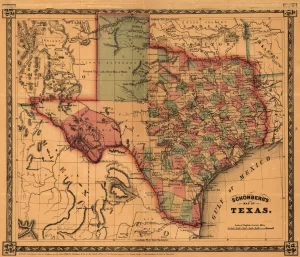
The number of counties has stood at 254 since 1931, when Loving County became the last to be organized. No Texas county has ever been consolidated or dissolved, and creating a new one would face constitutional restrictions on minimum size and procedures — so the map of Texas counties has remained effectively fixed for nearly a century, even as the state’s population has quintupled.
Regardless of size, each county operates under the same basic structure prescribed by the Texas Constitution: a Commissioners Court made up of a county judge elected at large and four commissioners elected from individual precincts
To fund operations, counties rely primarily on property taxes, supplemented by sales taxes in many counties, along with fees, fines, and grants from state and federal sources. Despite their local focus, counties have no inherent sovereignty—they are legal extensions of the state and may exercise only those powers specifically granted by law.
Core Functions of County Governments
- Road Maintenance: Counties in Texas are responsible for maintaining county roads and bridges, which connect smaller towns, rural areas, and unincorporated parts of the county. However, counties do not maintain state highways, interstate highways, or roads within cities.
- Law Enforcement: Counties maintain sheriff’s departments and constables offices, and run county jails.
- Judicial Services: Counties operate county courts for misdemeanor crimes and civil matters, and justice of the peace courts for traffic cases, evictions, and debt claims. They run the jury system, maintain court records, and pay for indigent defense. Counties also provide courthouses, staff, and funding for the state district courts that sit in each county.
- Property Tax Collection: County tax assessor-collectors manage the collection of property taxes not only for the county itself but also on behalf of all local governments that levy a property tax. Property values, however, are set separately by each county’s appraisal district, an independent entity.
- Elections: Counties are responsible for the administration of local elections in Texas. This includes setting up polling locations, managing voter registration, and counting ballots. Depending on the county, these functions belong to the county clerk and tax assessor-collector or to an appointed elections administrator.
- Emergency Management: County judges serve as emergency management directors, coordinating disaster response and recovery efforts. They have the authority to declare local disasters, order evacuations, and control access to affected areas to protect public safety.
Other duties of counties include enforcing animal control laws and managing shelters, maintaining public records like property deeds and marriage licenses, and managing county parks.
Elected County Officials
The governing body of each county is the Commissioners Court, composed of five members:
- Four commissioners, each elected from one of four precincts.
- One county judge, elected at-large by all voters in the county.
The county judge serves as the ceremonial head of the county government and has a mix of executive, legislative, and judicial functions. In addition to the Commissioners Court, voters elect several other key county officials, including:
- County sheriff – responsible for law enforcement and the county jails.
- County tax assessor-collector – responsible for collecting property taxes.
- Judges of county courts at law – hear civil and criminal cases in larger counties. (District judges, though elected locally, are state officials.)
- Justices of the peace and constables – handle minor cases and process service.
- County clerk – responsible for administering elections and maintaining public records, including marriage licenses, property deeds, and court records.
- County attorney – serves as the chief legal advisor to the county government, handling legal matters and representing the county in court. In some counties, the county attorney also prosecutes criminal cases.
Sources of County Funding
Texas county governments have several main sources of funding to support their operations. One of the largest sources is property taxes. Property owners in the county are required to pay taxes based on the value of their land and buildings. These taxes help fund local services like law enforcement, road maintenance, and public health.
Another important source of funding is state and federal grants. Texas counties receive money from both the state government and the federal government to help cover specific programs or projects. For example, counties might get grants to improve their infrastructure, support public safety, or provide services to low-income families. These grants are often tied to specific requirements or goals.
Lastly, county governments also generate revenue through fees and fines. For instance, they may charge fees for services like issuing marriage licenses, court filings, or vehicle registrations. Counties may also collect fines for traffic violations. While these sources of income aren’t as large as property taxes or grants, they still help counties cover their costs.
Overlap with Other Local Governments
Counties in Texas overlap with other forms of local government such as cities, school districts, and special districts(e.g., utility districts). While counties provide certain services, local governments like cities or school districts are responsible for others, such as public schools (which are separate from county jurisdiction in Texas).
Texas counties do not operate schools, unlike county governments in some other states. Instead, public schools in Texas are organized into independent school districts.
Relationship to the State Government
Counties are political subdivisions of the state, created to carry out state functions at the local level, and they hold only the powers state law grants them. The Texas Legislature and state agencies set standards that counties must follow in areas such as elections, finances, taxation, criminal justice, and public health. When county actions conflict with state law, state law prevails — a principle known as preemption. Unlike home-rule cities, which may do anything not prohibited by state law, counties may do only what state law authorizes.
- State standards: The Texas Legislature and state agencies set a variety of standards affecting county operations, requiring counties to follow state mandates on issues like elections, finances, taxation, criminal justice, and public health.
- Preemption: The state can pass laws that override local ordinances when they conflict with state or federal law.
In summary, the state provides oversight and has the power to preempt local laws, ensuring that county governance aligns with state policies.