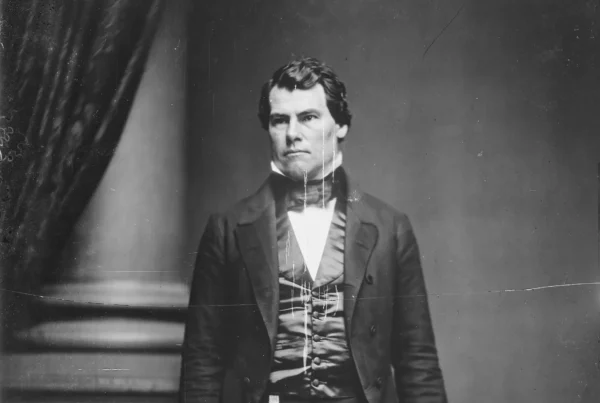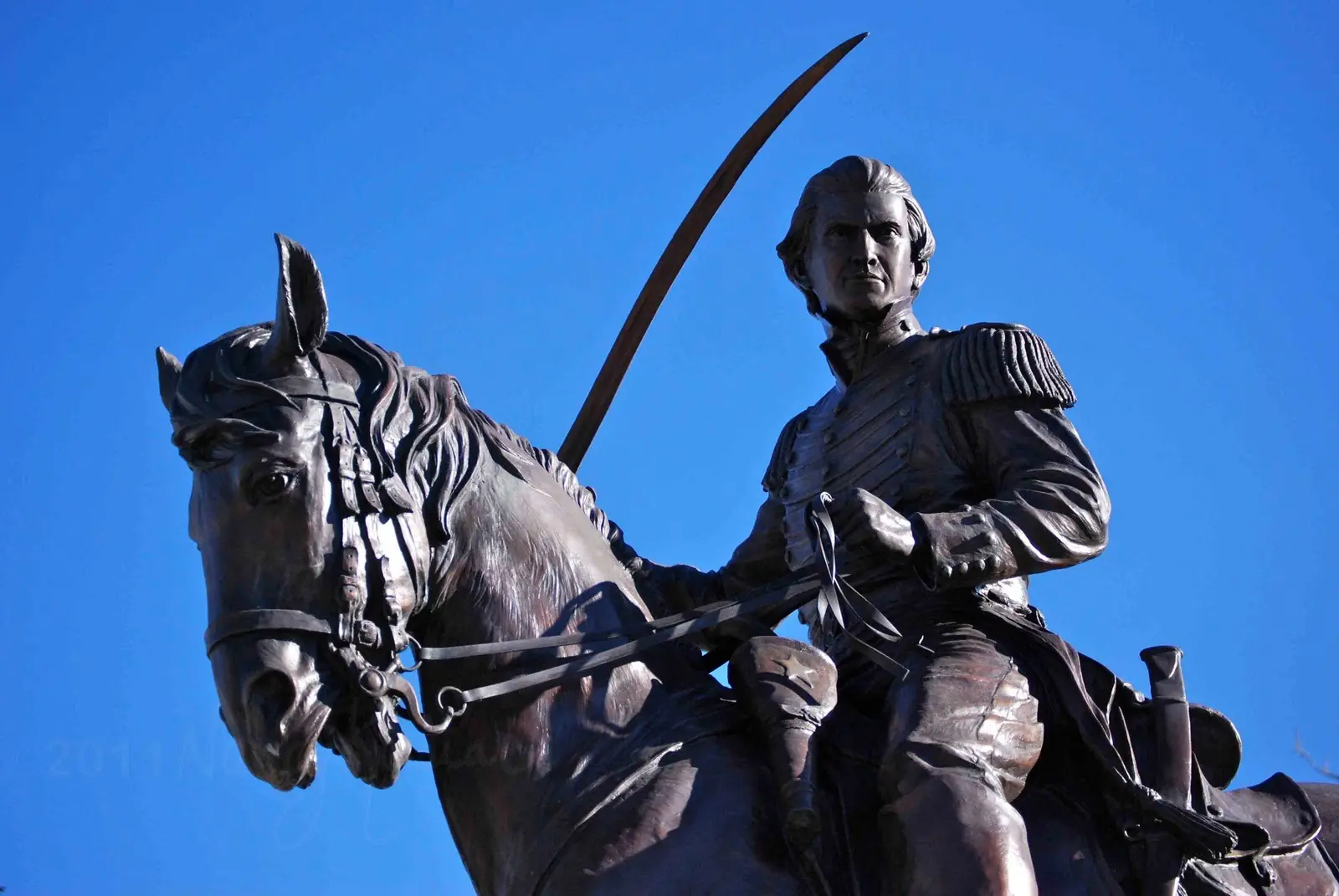
Juan Nepomuceno Seguín (1806–1890) was a Tejano political and military leader during the Texas Revolution. He commanded a Tejano unit at the Siege of Béjar and the Battle of San Jacinto, oversaw burials at the Alamo, served as a senator of the Republic, and later became mayor of San Antonio before political conflict forced him into exile.
Early Life and Family
Juan Seguín was born in San Antonio on October 27, 1806, the eldest son of Juan Erasmo Seguín and María Josefa Becerra. His father was a respected public servant who held several important offices, including as postmaster of San Antonio and as a deputy to the Mexican Congress. Though his formal schooling was limited, Seguín was taught to read and write and developed an early interest in civic affairs.
At the age of nineteen he married María Gertrudis Flores de Abrego, a member of one of San Antonio’s leading ranching families. The couple had ten children, among them Santiago, who later served as mayor of Nuevo Laredo, and Juan Jr., who became an officer in the Mexican military during the 1860s and 1870s.
Seguín’s political career began in the late 1820s. He assisted in managing his father’s post office during the early 1820s, was elected alderman of San Antonio in December 1828, and served on several electoral boards in the following years. In December 1833 he was elected alcalde (mayor) of San Antonio, and in 1834 he briefly acted as political chief of the Department of Béxar after the incumbent fell ill. By the mid-1830s he had established himself as a prominent municipal leader in San Antonio.
The Texas Revolution
Seguín’s military career began in 1835 during Mexico’s federalist-centralist conflict. Responding to the federalist governor of Coahuila, he led a militia detachment to Monclova in support of the constitutional cause. After the battle of Gonzales in October 1835, Stephen F. Austin issued Seguín a captain’s commission. He quickly raised a company of thirty-seven Tejano volunteers, the only all-Mexican Texian unit to fight throughout the Revolution.
That autumn his men scouted for and helped supply the besieging revolutionary army at San Antonio, and on December 5 they joined in the assault on General Martín Perfecto de Cos’s troops, compelling the Mexican garrison to surrender. Seguín entered the Alamo with Texian defenders in February 1836, but William B. Travis dispatched him as a courier before Santa Anna’s final assault. From Gonzales he organized reinforcements and ultimately commanded the rear guard of Sam Houston’s army. At San Jacinto his company fought as the only Tejano unit engaged, and Seguín personally witnessed the Mexican army’s retreat.
After independence, Seguín formally accepted the Mexican surrender of San Antonio in June 1836 and was appointed military commander of the city. He oversaw the burials of the Alamo dead and maintained order until the fall of 1837, when he resigned his commission to enter politics.
Political Career in the Republic
Seguín represented Bexar in the Senate of the Republic of Texas from 1837 to 1840, the only Mexican Texan to serve in that chamber. Despite his limited English, he chaired the Committee on Military Affairs and also served on the Committee of Claims and Accounts. He pressed for the printing of laws in Spanish to make the republic accessible to Tejano citizens, and consistently advocated for bilingual governance.
In 1840 Seguín resigned from the Senate to assist federalist General Antonio Canales in northern Mexico against centralist forces, a campaign that failed. Upon returning to San Antonio he was elected mayor. His tenure placed him at the center of growing tensions between Anglos and Mexican Texans. Land disputes, resentment over his speculative ventures, and persistent suspicion of his contacts with Mexico fueled hostility.
Conflict and Exile
Seguín was reelected mayor at the end of 1841, but tensions in San Antonio quickly escalated. His land speculation, debts from financing the Canales expedition, and business correspondence with Mexico made him vulnerable to attack from Anglo opponents who were already suspicious of Tejano leadership. These conflicts coincided with growing unrest along the frontier, where San Antonio remained exposed to possible Mexican incursions.
In March 1842 General Rafael Vásquez briefly invaded and occupied San Antonio. Although Seguín and local citizens pursued the retreating Mexican troops, many Anglos held him responsible for the Mexican occupation of the city. The suspicion that he had colluded with the invaders, combined with rising hostility over property disputes, left him increasingly isolated. Under pressure and fearing for his safety, he resigned as mayor on April 18, 1842.
Soon afterward Seguín fled to Mexico with his family. He later wrote that he had been forced to “seek refuge among my enemies.” While there he was drawn into service with Mexican forces, claiming it was under duress. He participated in General Adrián Woll’s September 1842 invasion of San Antonio and afterward commanded a company on the Rio Grande frontier. His company served in defense roles, including against Indigenous groups, and he later fought against United States forces during the Mexican–American War.
Seguín remained in Mexico until 1848. His enforced service with Mexican forces during a period of repeated invasions of Texas further damaged his reputation among Anglo Texans. When he returned after the Mexican-American War, he was largely confined to local political offices, never again regaining the influence he had once held.
Later Life and Legacy
In the 1850s Seguín resettled near his father’s ranch in what became Wilson County. He served as constable and precinct chairman in Bexar County and, briefly, as county judge in Wilson County. Yet his economic position remained fragile, and business ties repeatedly took him back across the Rio Grande. By the late 1860s he had retired permanently to Nuevo Laredo, where his son Santiago had become mayor.
Juan Seguín died in Nuevo Laredo on August 27, 1890, at the age of 83. In 1974 his remains were returned to Texas and reinterred in the town of Seguin on July 4, 1976. He is remembered as one of the most prominent Tejano participants in the Texas Revolution, noted for his role at San Jacinto, his service as a senator of the Republic, and his later tenure as mayor of San Antonio.
📚 Curated Texas History Books
Dive deeper into this topic with these handpicked titles:
- The Alamo Remembered: Tejano Accounts and Perspectives
- Tejano Legacy: Rancheros and Settlers in South Texas, 1734-1900
- A Revolution Remembered: The Memoirs and Selected Correspondence of Juan N. Seguín
- Wars of the Mexican Gulf: The Breakaway Republics of Texas and Yucatan, US-Mexican War, and Limits of Empire 1835-1850
Texapedia earns a commission from qualifying purchases. Earnings are used to support the ongoing work of maintaining and growing this encyclopedia.