In the decades following World War II, Dallas emerged as a center of conservative political thought and organizing in Texas. Shaped by rapid economic growth, civic boosterism, and a deep skepticism of federal intervention, the city fostered a political culture that would help lay the groundwork for the Republican realignment that overtook Texas by the end of the 20th century.
From early business-backed campaigns and ideological advocacy to donor networks and national bids, Dallas played an outsized role in the state’s rightward shift—culminating in the ascendance of Ronald Reagan and the consolidation of Republican power.
Postwar Conservatism and Civic Leadership
Dallas’s postwar boom brought with it a new class of civic and business leaders committed to rapid urban development and minimal government interference. The city’s economy flourished in the 1940s and 1950s, anchored by oil, finance, insurance, and construction. Local chambers of commerce and civic associations embraced a forward-looking but explicitly anti-New Deal orientation, framing federal regulation and labor protections as threats to growth and stability. In this context, conservatism took root not as nostalgia, but as a set of principles favoring market autonomy, limited taxation, and assertive anti-communism.
These sentiments were reflected in the editorial pages of Dallas newspapers, the programming of religious broadcasters, and the mission statements of foundations and civic clubs. Local elites viewed the centralization of federal power with deep suspicion and sought to reinforce state and local autonomy. By the 1950s, Dallas was recognized nationally as a city where economic modernity coexisted with political reaction—an apparent contradiction that would shape Texas conservatism in the decades to follow.
Bruce Alger and the Early Republican Breakthrough
The city’s growing ideological distinctiveness produced one of the first major Republican victories in Texas since the 1870s. In 1954, Bruce Alger was elected to Congress from the Dallas area, becoming the state’s lone GOP representative. An outspoken opponent of federal programs, Alger rejected aid to education, public housing, and civil rights legislation, framing his positions in terms of constitutional limits and individual freedom. His style was both confrontational and uncompromising—qualities that earned him national attention.
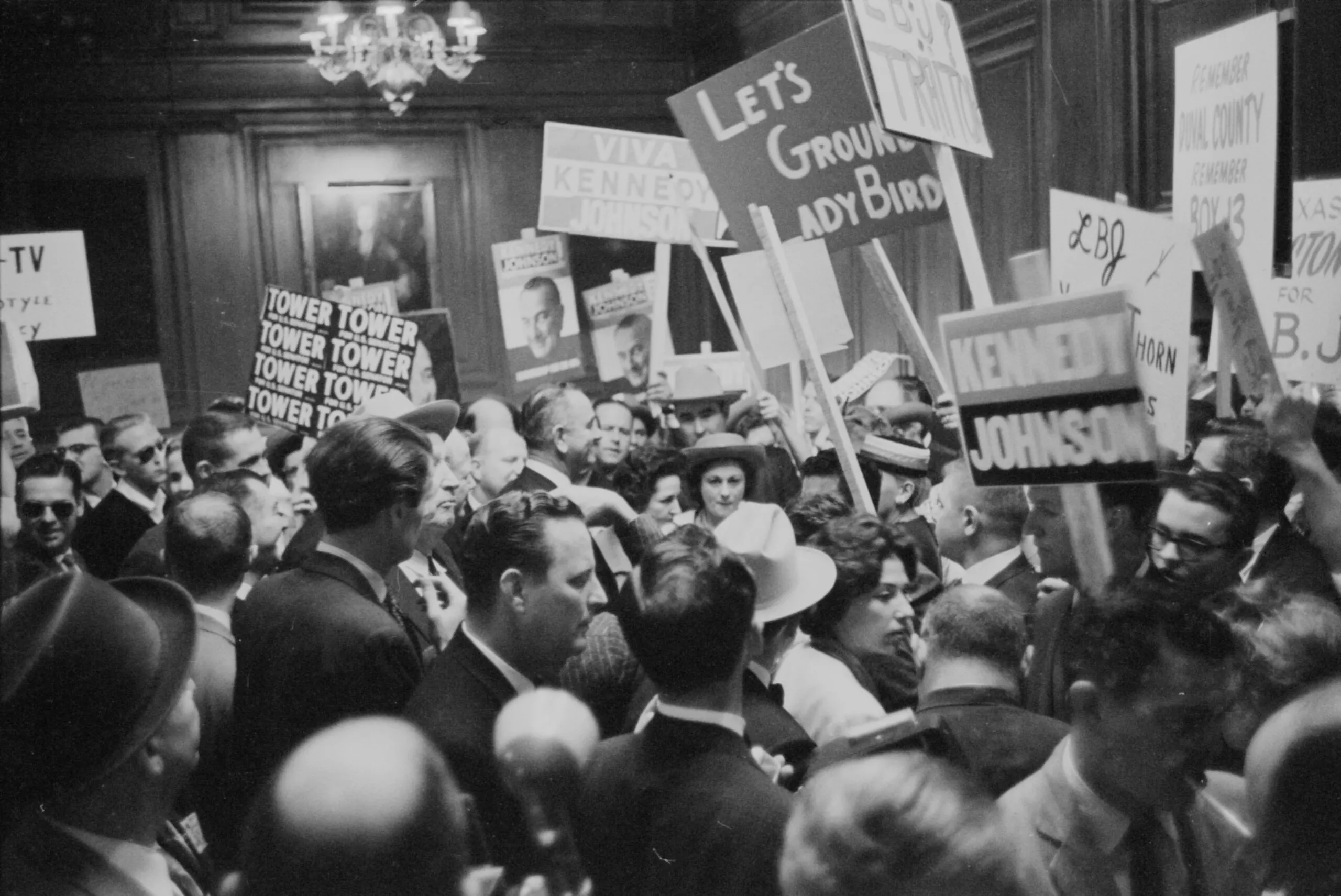
Alger became a symbol of Dallas’s emerging brand of conservatism: suburban, ideological, and resistant to federal programs. In 1960, his involvement in a chaotic protest against a campaign visit by Vice President Richard Nixon—sometimes known as the “mink coat mob” incident—cemented his image as a lightning rod. Though Alger would lose his seat in 1964, his decade-long presence in Congress reflected a changing political base in North Texas and demonstrated the viability of Republican appeals in urban-suburban districts.
Jim Collins and the Institutionalization of GOP Support
Bruce Alger’s departure from Congress in 1964 created a temporary vacuum in Dallas-area Republican leadership. That void was filled in 1968 by Jim Collins, a businessman and West Point graduate. Unlike Alger, Collins adopted a more conventional and measured political style, focusing on defense, tax policy, and economic development. He was less combative than his predecessor, but no less committed to conservative principles.
Collins’s electoral success reflected the growing normalization of Republican politics in Dallas. He regularly won re-election by wide margins and served in the U.S. House until 1983, helping cultivate the region’s identity as a safe Republican district. As part of the House Republican Conference, he played a role in national party fundraising and legislative messaging, further embedding Dallas in the institutional fabric of the post-Goldwater GOP. Though less ideologically flamboyant than Alger, Collins proved to be a durable figure in the party’s regional consolidation.
Donors, Organizers, and Activists
Beyond candidates for office, Dallas was home to a network of organizers, religious leaders, and wealthy donors who built the ideological and logistical infrastructure of modern Texas conservatism. These individuals, operating through overlapping institutions, media platforms, and philanthropic foundations, helped transform the city from a political outlier into a Republican stronghold.
Peter O’Donnell Jr., a Dallas businessman and political strategist, was perhaps the most effective behind-the-scenes figure in the Texas GOP of the 1960s and 1970s. As state party chair from 1962 to 1969, he expanded candidate recruitment efforts, improved fundraising operations, and positioned Texas Republicans to compete statewide. O’Donnell played a key role in backing Barry Goldwater in 1964 and Ronald Reagan in 1976 and 1980, using Dallas as a political and financial base for national conservative organizing.
A generation younger, Tom Pauken emerged as a youth activist in the 1960s through his involvement in Young Americans for Freedom and later became a Republican strategist and party chair. Based in Dallas, Pauken was part of the movement that pushed the party further toward social conservatism in the 1980s and 1990s, helping tie the Dallas GOP to emerging religious-right coalitions.
That religious influence was already strong by midcentury. W. A. Criswell, longtime pastor of First Baptist Church Dallas, served as both a spiritual and civic figure for conservative Protestants across Texas. He used his pulpit and national religious networks to promote Biblical literalism, moral traditionalism, and political activism, particularly in opposition to the cultural liberalism of the 1960s and 1970s. Criswell’s church attracted politicians, donors, and aspiring leaders alike, reinforcing the role of religion in Dallas conservative identity.
Among the most influential funders of this ecosystem was H. L. Hunt, one of the wealthiest men in America and an outspoken opponent of the New Deal. His radio and television program, Facts Forum, aired in the 1950s and delivered a mix of anti-communist rhetoric and libertarian economics to audiences across Texas and beyond. His son, Nelson Bunker Hunt, carried that legacy into the 1970s and 1980s, supporting conservative Christian organizations, backing the John Birch Society, and funding campaigns aligned with the Reagan-era right.
Together, these figures helped ensure that Dallas conservatism was not a passing phenomenon tied to a single candidate or issue, but rather a sustained and adaptable movement with national reach. Their efforts created a foundation of media, money, and organizing capacity that would power Republican victories in Texas for decades to come.
The 1964 GOP Convention Bid
In early 1963, Dallas made a formal bid to host the 1964 Republican National Convention. The effort was backed by local party leaders, business associations, and donors eager to elevate the city’s national profile. Though ultimately unsuccessful—the convention went to San Francisco—the bid underscored Dallas’s self-image as a rising political capital for conservatism in the South and Southwest.
The Kennedy assassination in November 1963, which occurred in Dallas just months after the bid was submitted, cast a long shadow over the city’s political ambitions. National media depicted Dallas as a place of extremism and intolerance, further complicating its political reputation. Nonetheless, the convention bid remained a symbol of how far the city’s Republican and conservative organizing had advanced—and how determined local leaders were to position Dallas as central to the future of national politics.
Below, news footage of the 1964 Dallas County Republican Convention:
Resistance and Electoral Realignment
As the federal government moved to enforce civil rights protections and expand federal welfare programs in the 1960s, Dallas became a site of legal and political resistance. Like many large Texas cities, it faced federal court orders related to school desegregation, voting rights, and public accommodations. Compliance was uneven and often delayed. Local opposition to civil rights mandates, while not always expressed in overtly racial terms, frequently emphasized constitutional principles, local control, and fears of social disruption.
In the same pivotal year, 1964, Texas Republicans expanded their ambitions beyond suburban congressional races: Dallas-area conservatives backed George H. W. Bush in a high-profile bid for the U.S. Senate. Bush campaigned in opposition to the Civil Rights Act, arguing it infringed upon states’ rights—a position that resonated with voters in North Texas but which he later came to regret. Though he lost decisively to liberal Democrat Ralph Yarborough, Bush nevertheless amassed over a million votes, more than any previous Republican Senate candidate in Texas. The campaign, supported heavily by Dallas-based donors and organizers, demonstrated the city’s growing influence in financing and mobilizing conservative statewide bids.

These developments accelerated political realignment in the Dallas area. Many White, middle-class voters—especially in suburban precincts—gravitated toward Republican candidates who emphasized law and order, opposition to busing, and limited government. At the same time, Democratic candidates who had previously relied on support from business interests and civic groups in Dallas began to lose ground. By the early 1970s, Republican strength in North Texas was no longer limited to symbolic races; it became institutionalized through party infrastructure, fundraising capacity, and a growing bench of viable candidates.
Dallas and the Rise of Reagan
The culmination of Dallas’s conservative evolution came with the rise of Ronald Reagan. In 1976, Reagan challenged President Gerald Ford for the Republican nomination and found some of his strongest support in Dallas. Local donors, including influential oilmen and businessmen, poured money into the Reagan campaign, and civic organizers provided grassroots infrastructure. Although Reagan narrowly lost the nomination that year, his campaign demonstrated the growing influence of Texas conservatives within the national GOP.
By 1980, Reagan had consolidated national support and won the presidency with ease. In Texas, he carried the state with 55 percent of the vote. Dallas-based organizations continued to shape policy and messaging into the 1980s and beyond, supporting education reform, tax limitation, and business deregulation.
The 1978 election of Bill Clements, a Dallas native and the first Republican governor of Texas since Reconstruction, marked the full arrival of Dallas-led conservatism at the state level.
From Outlier to Vanguard
From the 1940s to the 1980s, Dallas transformed into a powerhouse of conservative political influence. Its early embrace of anti-New Deal rhetoric, opposition to federal civil rights enforcement, and investment in ideological infrastructure made it one of the first Texas cities to support Republican candidates with consistency and conviction. While figures like Bruce Alger and the 1964 convention bid may have seemed fringe at the time, they foreshadowed a broader shift that would eventually reshape Texas politics at every level.
By the time of Reagan’s victory in 1980, Dallas was no longer an outlier—it was a model. Its institutions, donors, and voters had helped move Texas from a one-party Democratic state to a Republican stronghold, with lasting effects on state policy and national politics.